
Why choose an OEM study timer smart for reseller programs?
- 1. What are realistic MOQs, lead times and NRE costs for a custom smart study timer with an app and voice prompts?
- 2. How do I ensure OTA firmware updates, mobile app integrations and GDPR-compliant telemetry without high ongoing maintenance?
- 3. Which certifications (CE, FCC, RoHS, REACH) are mandatory per region, and how should resellers budget testing and certification timelines?
- 4. How do I verify real-world battery life, power management and charging options so customers aren’t disappointed?
- 5. Which hardware choices (display, haptics, speaker, enclosure material) most affect cost, durability and user experience for a focus timer?
- 6. How do I negotiate branding, packaging, warranty, RMA and after-sales support in OEM contracts to protect margins and brand reputation?
When selecting a smart study timer or an OEM study timer smart for reseller programs, beginner resellers face very specific operational, technical, and compliance questions that generic product pages do not answer. Below are six long-tail, pain-point-centered questions with industry-grounded, actionable answers based on manufacturer datasheets, certification lab guidance, and OEM best practices.
1. What are realistic MOQs, lead times and NRE costs for a custom smart study timer with an app and voice prompts?
Why it matters: Resellers must set cashflow, predict inventory risk and price correctly. MOQs, lead time and non-recurring engineering (NRE) costs vary dramatically with hardware complexity and software integration.
Key expectations and practical ranges:
- MOQ ranges: For simple rebranded digital study timers (no custom PCB or app) many suppliers accept 300–1,000 units. For customized hardware (new PCB, custom enclosure, logo, unique speaker) expect 500–3,000 units. For full turnkey solutions with custom mobile apps, MOQs often start at 1,000+ units.
- Lead times: Standard injection-molded enclosures with existing tooling: 8–12 weeks. New tooling adds 6–12 weeks. Electronics assembly (PCB fab, component sourcing) adds 4–8 weeks depending on component availability. Combined typical window for a customized smart timer with companion app is 12–24 weeks.
- NRE / tooling: Tooling for a plastic enclosure (two-cavity mold) typically represents the biggest single upfront cost. Expect tooling quotes in the thousands to tens of thousands USD depending on cavity complexity and steel grade. Firmware customization, mobile app development, and certification preparation are separate NRE lines—budget accordingly.
How to reduce risk:
- Ask the OEM for phased delivery: an engineering pilot batch (50–200 units) to validate firmware, app and packaging before full MOQ.
- Negotiate tooling amortization into unit prices or a partial refund if annual reorder volumes hit a threshold.
- Prioritize reusing an existing platform (reference design) rather than full ground-up hardware to cut NRE and lead time.
2. How do I ensure OTA firmware updates, mobile app integrations and GDPR-compliant telemetry without high ongoing maintenance?
Why it matters: Buyers expect companion apps, analytics and OTA fixes. Poorly designed update mechanisms or telemetry can create costly support and legal exposure.
Checklist and implementation guidance:
- Protocol choice: BLE (Bluetooth Low Energy) is common for one-to-one app pairing and low power consumption. Wi‑Fi allows cloud connectivity and scheduled analytics but increases power draw and hardware cost. Choose based on feature needs (local control vs cloud dashboards).
- OTA architecture: Prefer staged OTA via the mobile app (phone downloads firmware from OEM cloud and pushes to the device via BLE) for smaller firmware images. For larger, direct Wi‑Fi OTA is more scalable. Verify resumable transfers and delta updates (binary diffs) to minimize data use.
- Security & privacy: Require secure boot/firmware signing to prevent unauthorized firmware. For telemetry, ensure GDPR compliance by minimizing personal data collection, using pseudonymization, and publishing a privacy policy. Include user consent flows in the app and provide option to opt out of analytics.
- Maintenance cost control: Ask OEM for an SLA on firmware maintenance and a per-release cost model. Negotiate a defined free support window (e.g., first 12 months) and then a predictable per-release or per-hour rate.
3. Which certifications (CE, FCC, RoHS, REACH) are mandatory per region, and how should resellers budget testing and certification timelines?
Why it matters: Missing regional compliance can block sales channels and lead to costly rework or fines.
Regional must-haves and budgeting guidance:
- United States: FCC Part 15 (radiated and conducted emissions) for devices with radio (BLE/Wi‑Fi). For battery-powered devices, also consider specific state-level requirements (e.g., battery labeling).
- European Union: CE marking requires compliance with applicable directives: Radio Equipment Directive (RED) for wireless, EMC Directive for emissions/ immunity, Low Voltage Directive (if mains-connected), and RoHS/REACH for hazardous substances. MDD/medical not typical unless marketed as medical device.
- Other markets: CCC for China, TELEC for Japan, etc.—these depend on distribution plans. Work with the OEM to map targeted markets early.
- Testing timeline and cost: Pre-compliance checks can take 1–2 weeks. Full accredited lab testing for radio and EMC typically needs 2–6 weeks. Costs vary widely: RF/EMC lab tests often run several thousand USD per test campaign. Budget time and money into your initial NRE plan.
Practical steps:
- Request copies of the OEM’s previous test reports (CB, FCC, RED) and associated test conditions. Validate the BOM and enclosure are unchanged—any changes may invalidate reports.
- Include a requirement in the OEM contract that units delivered for certification are representative of final production (golden sample) and that supplier will support corrective actions if tests fail.
4. How do I verify real-world battery life, power management and charging options so customers aren’t disappointed?
Why it matters: Battery life and charging convenience directly influence user satisfaction for a smart study timer (focus timer, pomodoro timer).
Verification approach and metrics to demand from OEM:
- Specify real use‑case scenarios for tests: e.g., daily 8 cycles of 25-min focus + 5-min break with app-connected notifications, screen on/off patterns, and occasional BLE sessions. Simulated idle, active, and frequent notification profiles give meaningful numbers.
- Ask for cycle tests and battery aging data: For rechargeable Li‑ion cells demand battery cycle-life tests (e.g., retained capacity after X cycles). For coin cell designs (CR2032) ask for typical operating hours and realistic real‑use expectations (not just standby).
- Charging: If including USB-C charge, confirm supported charging currents, charging time, and charge controller protections. If product is rechargeable, require battery protection circuitry and thermal tests for safety.
- Power optimization: Request firmware features for power management — automatic display sleep, deep-sleep between sessions, BLE advertising intervals, and ability to disable cloud features to save power.
How to test as reseller before ordering a full run:
- Run a pilot batch and execute your own usage scripts (real app interactions and offline-only modes) to validate OEM claims.
- Include acceptance criteria in the purchase order (e.g., at least 30 days of typical intermittent use or defined cycle counts) and allow a small returns window if pilot units fail to meet it.
5. Which hardware choices (display, haptics, speaker, enclosure material) most affect cost, durability and user experience for a focus timer?
Why it matters: Small component choices shift unit cost, perceived quality and return rates significantly.
Trade-offs and recommended choices:
- Display type: Monochrome LCD (low power, low cost) vs IPS/TFT color screens (higher cost, higher power consumption). For long battery life and clear numeric timers, segmented LCD or low-power e-ink can be best. Color screens are compelling for app-synced visuals but usually need more battery and higher BOM.
- Haptics & sound: A modest piezo buzzer is low cost and reliable. For High Quality experience, a small speaker with clear voice prompts is better but increases BOM and firmware complexity (voice files, language packs). Haptic motors improve discrete notifications but raise power draw.
- Enclosure & durability: ABS/PC blends are typical for low cost and acceptable durability. Silicone sleeves or High Quality injection-molded finishes increase perceived value for educational or gift channels. Consider drop tests if selling to students.
- Sensors & extras: Ambient light sensors for auto-brightness, capacitive touch for controls, or simple physical buttons—each adds cost and potential failure modes. Ask whether the OEM uses proven components with lifecycle availability to avoid future sourcing issues.
Practical procurement checklist:
- Demand samples of each hardware configuration and run a durability test plan: button lifecycle, drop tests, humidity/temperature soak.
- Specify repairability and spare parts policy: availability of replacement buttons, screens, or batteries and expected lead time for spares.
6. How do I negotiate branding, packaging, warranty, RMA and after-sales support in OEM contracts to protect margins and brand reputation?
Why it matters: Poorly defined after-sales terms create margin erosion and customer complaints when products arrive with defects or software issues.
Contract items to insist upon:
- Branding & IP: Clear ownership clauses for custom design elements, logo rights, and firmware copyright. Ensure the OEM grants you the right to use source code or binaries required to maintain the product if you change suppliers later.
- Packaging & labeling: Include dielines, translations, regulatory markings, and barcode (EAN/UPC) responsibilities. Clarify whether the OEM will print customized packaging and what artwork formats they need.
- Warranty & RMA: Define warranty length (commonly 12 months for consumer electronics), RMA process (turnaround time, cost sharing for returns), defective rate thresholds, and allowable AQL (acceptable quality level) at incoming inspection. Have provisions for corrective action if defect rates exceed agreed thresholds.
- After-sales support: Negotiate a technical handover including source code (or a long-term firmware maintenance agreement), access to engineering support hours, and committed response times for critical security or cloud outages.
- Margins & pricing protections: Agree on volume-price tiers, and include clauses for component price volatility or minimum reorder frequencies to avoid sudden margin squeeze. Consider exclusivity in specific regions only if you commit to realistic minimum purchases.
Operational tips:
- Use an acceptance test plan as part of the purchase order: functional checks, cosmetic standards, and a sample test matrix for timers, displays, speakers, BLE pairing and firmware behavior.
- Ask the OEM for a spare parts kit and QA documentation (PCB layouts, BOM, firmware versioning) to speed up after-sales repairs.
Conclusion — Advantages of choosing an OEM study timer smart for reseller programs
Working with an experienced OEM for a smart study timer offers resellers predictable unit economics, faster route-to-market, packaging and branding control, and the ability to include software features such as a companion app, OTA firmware updates, and analytics. By requiring representative pilot samples, clear certification deliverables (FCC/CE/RoHS), documented battery and durability testing, and contractual guarantees for warranties and RMAs, resellers can protect margins and customer satisfaction while offering a compelling programmable countdown, focus timer and productivity tracker product to their markets.
For bespoke quotes, pilot orders or to review an OEM specification checklist tailored to your channel, contact us at www.youbenlife.com or info@youbenlife.com for a quote.
Contacts
Sofia
WhatsApp/Phone
All
Do you offer OEM & ODM clock services?
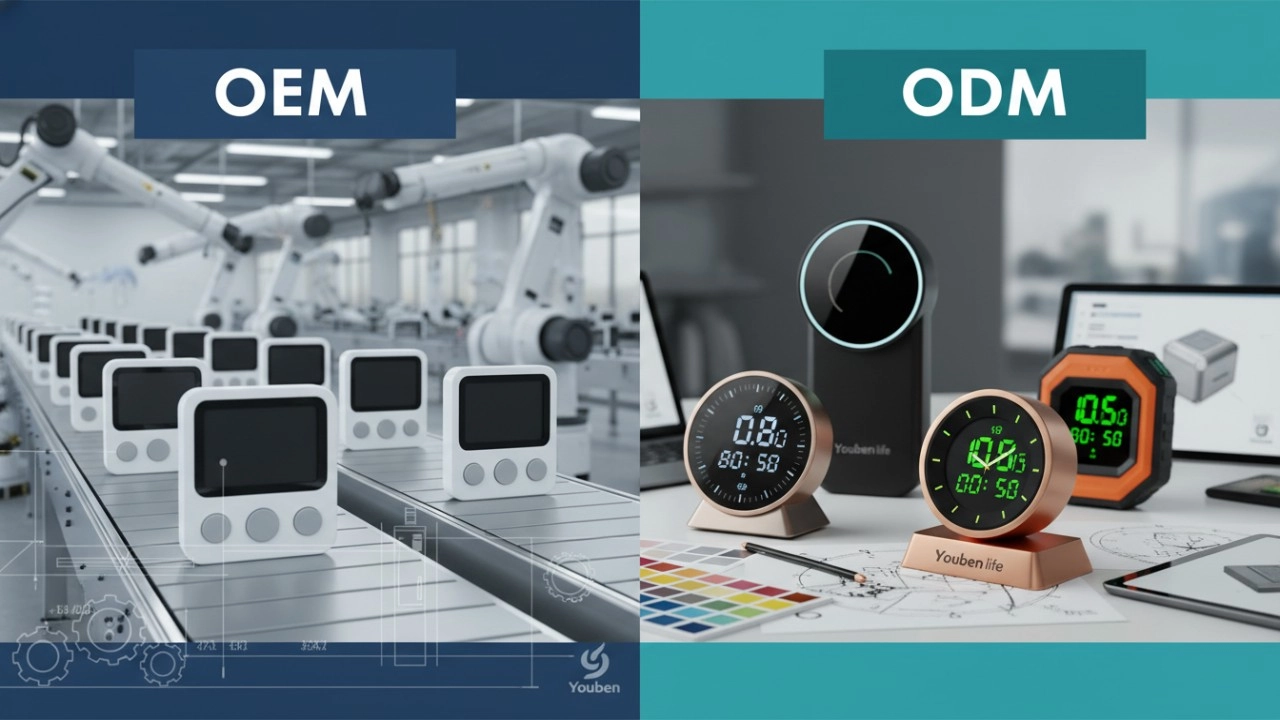
Yes, we provide both OEM & ODM solutions, allowing clients to customize clock design, materials, packaging, and branding.
What types of clocks can you manufacture?
We manufacture a wide range of clocks, including wall clocks, desk clocks, digital clocks, and smart clocks.
Can I customize the clock design and logo?
Absolutely. We offer customization for clock appearance, structure, materials, and logo printing to perfectly match your brand.
What is the minimum order quantity (MOQ)?
Our standard MOQ varies depending on the model, usually starting from 200–500 pieces. Custom designs may require different quantities.
How do you ensure product quality?
All clocks undergo strict quality control, including time accuracy tests, durability checks, and packaging inspections before shipment.
Interested in this article?
Let’s talk.
Need specifications, pricing, or customization options? We’ll provide everything you need.
By clicking “Submit,” you agree to share your information with our authorized team to process your request.
Your data will only be used for necessary communication and support.

Youben life
Youben life