
Smart Kitchen Timer Supplier Guide: Product, OEM & Sample Evaluation
- What Is a Smart Kitchen Timer Supplier?
- Define Your Kitchen Timer Project Before Choosing a Supplier
- Consumer or Retail Kitchen Timer
- Promotional Kitchen Timer
- Private Label Kitchen Timer
- Commercial Kitchen Timer
- Connected or IoT Kitchen Timer
- Smart Kitchen Timer vs Standard Digital Kitchen Timer
- What Product Capabilities Should the Supplier Support?
- Timer Logic
- Multi-Timer Capability
- Display
- Controls
- Alarm and User Feedback
- Mounting
- Power
- Existing Platform, Modified Platform, or New Development?
- What OEM and Private Label Capabilities Matter?
- Branding
- Product Appearance
- Firmware
- Mechanical Changes
- Electronics
- Packaging
- How to Evaluate Smart Kitchen Timer Samples
- Test Real User Tasks
- Test Edge Cases
- Consumer vs Commercial Kitchen Timer Supplier Requirements
- Consumer / Retail Project
- Commercial Kitchen Project
- When Does a Kitchen Timer Actually Need Connectivity?
- Bluetooth
- Wi-Fi
- Matter or Other Ecosystem Integration
- Data Logging
- Compliance Planning for Kitchen Timer Projects
- What Evidence Should Buyers Request From a Supplier?
- Relevant Product Sample
- Technical Response to the Product Brief
- Sample Revision Record
- Quality-Control Information
- What Determines MOQ, Cost and Project Schedule?
- Smart Kitchen Timer Supplier Evaluation Checklist
- 1. Product Fit
- 2. Existing Product Platform
- 3. Engineering Support
- 4. Sample Quality
- 5. Quality Control
- 6. Customization
- 7. Project Evidence
- 8. Commercial Fit
- Common Mistakes When Choosing a Smart Kitchen Timer Supplier
- Choosing Technology Before Defining the User
- Comparing Suppliers Only by Unit Price
- Assuming Every Existing Timer Is Equally Customizable
- Accepting Generic Evidence
- Ignoring Sample Workflow Testing
- Treating Connected Features as Automatically Better
- What Should Buyers Prepare Before Requesting a Quote?
- Product
- Customization
- Commercial
- Connected Requirements
- Compliance
- Smart Kitchen Timer Supplier FAQ
- What makes a kitchen timer “smart”?
- Does a smart kitchen timer need Matter support?
- What should I test before selecting a kitchen timer supplier?
- What evidence should I request from a kitchen timer supplier?
- What is important for a commercial kitchen timer?
- How loud should a commercial kitchen timer be?
- Does every commercial kitchen timer need a specific IP rating?
- What determines MOQ for a custom kitchen timer?
- When should a kitchen timer use Bluetooth or Wi-Fi?
- Can kitchen timer data satisfy HACCP requirements?
- Can Youben Life support OEM, ODM, or private label kitchen timer projects?
- Conclusion
- Discuss Your Smart Kitchen Timer Project
Choosing a smart kitchen timer supplier should begin with the product requirement, not with a list of trendy technologies.
For B2B buyers, retailers, distributors, promotional product companies, private label brands, and commercial-kitchen projects, the right supplier needs to understand the type of timer being developed, the intended user, the required functions, the customization depth, and the expected production requirements.
A “smart” kitchen timer does not necessarily need Wi-Fi, Matter, cloud software, or voice control.
In many projects, smart functionality may simply mean better digital timing through:
- Preset timing
- Multiple timers
- Memory functions
- Clear visual feedback
- Flexible alarm modes
- Faster controls
- Better mounting options
- Optional connectivity where the use case actually requires it
This guide explains how buyers can evaluate a kitchen timer supplier based on real product and project requirements rather than technology labels alone.
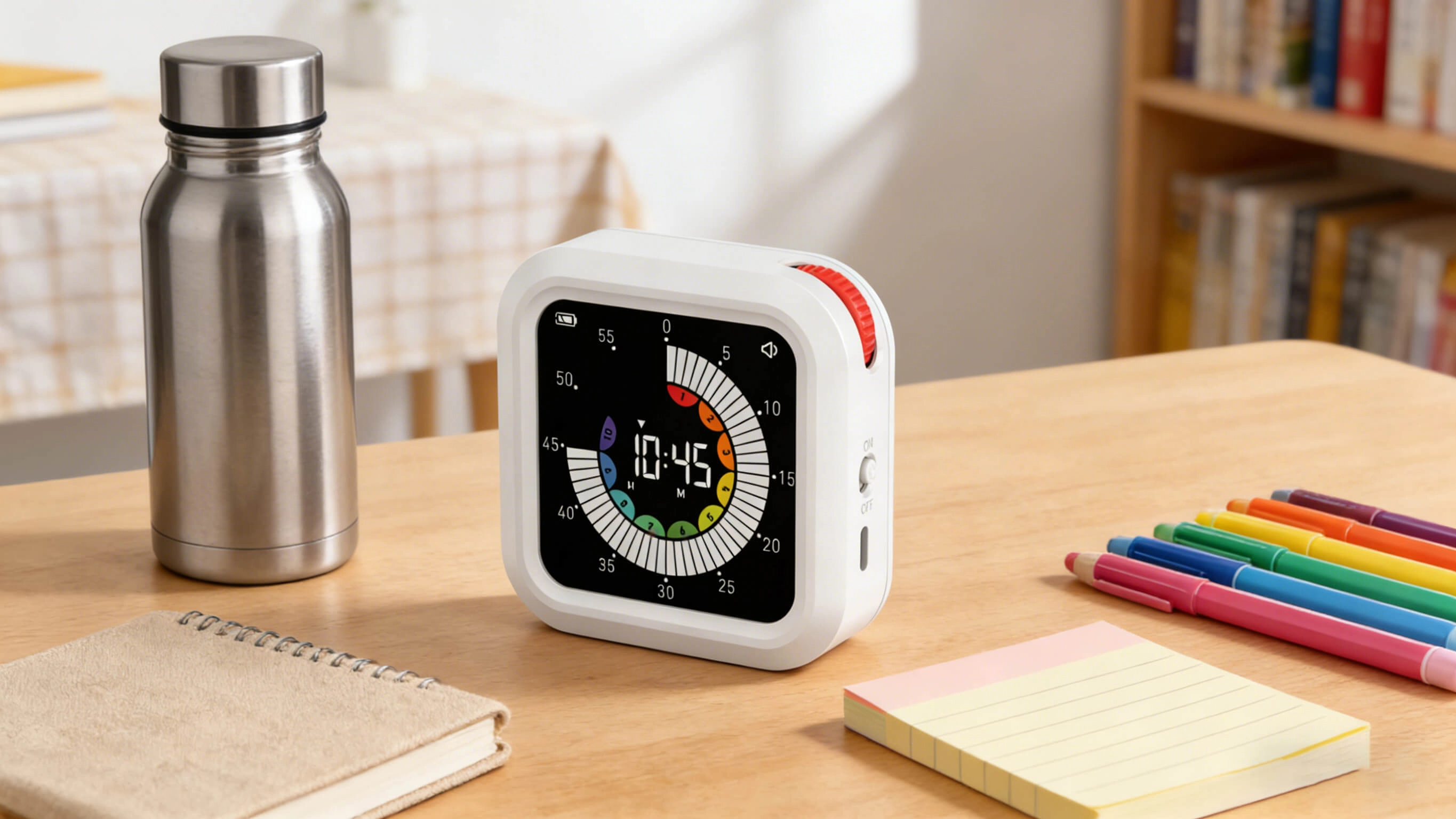
What Is a Smart Kitchen Timer Supplier?
A smart kitchen timer supplier is a company that supplies, manufactures, or supports the development of digital kitchen timing products for specific B2B requirements.
Depending on the project, the supplier may provide an existing timer platform, private label customization, selected firmware or product modifications, or support for deeper product development.
Possible product requirements may include:
- Countdown timing
- Count-up timing
- Preset durations
- Multiple independent timers
- Memory
- Digital display
- Visual alerts
- Audible alerts
- Magnetic mounting
- Stand or countertop placement
- Rechargeable or replaceable power
- Branding
- Packaging
- Firmware changes
- Optional wireless connectivity
Not every supplier needs to support every function. The important question is whether the supplier can support the requirements of the actual product.
Define Your Kitchen Timer Project Before Choosing a Supplier
Supplier evaluation becomes much easier when the project type is clear. Before comparing suppliers, define how the timer will be used and sold.
Consumer or Retail Kitchen Timer
- Easy operation
- Clear display
- Attractive appearance
- Magnetic or countertop placement
- Audible alarm
- Simple presets
- Packaging
- Branding
Promotional Kitchen Timer
- Brand visibility
- Simple operation
- Useful everyday function
- Appropriate logo position
- Packaging for campaigns or events
Private Label Kitchen Timer
- Branding
- Packaging
- Product appearance
- User instructions
- Preset timing
- Alarm behavior
- Display presentation
- Target-market information
Commercial Kitchen Timer
- Multiple independent timers
- Fast preset selection
- Clear visual differentiation
- Easy-to-use controls
- Alarm performance in a noisy environment
- Durability
- Cleaning conditions
- Mounting
- Stable power
- Repeatable operation
Connected or IoT Kitchen Timer
- App configuration
- Remote preset management
- Data synchronization
- Centralized settings
- Workflow logging
- Integration with another system
Connectivity should be selected because the product needs it, not because the timer is labeled “smart.”
Smart Kitchen Timer vs Standard Digital Kitchen Timer
A standard digital kitchen timer may already provide everything a project needs. The difference between “smart” and “standard” should therefore be defined by useful functionality rather than marketing terminology.
| Product Area | Standard Digital Timer | More Advanced / Smart Timer |
|---|---|---|
| Timing | Basic countdown | Presets, count-up, multiple timing modes |
| Memory | May be limited | Stored presets or previous settings |
| Display | Basic numeric display | More status information or visual differentiation |
| Controls | Simple buttons | Rotary, touch, preset keys or combination controls |
| Alerts | Standard alarm | Adjustable, visual or multiple alert modes |
| Multi-tasking | Usually one timer | Multiple independent timers where required |
| Connectivity | Usually none | Optional Bluetooth, Wi-Fi or system integration |
| Customization | Branding and appearance | May include firmware, interface or deeper product changes |
The right product is not automatically the one with the most advanced column. The right product is the one that fits the intended user with the least unnecessary complexity.
What Product Capabilities Should the Supplier Support?
Timer Logic
- Countdown
- Count-up
- Repeat timing
- Preset durations
- Multiple presets
- Memory
- Multi-channel timing
- Pause
- Resume
- Reset
- Automatic restart
Multi-Timer Capability
- Number of independent timers
- How each timer is started
- How timers are identified
- Whether simultaneous alarms are distinguishable
- How completed timers are cleared
- Whether presets are assigned to channels
Display
- Digit size
- Viewing angle
- Contrast
- Status indicators
- Multiple-timer presentation
- Backlight where applicable
- Alarm or mode indicators
Controls
- Buttons
- Preset keys
- Rotary control
- Touch controls
- Combination interfaces
Alarm and User Feedback
- Is the alarm easy to hear in the intended environment?
- Is volume adjustable?
- Are different tones required?
- Is visual feedback needed?
- Do multiple timers need different alerts?
- Is silent or vibration feedback relevant?
There is no universal alarm-volume requirement for every kitchen timer project.
Mounting
- Magnet
- Stand
- Countertop placement
- Clip
- Hanging
- Wall placement
Power
- Replaceable batteries
- Rechargeable batteries
- USB power
- Another product-specific power configuration
Existing Platform, Modified Platform, or New Development?
| Project Path | Starting Point | Typical Scope |
|---|---|---|
| Existing Platform / Private Label | Existing kitchen timer | Branding, packaging, selected appearance changes |
| Modified Platform | Existing product architecture | Firmware, controls, display, alarm or selected hardware changes |
| New Product Development | New product concept | New housing, electronics, firmware, tooling or product architecture |
Buyers considering deeper development can review Youben Life's OEM & ODM services, while projects based mainly on branding and packaging can also review the Private Label service.
What OEM and Private Label Capabilities Matter?
“Customization” should not be treated as one single capability. Buyers should separate it into layers.
Branding
Logo, product artwork, brand presentation, instructions, and packaging artwork.
Product Appearance
Housing color, surface finish, control appearance, display presentation, and overall visual style.
Firmware
Presets, memory, multi-timer logic, alarm modes, display states, control behavior, auto-repeat, and other timing functions where supported by the selected architecture.
Mechanical Changes
New housing, button layout, dimensions, mounting, new mechanical parts, or tooling.
Electronics
PCB, display, buzzer, controls, sensors, charging, power, or wireless modules where the project requires them.
Packaging
Branded box, instructions, labels, barcode information, market information, and product protection.
How to Evaluate Smart Kitchen Timer Samples
A supplier should not be selected only from specifications, quotations, or product photos. The sample is where buyers can verify whether the timer actually works for the intended user.
| Evaluation Area | What to Check |
|---|---|
| Timing | Countdown, count-up, presets and repeat behavior |
| Multi-timer | Independent operation and timer identification where applicable |
| Display | Readability, viewing angle and status clarity |
| Controls | Setting speed, button logic and accidental operation |
| Alarm | Audibility, tone, volume and differentiation |
| Mounting | Magnet, stand or other placement method |
| Power | Battery, charging, indication and idle behavior |
| Firmware | Memory, state transitions, presets and edge cases |
| Housing | Fit, finish, assembly and handling |
| Branding | Logo position, visibility and appearance |
| Packaging | Product fit, protection, instructions and labels |
Test Real User Tasks
Do not only check whether the timer powers on. Test actual workflows.
For a multi-timer product:
Test Edge Cases
- Rapid button input
- Reset while running
- Reset while paused
- Low battery
- Power interruption
- Simultaneous alarms
- Memory after power loss
- Repeated use
- Mounting stability
Consumer vs Commercial Kitchen Timer Supplier Requirements
Consumer / Retail Project
- Easy learning
- Clear display
- Attractive design
- Convenient mounting
- Appropriate alarm
- Packaging
- Brand presentation
Commercial Kitchen Project
- Fast repeated operation
- Multiple timers
- Clear preset selection
- Alarm differentiation
- Easy-to-read displays
- Stable mounting
- Durability
- Cleaning environment
- Power reliability
If splash, moisture, heat, grease, or other environmental exposure is expected, the relevant enclosure and material requirements should be defined according to the actual installation conditions. Do not assume one universal protection rating applies to every commercial kitchen timer.
When Does a Kitchen Timer Actually Need Connectivity?
Connectivity can be useful, but it should solve a specific problem.
Bluetooth
May be useful for app-based configuration, preset setup, local synchronization, or data transfer.
Wi-Fi
May be relevant when remote management, cloud synchronization, centralized configuration, or integration with a wider system is genuinely required.
Matter or Other Ecosystem Integration
Consider ecosystem integration only after the actual use case has been defined.
- What device or system needs to communicate with the timer?
- What function needs to be controlled?
- Is remote control actually necessary?
- Is the timer expected to work independently without the ecosystem?
- Who maintains the software or integration?
Data Logging
Some commercial projects may require timing data for workflow analysis or integration into a wider process-management system. If data is used for food-safety, operational, or compliance-related processes, the broader system requirements should be defined separately. A timer alone should not be treated as proof that a complete food-safety program or compliance system has been satisfied.
Compliance Planning for Kitchen Timer Projects
Compliance should be determined from the final product configuration and destination market.
Depending on the final product, relevant areas may include:
- Electronic equipment requirements
- Radio requirements where connectivity is included
- Battery requirements
- Battery transportation
- Material restrictions
- Labeling
- Technical documentation
- Market-specific conformity procedures
Buyers should verify that any documentation provided corresponds to the relevant product configuration. Documents from another timer model should not automatically be treated as evidence for a new product.
What Evidence Should Buyers Request From a Supplier?
Supplier claims are more useful when they can be connected to project-specific evidence.
Relevant Product Sample
Use a physical sample to verify timer functions, display, controls, alarm behavior, mounting, power, and housing quality.
Technical Response to the Product Brief
Ask which requirements already exist, which can be modified, which need engineering review, and which may affect tooling, firmware, or electronics.
Sample Revision Record
For modified or new projects, relevant revision information may include firmware, housing, display, component, or packaging changes.
Quality-Control Information
Understand how functional checks, assembly checks, appearance inspection, packaging checks, approved sample references, and change control will be handled for the actual project.
What Determines MOQ, Cost and Project Schedule?
There is no universal MOQ, unit price, tooling cost, or project schedule that applies to every smart kitchen timer.
- Existing platform vs new development
- Branding
- Housing color
- Packaging
- Firmware changes
- Multi-timer functions
- Display changes
- PCB changes
- Control method
- Alarm requirements
- Power architecture
- Battery
- Wireless features
- New tooling
- Component sourcing
- Compliance testing
- Sample revisions
- Pilot-production requirements
- Expected production quantity
A branded existing timer and a connected multi-channel timer with new firmware and electronics should not be evaluated as equivalent projects. Commercial terms should be based on the defined project scope.
Smart Kitchen Timer Supplier Evaluation Checklist
1. Product Fit
Does the supplier understand digital timing products, the kitchen use case, the required functions, and the technical limitations of the proposed product?
2. Existing Product Platform
Clarify which functions already exist, which can be changed, and which require firmware, tooling, or electronics work.
3. Engineering Support
Where required, evaluate firmware, PCB, display, controls, technical revisions, and product-specific validation capabilities.
4. Sample Quality
Verify the complete workflow, controls, display, alarm, mounting, assembly, finish, branding, and packaging direction.
5. Quality Control
Understand how incoming components, functional testing, assembly, final inspection, approved samples, product revisions, and component changes are controlled.
6. Customization
Confirm the real scope for branding, appearance, firmware, mechanical changes, electronics, and packaging.
7. Project Evidence
Look for project-relevant samples, technical responses, revision information where applicable, a QC approach, and an approved sample reference.
8. Commercial Fit
Clarify expected quantity, target market, packaging, delivery destination, schedule, and whether the project uses an existing platform or deeper development.
The purpose of the checklist is not to find a supplier that claims to support every possible feature. It is to find a supplier whose capabilities match the actual project.
Common Mistakes When Choosing a Smart Kitchen Timer Supplier
Choosing Technology Before Defining the User
Start with what the end user needs the timer to do. Select connectivity architecture only when the requirement justifies it.
Comparing Suppliers Only by Unit Price
Unit price alone does not show whether the timer is easy to use, whether firmware is stable, whether branding is correct, or whether the supplier can support the requested changes.
Assuming Every Existing Timer Is Equally Customizable
Products that look similar may use different PCBs, firmware, displays, housing structures, tooling, and components.
Accepting Generic Evidence
A sample, certificate, test report, or capability statement from a different product should not automatically be treated as proof that the proposed kitchen timer has the same configuration or capability.
Ignoring Sample Workflow Testing
A sample that powers on is not necessarily ready for approval. Test the actual usage sequence.
Treating Connected Features as Automatically Better
Wi-Fi, Bluetooth, Matter, apps, dashboards, and cloud functions increase system complexity. Use them when they create real user or operational value.
What Should Buyers Prepare Before Requesting a Quote?
Product
Target user, consumer or commercial use, timer type, countdown/count-up requirements, presets, number of timers, display, controls, alarm, mounting, power, and optional connectivity.
Customization
Existing platform or new development, branding, housing appearance, firmware changes, electronics changes, packaging, and instructions.
Commercial
Expected quantity, target market, sales channel, delivery destination, and desired project schedule.
Connected Requirements
If connectivity is required, specify Bluetooth, Wi-Fi or other architecture, app requirements, remote management, data synchronization, and integration requirements.
Compliance
Provide intended sales countries or regions, battery requirements where relevant, wireless functions where relevant, and any market requirements already identified.
Buyers comparing timer platforms can also review the Digital Timer product category. For project-specific discussions, use the Contact page to submit your requirements.
Smart Kitchen Timer Supplier FAQ
What makes a kitchen timer “smart”?
A smart kitchen timer can be understood as a digital timing product that provides functions beyond a basic countdown, such as presets, memory, multiple timers, richer alerts, improved user controls, or optional connectivity. It does not automatically require Wi-Fi, Matter, or cloud software.
Does a smart kitchen timer need Matter support?
No. Matter should only be considered when the project has a defined ecosystem-integration requirement that the selected architecture can support. Many kitchen timer projects may not require ecosystem connectivity at all.
What should I test before selecting a kitchen timer supplier?
Test relevant product samples for timing, display, controls, alarm behavior, mounting, power, firmware, housing, branding, and packaging. If the project uses multiple timers or connected functions, test those complete workflows as well.
What evidence should I request from a kitchen timer supplier?
Relevant evidence may include a product sample, a technical response to the product brief, revision information where applicable, and an explanation of the quality-control approach. The evidence should relate to the actual product or development scope rather than an unrelated model.
What is important for a commercial kitchen timer?
Depending on the environment, commercial projects may require fast operation, multiple independent timers, clear presets, alarm differentiation, readable displays, stable mounting, durability, and appropriate environmental protection.
How loud should a commercial kitchen timer be?
There is no single alarm level that is correct for every commercial kitchen. The appropriate alarm should be evaluated against expected ambient noise, distance, visual-alert options, timer differentiation, and actual operating conditions.
Does every commercial kitchen timer need a specific IP rating?
No. If the timer will be exposed to moisture, splashes, grease, heat, or other environmental conditions, an appropriate enclosure requirement should be defined for the actual installation environment.
What determines MOQ for a custom kitchen timer?
MOQ can be affected by the existing product platform, branding, housing color, packaging, firmware changes, electronics changes, component sourcing, tooling, and production requirements. It should be confirmed for the actual project rather than assumed from a generic industry number.
When should a kitchen timer use Bluetooth or Wi-Fi?
Connectivity is useful when the project requires functions such as app configuration, remote preset management, synchronization, centralized control, data logging, or system integration. If these functions are not required, a standalone product may be simpler.
Can kitchen timer data satisfy HACCP requirements?
A timer or logging function can potentially support workflow records, but it should not be treated by itself as proof that a complete HACCP or food-safety program has been satisfied. The broader process and compliance requirements should be defined separately.
Can Youben Life support OEM, ODM, or private label kitchen timer projects?
Youben Life provides OEM, ODM, and private label services at the company level. The exact branding, firmware, electronics, housing, packaging, connectivity, compliance, MOQ, and production requirements for a specific kitchen timer project should be confirmed according to the selected product and actual project scope.
Conclusion
Choosing a smart kitchen timer supplier should begin with the project requirement.
- Target user
- Consumer or commercial application
- Timer functions
- Presets
- Multi-timer requirements
- Display
- Controls
- Alarm
- Mounting
- Power
- Connectivity, if required
- Branding
- Packaging
- Customization depth
Then evaluate the supplier according to whether it can support those requirements and provide relevant evidence for the proposed product.
The important question is not:
“Which supplier offers the most advanced technology?”
It is:
“Which supplier can reliably support the product, customization, sample quality, project evidence, and production requirements of this project?”
Youben Life provides OEM, ODM, and private label services at the company level. The exact project scope should be confirmed according to the selected product and actual requirements.
Discuss Your Smart Kitchen Timer Project
If you are evaluating a kitchen timer for private label, wholesale, retail, commercial, connected, or new product development, prepare your intended application, timer functions, expected quantity, branding, packaging, connectivity requirements where applicable, target market, and delivery destination before starting the project discussion.
Contacts
Sofia
WhatsApp/Phone

Interested in this article?
Let’s talk.
Need specifications, pricing, or customization options? We’ll provide everything you need.

Youben life
Youben life