
Which smart study timer offers best value for bulk buyers?
- 1) Which smart study timer gives predictable battery life under continuous daily classroom use, and how do I validate the vendor’s claims?
- 2) How do I verify firmware updateability and IoT security when ordering 500+ smart study timers?
- 3) Which smart study timer offers best value for bulk buyers with customizable branding — what are realistic MOQs, tooling costs, and lead times?
- 4) How can I measure and compare timing accuracy (countdown and Pomodoro modes) across different smart study timers for exam simulations?
- 5) What certifications and materials specs should I require in the contract to ensure classroom durability, safety and quick customs clearance?
- 6) How do I calculate the total landed cost per unit (FOB price + freight + duty + warranty reserve) for importing 1,000 smart study timers?
- Concluding summary: advantages of choosing the right smart study timer for bulk purchases
Which smart study timer offers best value for bulk buyers? An expert buying guide
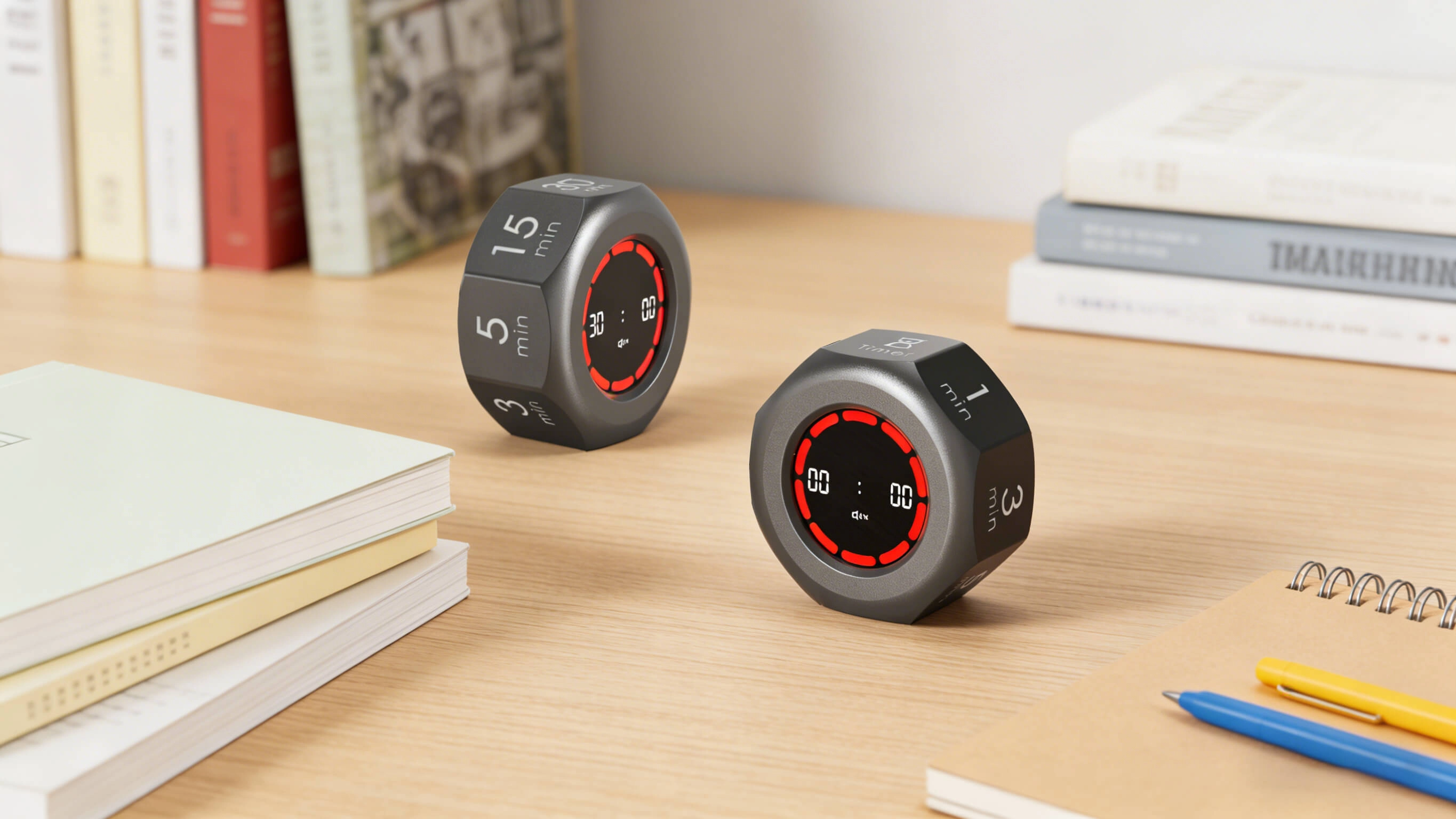
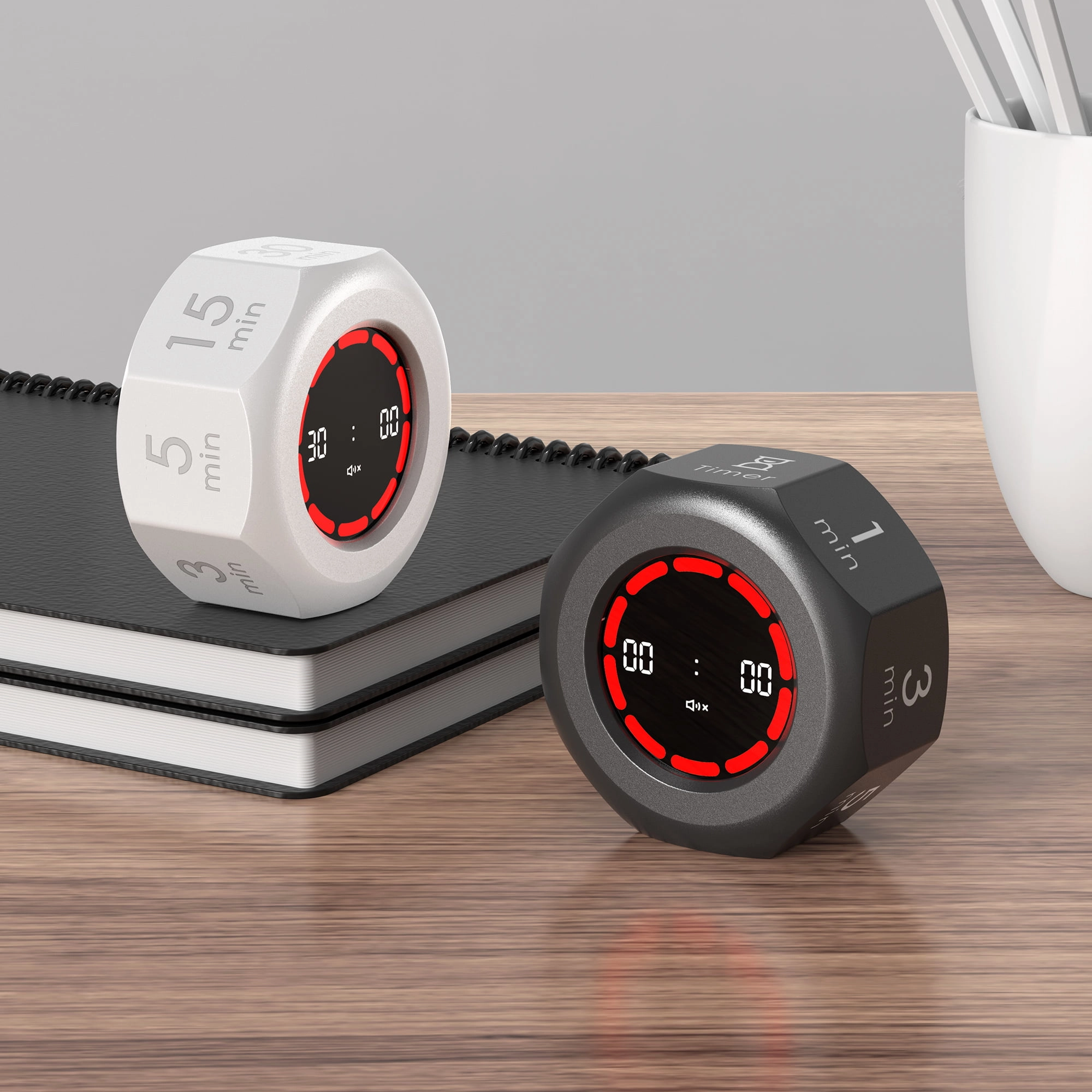
As an expert in digital timers and OEM procurement, I answer six advanced, often-missed buyer questions about smart study timers. This guide uses industry practices (battery math, RTC ppm accuracy, CE/FCC/RoHS standards, MOQ/lead-time norms, OTA/firmware security checks, and landed-cost formulas) so education buyers, resellers, and procurement managers can choose the best-value timer at scale.
1) Which smart study timer gives predictable battery life under continuous daily classroom use, and how do I validate the vendor’s claims?
Pain point: Vendors often quote “long battery life” without showing how duty cycle, display type, wireless radios and backlight usage change real-world run time.
How to evaluate—practical checklist:
- Understand the battery chemistry & capacity: ask for cell type (AA/AAA, Li-ion pouch, LiFePO4, CR2032) and capacity in mAh. For rechargeable models, request charge cycle spec (e.g., 500–1000 cycles) and USB-C charging info.
- Use the battery-life formula: hours = battery capacity (mAh) ÷ average current draw (mA). If the vendor gives average current draw at different modes (idle, display on, BLE transmit), you can compute realistic run times. Example: 2000 mAh ÷ 200 mA = 10 hours.
- Account for duty cycle: estimate % time display/backlight/wireless is active. A classroom Pomodoro device with backlight off most of the day and BLE off except for initial sync will last far longer than one with a bright LED matrix and always-on Wi‑Fi.
- Compare display tech: LED/LCD with backlight consumes more than e-ink. For long unattended use, choose low-power displays or models with configurable brightness and auto-sleep.
- Request vendor test logs: ask for continuous-discharge curves, test conditions (ambient temp, duty cycle), and degradation data after 300–500 cycles. If unavailable, require a short pre-shipment sample test under your expected duty cycle.
- Field validation: run a 7–14 day validation with samples in the actual classroom environment. Log start/stop times and battery voltage daily. That yields real-world figures you can rely on for SLAs.
Why this matters: battery claims are cheap marketing; the draw from radios and backlights usually dominates. Calculating by current draw and validating with samples reduces unexpected downtime and returns.
2) How do I verify firmware updateability and IoT security when ordering 500+ smart study timers?
Pain point: Many inexpensive timers have no OTA path or insecure update mechanisms, creating long-term maintenance and privacy risks.
Security and firmware checklist:
- OTA and secure signing: require an over-the-air (OTA) update mechanism that uses signed firmware images. Ask for the update process documentation and whether images are signed with asymmetric keys (recommended) rather than simple checksums.
- Transport encryption: for Wi‑Fi or cloud-connected models, require TLS 1.2+ and vendor documentation on certificate management. For BLE, ensure secure pairing modes (LE Secure Connections) rather than Just Works.
- Vulnerability disclosure: request the vendor’s vulnerability disclosure policy and history. Ask if they’ve had third-party security audits, penetration tests, or a change log including CVE references if applicable.
- Local-only vs cloud: if privacy or offline use is required, prefer local-only devices (no cloud telemetry) or ensure the vendor provides a strict data-use contract and on-premises deployment options.
- Remote management: for deployments across classrooms, use a device management platform (MDM/IoT management) that supports grouped OTA, device inventory, and rollback capability. Verify API docs and role-based access controls for administrators.
- Provisioning at scale: ask about secure device provisioning procedures (per-unit keys, unique device IDs) to avoid mass cloning risks on the factory floor.
Procurement tip: include firmware/security requirements in the RFP and make passing a basic audit or providing signed attestation a contract condition before full payment.
3) Which smart study timer offers best value for bulk buyers with customizable branding — what are realistic MOQs, tooling costs, and lead times?
Pain point: Buyers expect quick, cheap branding but run into minimum order quantities (MOQs), hidden tooling fees, and long lead times for custom colors, molded parts, or printed logos.
What to expect and how to negotiate:
- MOQ ranges: for basic printed branding on stock enclosures, many OEMs accept MOQs of 100–500 units. Full custom molds, new housings, or custom PCB silk-screening typically require higher MOQs, commonly 300–1,000 units or more depending on the factory and degree of customization.
- Tooling & setup fees: custom injection molds carry one-time tooling costs. Ask for amortized tooling per-unit quotes (tooling cost ÷ MOQ) so you can compare effective unit cost versus non-custom options.
- Lead times: stock models with branding only often ship in 4–8 weeks. Custom molds or PCB changes extend lead times to 8–16+ weeks. If firmware changes are needed, add 2–6 weeks for development and validation.
- Samples and pre-production: always obtain a pre-production sample with final firmware and label. Confirm colors, button tactile feel, logo placement, and packaging before mass production.
- Negotiation levers: higher unit price but lower MOQ, shared tooling cost, or longer lead times can be negotiated. Consolidating multiple SKUs into one order can reduce per-unit tooling amortization.
Recommendation: if you need custom branding but have limited volumes, choose a vendor offering dye-sublimated labels or pad printing on stock enclosures to avoid full tooling fees.
4) How can I measure and compare timing accuracy (countdown and Pomodoro modes) across different smart study timers for exam simulations?
Pain point: In exam prep and timed assessments, small timing drift accumulates and invalidates standardized simulations, but most product pages don’t specify oscillator accuracy or provide tests.
Technical background and test method:
- Know the oscillator spec: timing accuracy is driven by the real-time clock (RTC) crystal spec, usually given in parts per million (ppm). Example: 20 ppm drift equates to ~1.7 seconds drift per day. Ask vendors for the RTC ppm or crystal tolerance and any temperature compensation used.
- Network-synced options: devices that sync to NTP via Wi‑Fi or to a controller reduce drift to sub-second levels across devices. For exam centers, prefer NTP-synced or BLE-anchor-synced devices to ensure consistent start/stop across rooms.
- Practical test setup: use a single reference stopwatch or oscilloscope to capture the timer’s audible beep or relay closure at start and end events. Run both short sessions (25/5 Pomodoro) and long sessions (90–120 minutes) and log discrepancies over multiple cycles and temperatures.
- Acceptable tolerances: for classroom and study use, ±1–5 seconds per hour is typically acceptable. For certified testing environments, require network-synced accuracy or a spec under ±1 s/hour and include it in the contract.
Latency considerations: button debounce and UI delays add milliseconds to seconds. For synchronized multi-room starts, use a master sync signal (NTP or BLE mesh) rather than relying on manual press.
5) What certifications and materials specs should I require in the contract to ensure classroom durability, safety and quick customs clearance?
Pain point: Cheap devices may fail drop tests, have non-compliant batteries, or be delayed at customs for missing certifications.
Minimum certification and material checklist for bulk buyers:
- Regulatory certifications: require CE (EU), FCC (US) for RF devices, and RoHS for hazardous substances. For lithium batteries, ask for UN38.3 transport test documentation and manufacturer battery safety datasheets.
- Safety & testing: request UL or equivalent safety test reports for battery packs, and provide IEC/EN standards references if deploying in regulated school systems. For flame retardancy, request material grade (e.g., UL94 V-0) if needed.
- Ingress and mechanical durability: specify an IP rating if devices will be used in variable environments (IP54 for splash resistance). Ask for drop-test or shock tolerance reports—many vendors reference MIL-STD-810G for shock/temperature if ruggedness is required.
- Third-party lab reports: for customs and procurement, require test reports from recognized labs (SGS, Intertek, TÜV). These speed customs clearance and reduce import risk.
- Labeling and documentation: ensure manufacturer provides CE/FCC IDs, test reports, country-of-origin declarations, and battery safety labels. These reduce customs holds and local certification delays.
Procurement clause: include acceptance criteria based on documented test results (drop test height, IP ingress test method, battery cycle life) and withhold final payment until third-party sample verification is complete.
6) How do I calculate the total landed cost per unit (FOB price + freight + duty + warranty reserve) for importing 1,000 smart study timers?
Pain point: Unit cost quotes exclude shipping, customs, local testing and returns handling—leading to margin erosion or unexpected price increases.
Step-by-step landed-cost model and recommended reserves:
- Start with FOB unit price from vendor.
- Add packaging and palletization per unit (include inner/outer box, labels).
- Freight: choose sea LCL/FCL or air. Convert total freight to per-unit by dividing the container/air freight cost by units. Don’t forget local inland pickup and last-mile delivery fees.
- Insurance and handling: typically 0.3–1.0% of shipment value for insurance + port handling fees per shipment.
- Customs duties and VAT: check HS code duties in your target market. Duties on electronics vary; add VAT/GST where applicable (and remember VAT can often be recovered).
- Testing and certification costs: amortize any pre-shipment or incoming lab testing per unit (e.g., one-off certification costs spread across the batch).
- Warranty and returns reserve: set aside a warranty reserve (commonly 1–5% of unit cost depending on supplier reliability). Include RMA logistics and refurbishment/refund costs.
- Local overheads: include warehousing, distribution, customs brokerage, and compliance documentation handling per unit.
Simple formula: Landed unit cost = FOB + (Packaging per unit) + (Freight per unit) + (Insurance & handling per unit) + (Duties & VAT) + (Certification/test amortization) + (Warranty reserve) + (Local overheads).
Example approach (without specific numbers): gather quotes for each line-item, convert all to the same currency, and build the model as a spreadsheet. Use conservative ranges for freight (spot rates can swing) and warranty (use historical return rates if available or default to 2–5%).
Negotiation tip: shipping a full container (FCL) typically reduces freight per unit compared with LCL or air, so plan inventory and cash flow to optimize freight economics.
Concluding summary: advantages of choosing the right smart study timer for bulk purchases
Buying smart study timers in volume gives cost advantages and consistent classroom experience, but only when batteries, firmware security, timing accuracy, durability certifications, MOQ/tooling structure, and landed-costs are validated in advance. Insist on measurable data: battery current draw, signed OTA firmware, RTC accuracy or NTP sync, third‑party lab reports, and clear MOQs with amortized tooling. That disciplined approach minimizes downtime, returns, and hidden costs while maximizing lifetime value for schools and resellers.
For a tailored quote, sample evaluation program, or help drafting RFP security and QC clauses, contact us for a quote at www.youbenlife.com or email info@youbenlife.com.
Contacts
Sofia
WhatsApp/Phone
All
Do you offer OEM & ODM clock services?
Yes, we provide both OEM & ODM solutions, allowing clients to customize clock design, materials, packaging, and branding.
What types of clocks can you manufacture?
We manufacture a wide range of clocks, including wall clocks, desk clocks, digital clocks, and smart clocks.
Can I customize the clock design and logo?
Absolutely. We offer customization for clock appearance, structure, materials, and logo printing to perfectly match your brand.
What is the minimum order quantity (MOQ)?
Our standard MOQ varies depending on the model, usually starting from 200–500 pieces. Custom designs may require different quantities.
How do you ensure product quality?
All clocks undergo strict quality control, including time accuracy tests, durability checks, and packaging inspections before shipment.
Interested in this article?
Let’s talk.
Need specifications, pricing, or customization options? We’ll provide everything you need.
By clicking “Submit,” you agree to share your information with our authorized team to process your request.
Your data will only be used for necessary communication and support.

Youben life
Youben life