
Wholesale digital countdown timer manufacturer and supplier
- Why accurate timing matters in product design and market success
- User experience: visibility, feedback, and simplicity
- Engineering accuracy: components, calibration, and firmware
- Regulatory compliance and risk mitigation
- Wholesale capabilities: OEM/ODM services and production scale
- Full-stack product development
- Scalable manufacturing and lead times
- Quality control, testing and certifications
- Design considerations: features that sell and technical tradeoffs
- Display types and power consumption
- Alerts: sound, light, and haptics
- Customization: branding, packaging, and Amazon readiness
- Market trends and application verticals
- Pomodoro and productivity hardware
- Education and special needs
- Commercial and industrial timing
- Choosing the right wholesale supplier: checklist
- Technical capability
- Quality systems and testing
- Supply chain and logistics
- Introduction
- Conclusion
- Frequently Asked Questions
- Q1: What minimum order quantity (MOQ) should I expect for a custom digital countdown timer?
- Q2: How long does certification (CE/FCC) take?
- Q3: What battery options are best for long-life timers?
- Q4: Can you build a Pomodoro timer for private label?
- Q5: Where can I find technical references about timing and timer history?
Youben Life, headquartered in Guangzhou with a 20,000 m² vertically integrated manufacturing campus, specializes in wholesale digital countdown timers, Pomodoro timers and visual countdown clocks for global brands. Our turnkey OEM/ODM services—covering ID/MD design, custom IC programming, precision tooling, and retail-ready packaging—enable partners to launch compliant CE/FCC/RoHS products quickly and scale production reliably.
Why accurate timing matters in product design and market success
Accurate, visible and reliable timing is essential across consumer, commercial and healthcare applications. Whether a kitchen digital countdown timer needs a clear LED display and tactile controls, or a classroom visual countdown clock requires color-coded segments for behavior management, product performance hinges on hardware design, IC calibration and power management. For time-management hardware to dominate search results and reviews, manufacturers must optimize display readability, battery life, and firmware stability while meeting regulatory standards.
User experience: visibility, feedback, and simplicity
End-users choose digital countdown timers that are immediately understandable: large digits, intuitive controls, audible/visual alerts, and easy mounting options. Visual countdown clocks that add color changes or progress bars increase engagement and comprehension—important for classrooms, gyms, and production lines. A well-crafted UX reduces returns and increases five-star reviews, which is crucial for Amazon sellers and retail partners.
Engineering accuracy: components, calibration, and firmware
Timing accuracy depends on crystal oscillators, low-drift circuits, and stable firmware. Youben Life’s in-house IC programming and calibration services ensure ±0.1% timing accuracy typical for high-quality consumer countdown timers. This level of precision is achieved by selecting stable timing crystals and implementing temperature-compensated firmware routines.
Regulatory compliance and risk mitigation
Products that enter global markets must satisfy regional safety and electromagnetic compatibility requirements such as CE in the EU and FCC in the U.S. Youben Life produces devices in compliance with CE, FCC and RoHS standards to reduce market-entry time and avoid costly rework. For more on CE marking requirements see the European Commission guidance here, and for FCC equipment authorization see the FCC resource here.
Wholesale capabilities: OEM/ODM services and production scale
When sourcing a wholesale digital countdown timer supplier, buyers evaluate manufacturing capacity, vertical integration, and the ability to deliver private-label solutions. Youben Life’s 20,000 m² facility and decade-plus of focused experience allow rapid prototyping, custom branding and scalable production runs from hundreds to hundreds of thousands of units.
Full-stack product development
Youben Life offers end-to-end services: industrial design (ID/MD), custom IC and firmware, PCB layout, injection molding with precision tooling, assembly, QA, and packaging. This approach reduces coordination headaches for brands and shortens time-to-shelf.
Scalable manufacturing and lead times
Typical lead times depend on the project stage: concept-to-prototype (4–8 weeks), mold tooling (6–10 weeks), pilot runs (2–4 weeks), and volume production (varies by quantity). Because tooling and calibration are done in-house, Youben Life can compress many timelines compared to subcontracted supply chains—especially important for seasonal campaigns and fast-moving ecommerce listings.
Quality control, testing and certifications
Routine QC includes incoming material checks, in-process inspection, 100% functional testing for timers, battery and thermal testing, and final inspection. For buyers seeking recognized standards, many manufacturers pursue ISO 9001 for quality management; see ISO’s overview here. Youben Life also ensures products meet CE, FCC and RoHS directives so devices can enter major markets without delay.
Design considerations: features that sell and technical tradeoffs
Designing a competitive digital countdown timer requires balancing cost, functionality and reliability. Key features that improve marketability include multi-mode timing (countdown/up), persistent memory, loud/adjustable alarms, magnet/wall/stand mounting, USB rechargeable batteries, and visual indicators such as LED rings or segmented displays.
Display types and power consumption
Common display options are 7-segment LED, LCD, and full-color TFT. 7-segment LEDs provide excellent legibility and are ideal for kitchen and industrial timers. LCDs (with backlight) offer long battery life. TFTs enable rich visual countdowns but increase cost and power draw. Battery life estimates:
- 7-segment LED (AA x2): typically 6–12 months with moderate use
- LCD with CR2032: 12–36 months for low-frequency use
- TFT with rechargeable Li-ion: depends on screen-use and brightness, typically 1–7 days between charges
Alerts: sound, light, and haptics
Audible alerts should offer variable volume or mute to suit environments such as classrooms. Visual alerts (flashing LEDs or changing color segments) help in noisy places. Haptics are less common but useful in personal productivity timers. A combination produces the best user experience and broadens market applicability.
Customization: branding, packaging, and Amazon readiness
Private-label brands win when the product matches their visual identity and listing requirements. Youben Life supports custom housings, logo printing, instruction manual localization, barcode and SKU labeling, and retail-ready packaging tailored to Amazon FBA or brick-and-mortar displays. Clear product specifications, attractive images, and reliable supply chains maximize conversion and reduce A-to-Z claims.
Market trends and application verticals
Digital countdown timers are widely used in households, education, fitness, hospitality, industrial processes and healthcare. Two trends shaping demand are the resurgence of Pomodoro-style productivity tools and the growing use of visual timers in special education and therapeutic settings.
Pomodoro and productivity hardware
The Pomodoro Technique remains popular; physical Pomodoro timers reduce distraction compared with smartphone apps. A well-built Pomodoro timer with simple mode-switching, long battery life and pleasant alerts sees strong sales on marketplaces. For background on the technique, see the Pomodoro Technique entry on Wikipedia here.
Education and special needs
Visual countdown clocks are increasingly used for classroom management and special education because they provide time awareness without verbal prompts. Features that help adoption include large color-coded displays, audible on/off options and sturdy housings. These products often qualify for institutional procurement, which demands consistent quality and certification.
Commercial and industrial timing
In commercial kitchens, gyms and manufacturing floors, timers must tolerate humidity, heat or dust; manufacturers may offer IP-rated housings or sealed buttons. Reliability and long-term calibration stability are key purchasing criteria for B2B buyers.
| Feature | Entry-level Timer | High Quality Visual Timer | Custom OEM/ODM (Youben Life) |
|---|---|---|---|
| Display | Basic 7-seg LED | Large LCD + color | Tailored: LED/LCD/TFT options |
| Battery | AA or CR2032 | Rechargeable Li-ion | Custom power solutions & MCU power management |
| Certifications | Limited | CE/FCC/RoHS typical | CE/FCC/RoHS + testing & documentation |
| MOQ | Large | Medium | Flexible—prototype to mass |
Choosing the right wholesale supplier: checklist
Buyers should evaluate suppliers using a simple checklist that reflects product, process and compliance requirements.
Technical capability
Confirm supplier expertise in IC programming, timing calibration, and display technologies. Ask for sample timing accuracy metrics and firmware revision control procedures.
Quality systems and testing
Request quality documentation, test reports, and certification copies. If your buyer requires ISO processes, inquire about supplier audits and corrective action records. Many purchasers reference ISO 9001 guidance for quality frameworks here.
Supply chain and logistics
Evaluate the factory’s vertical integration to reduce single-supplier risks. Youben Life’s in-house tooling and assembly help control lead times. Confirm shipping options, packaging specs for Amazon FBA, and contingency plans for component shortages.
Introduction
Wholesale buyers, private-label brands and retailers need a reliable partner who understands both the technical demands of a digital countdown timer and the commercial realities of market channels like Amazon and big-box retail. This article explains the core considerations when selecting a manufacturer, the key features that sell, compliance issues, and the advantages of working with a specialized OEM/ODM partner like Youben Life.
Conclusion
A successful digital countdown timer product requires more than an attractive enclosure: it needs precise timing, robust firmware, clear displays, reliable power management and regulatory compliance. Wholesale buyers benefit from partnering with vertically integrated OEM/ODM manufacturers who offer full R&D, tooling, QC and packaging services to reduce time-to-market and strengthen brand identity. Youben Life’s focused expertise in digital timers, decade-long experience, and CE/FCC/RoHS-compliant production capabilities make it a compelling partner for brands aiming to dominate the timer category.
Frequently Asked Questions
Q1: What minimum order quantity (MOQ) should I expect for a custom digital countdown timer?
MOQs vary by supplier and customization level. Off-the-shelf models often have higher MOQs for low unit cost, while true OEM/ODM partners—like Youben Life—offer flexible MOQs for prototypes and pilot runs, scaling to high-volume production. Discuss tooling amortization and pricing tiers with your supplier.
Q2: How long does certification (CE/FCC) take?
Certification time depends on product complexity and pre-existing test data. If a design uses known-compliant modules, certifications can be faster. Generally, allow 4–12 weeks for testing, documentation and agency processing. See EU CE guidance here and FCC resources here.
Q3: What battery options are best for long-life timers?
For ultra-long battery life, coin-cell (CR2032) or AA alkaline cells paired with low-power LCD displays are ideal. For more features (backlight, Bluetooth), rechargeable Li-ion with smart charging management is better but requires more design attention to safety and firmware.
Q4: Can you build a Pomodoro timer for private label?
Yes. Youben Life has experience producing Pomodoro timers with simple mode switching, tactile buttons, and customized branding. Physical Pomodoro devices often convert well on marketplace listings due to reduced phone distractions.
Q5: Where can I find technical references about timing and timer history?
For an overview of timer concepts and history, see the Wikipedia entry on timers here. For Pomodoro techniques, see here.
Contact Youben Life to discuss turnkey private-label digital countdown timers, customized Pomodoro timers, or visual countdown clocks: https://www.youbenlife.com or email info@youbenlife.com.
Ready to design or source a high-quality digital countdown timer? Contact us at info@youbenlife.com to start your OEM/ODM project today.
Mastering Focus: The Strategic Advantage of Pomodoro Timer Wholesale for Businesses
Top 10 temperature humidity monitor Manufacturers and Suppliers
Bulk Purchase Guide for Digital Alarm Clocks: Tips for Retailers
Wholesale digital timer for oven manufacturer and supplier
Food Thermometer
Can you provide private label services?
Yes, we support branding, packaging design, and customized product solutions.
Indoor Thermometer
What quality control processes do you have?
A: We follow strict quality control procedures, including raw material inspection, in-line production checks, and final product testing before shipment.
ODM R&D Development
Can I get a prototype before production?
Yes, we provide a prototype of the customized design for your approval before moving forward with full-scale production.
Do you provide ongoing support after the products are delivered?
Yes, we offer post-delivery support, including instructions, product up-gradation and technical assistance to ensure the long-term performance of your custom products.
Digital Timers
Can the Pomodoro Technique Timer be customized with a logo?
Absolutely—we specialize in Custom Logo Service for businesses and brands. As a direct manufacturer with in-house design capabilities, we support full customization of both the timer’s body and its outer packaging. Whether you’re a startup, an enterprise, or a distributor looking to brand your product line, simply share your logo files (e.g., AI, PNG) and packaging preferences (material, color, or branding elements), and our team will handle the rest. We’re not just a factory; we’re your partner in creating a distinct, market-ready product.
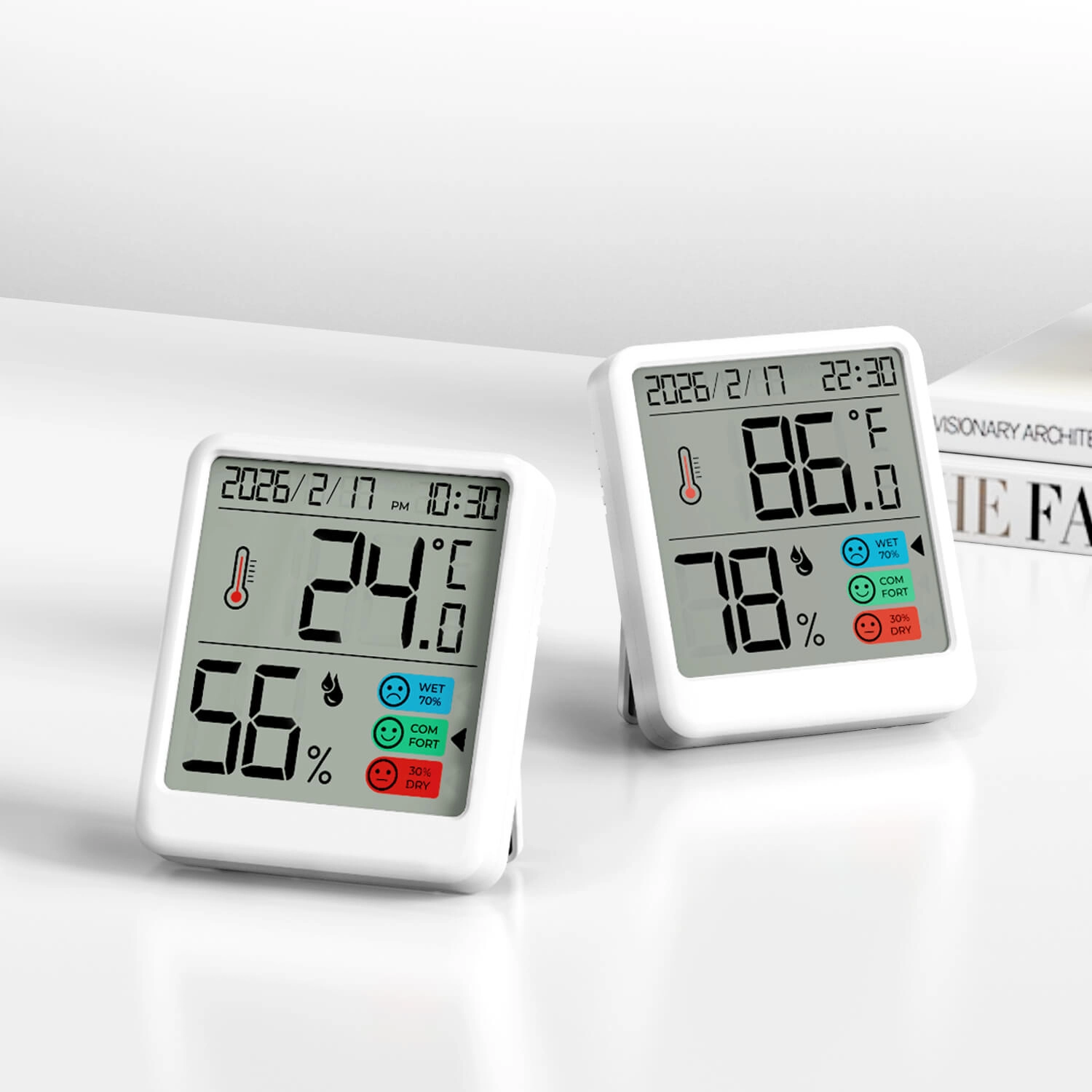
Digital Indoor Thermometer Hygrometer Temperature Humidity Monitor With Calendar Clock
The X-WSDJ312 Indoor Thermometer Hygrometer is a compact and multifunctional temperature and humidity monitor designed for home and office environments. It features a clear LCD screen displaying temperature, humidity, time, calendar, and comfort level at a glance.
Equipped with a high-sensitivity sensor, the device provides accurate real-time environmental monitoring to help maintain a comfortable indoor climate. The thermometer hygrometer supports 12/24-hour time format and ℃/℉ switching, making it convenient for global users.
Designed for flexible placement, it comes with a foldable desktop stand, magnetic back, and wall hanging hole, allowing installation on desks, refrigerators, or walls.
Powered by one AAA battery, the device operates with low power consumption and is ideal for homes, offices, greenhouses, classrooms, and storage environments.
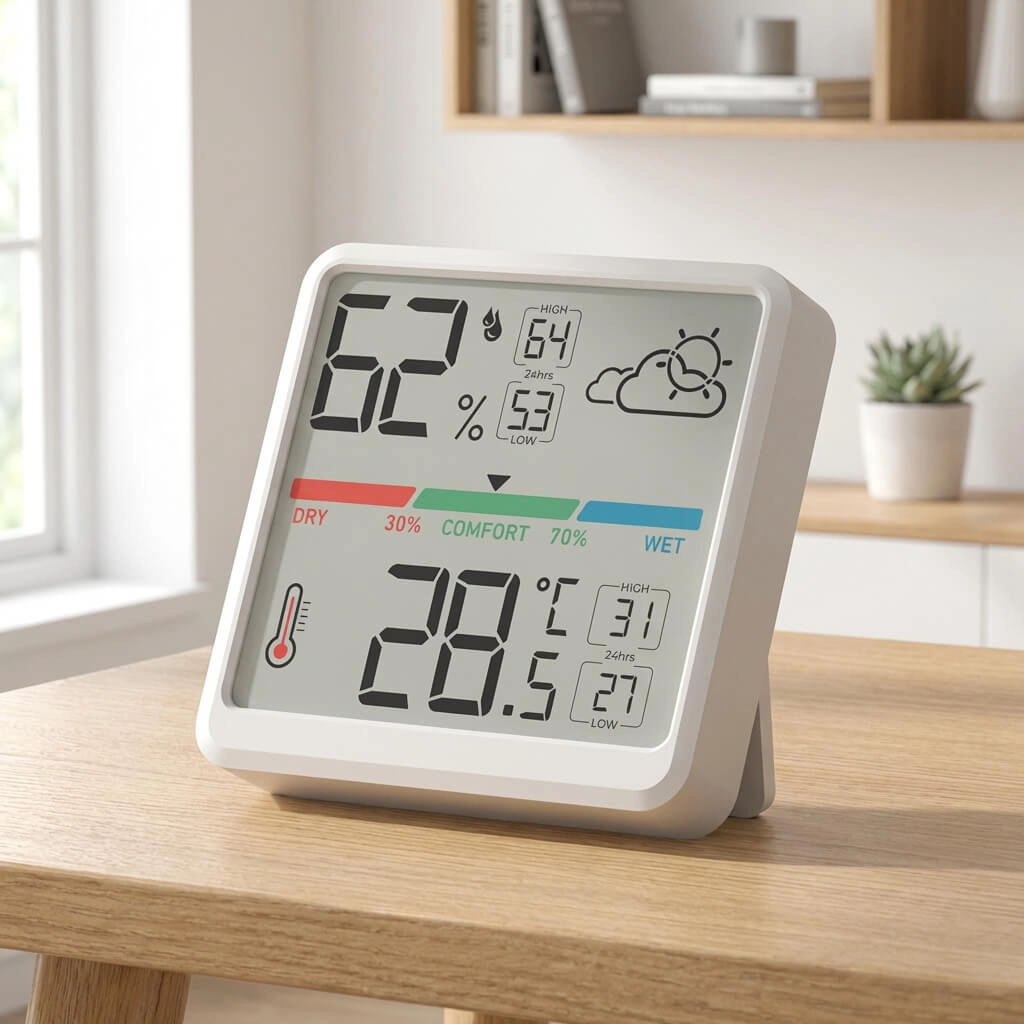
Digital Indoor Thermometer Hygrometer LCD Temperature Humidity Monitor
The Digital Indoor Thermometer Hygrometer is designed for accurate and reliable monitoring of indoor temperature and humidity. Featuring a clear LCD display, it provides real-time readings along with 24-hour maximum and minimum records for both temperature and humidity. The built-in comfort indicator clearly shows dry, comfortable, or humid conditions, helping users maintain a healthier indoor environment.
With a temperature measurement range from -20°C to 60°C (-4°F to 140°F) and humidity range from 10%RH to 99%RH, this device ensures consistent performance with high accuracy. The sensor updates every 10 seconds for real-time monitoring, while manual reset and unit switching (°C/°F) offer added convenience. Compact and versatile, it includes a foldable stand and magnetic back for flexible placement in homes, kitchens, offices, or warehouses.
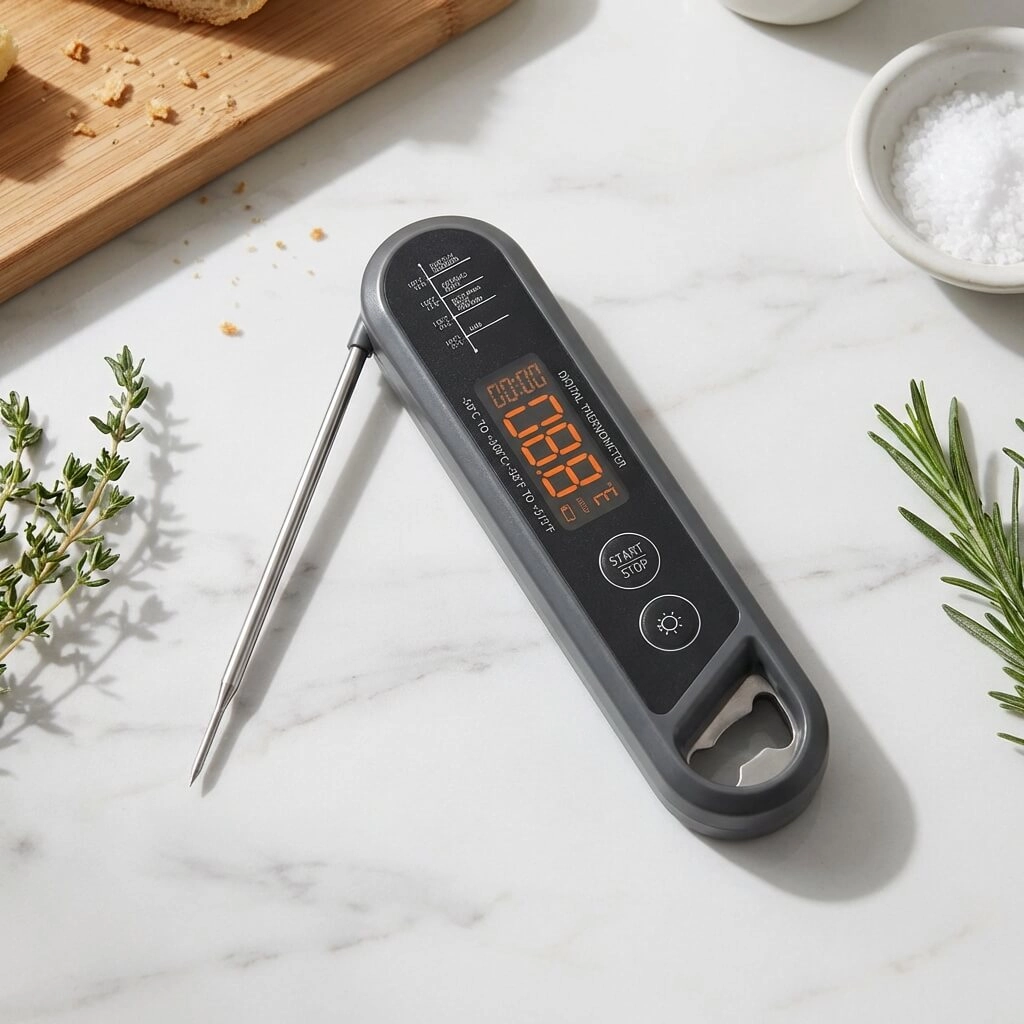
Instant Read Digital Meat Thermometer Food Thermometers With Count Up Timer Grill Oven
X-SPWDJ315-1 is a professional digital meat thermometer designed for B2B buyers such as e-commerce sellers, wholesalers, and OEM clients. Its foldable stainless steel probe ensures safe and compact storage while measuring temperatures from -50°C to 300°C with ±0.1°C accuracy. The thermometer features an integrated countdown timer (up to 59:59) and START/STOP control for precise cooking. An ergonomic handle with a built-in bottle opener adds multifunctional convenience. Powered by a single CR2450 battery, it is ideal for grilling, baking, restaurant kitchens, catering, and bulk supply, providing reliable performance and customization options for commercial customers.
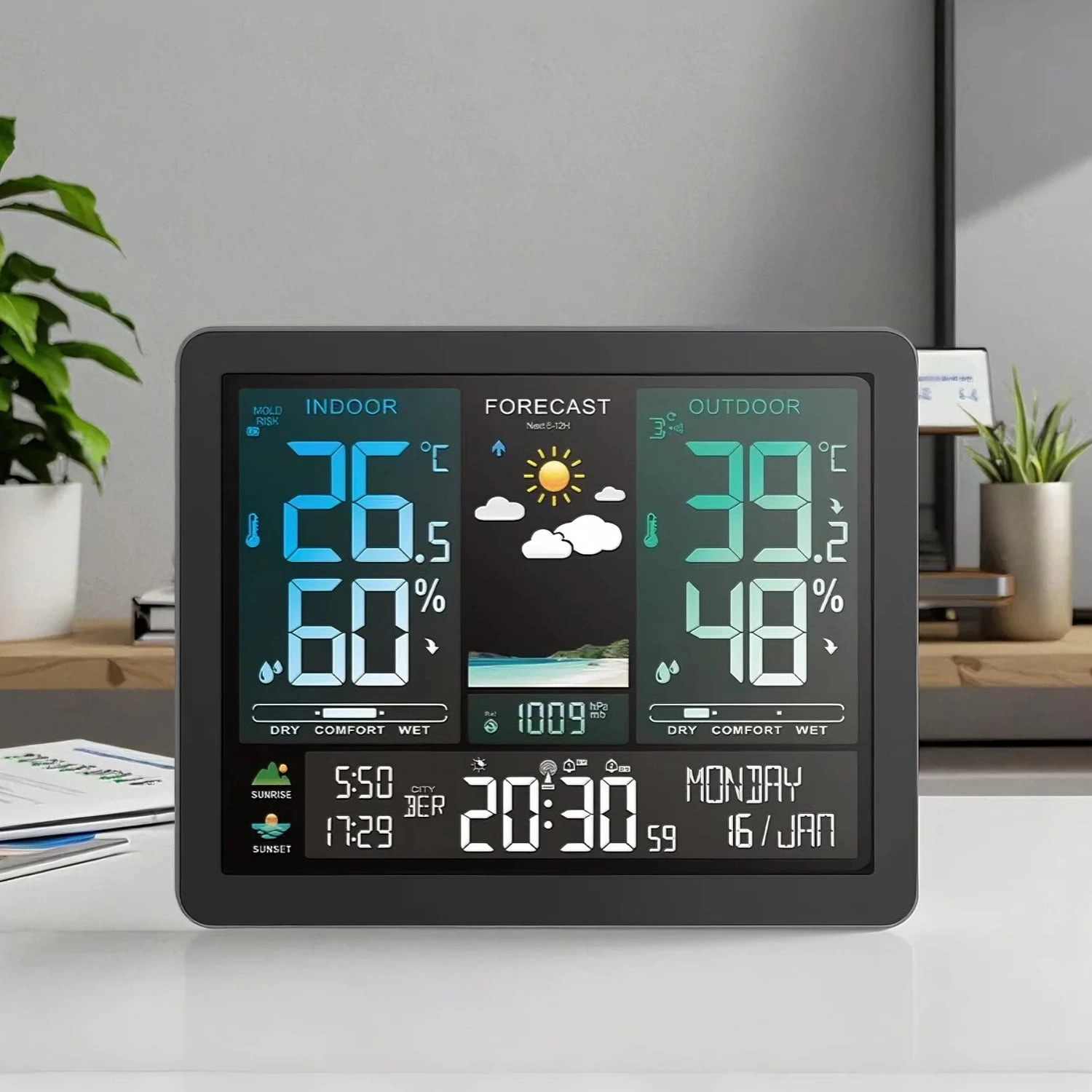
Custom USB Powered Daylight Savings Desktop Wall Alarm Clock Indoor and Outdoor Sensor Calendar Weather Thermometer Hygrometer Barometer
The X-WSDJ012 Smart Digital LED Alarm Clock is a multi-functional home device combining timekeeping with environmental monitoring.
It features a large LED display for time (12/24H), week, and date and integrates indoor/outdoor sensors to track temperature, humidity, atmospheric pressure, and weather trends.
Powered by USB (for a bright, always-on display) or batteries, it includes a waterproof outdoor sensor and offers customizable alarms, backlight control, and 8 language options.
Designed with a foldable stand or hanging hole, it fits desks, walls, or nightstands—ideal for home, garden, or office use.

Youben life
Youben life