
Wholesale digital timer for oven manufacturer and supplier
- Why accurate timing hardware matters in the kitchen and food service
- Operational safety and food quality
- Product differentiation through design and UX
- Regulatory and operational considerations
- Wholesale digital timer for oven: product types, features, and use cases
- Types of timers relevant to ovens
- Key features buyers request
- Example comparison table: timer categories
- How Youben Life supports wholesale OEM/ODM for oven timers
- End-to-end capabilities: R&D to retail-ready
- Quality, compliance and certifications
- Customization, MOQ and lead times
- Engineering, testing and production best practices
- IC programming and firmware stability
- Environmental testing and safety
- Supply chain and component selection
- Commercial considerations for buyers
- Cost drivers and pricing transparency
- Branding, packaging and marketplace readiness
- Sustainability and compliance expectations
- Case study: Bringing a private-label oven countdown timer to market (example workflow)
- Phase 1 — Concept and specification
- Phase 2 — Design, prototyping and testing
- Phase 3 — Tooling, production and launch
- FAQs
- What is the difference between an oven-safe timer and a kitchen timer?
- What certifications should I require from a wholesale manufacturer?
- What are typical MOQs and lead times for private-label timers?
- Can you integrate temperature sensing with a countdown timer?
- Conclusion
- References
Youben Life, headquartered in Guangzhou, China, provides turnkey OEM/ODM production of wholesale digital timers for oven applications and related kitchen timing hardware. With a 20,000m² vertically integrated facility, full R&D, precision tooling, and compliance to CE, FCC and RoHS, we support global brands and Amazon sellers seeking private-label oven timers, countdown displays, and time-management devices optimized for manufacturing, certification, packaging, and market-specific needs.
Why accurate timing hardware matters in the kitchen and food service
Operational safety and food quality
Accurate oven timing is critical for consistent food quality, safety, and energy efficiency. In commercial kitchens, unreliable timers can lead to undercooked or overcooked food, increasing food safety risks and waste. A robust digital timer for oven applications helps maintain repeatable cooking protocols, supports HACCP-aligned workflows, and reduces human error.
Product differentiation through design and UX
Beyond function, a well-designed oven timer becomes a brand differentiator. Features such as large LED displays, tactile controls, magnetic mounts, countdown and count-up modes, memory presets, and audible/visual alarms improve user experience. For manufacturers, offering custom industrial design (ID/MD) and retail-ready packaging strengthens shelf appeal and conversion on e-commerce platforms.
Regulatory and operational considerations
Kitchen electronics must comply with regional safety and EMC rules. For export-ready devices, CE marking, FCC compliance, and RoHS restricted-substances adherence are standard expectations. Many buyers also ask for quality-management evidence such as ISO 9001 processes to ensure traceable production and consistent product quality.
Wholesale digital timer for oven: product types, features, and use cases
Types of timers relevant to ovens
Not all timers are appropriate for in-oven use. Common categories include:
- External countertop and clip-on digital kitchen timers — used for tracking cook times outside the oven.
- Integrated oven controllers — specialized modules designed to be installed inside or as part of an oven control panel (require higher thermal and EMC ratings).
- Probe-based timers/thermometers — combine temperature sensing with count-down functionality; suitable for monitoring internal food temperature.
Key features buyers request
When sourcing wholesale digital timers for ovens, procurement teams typically evaluate:
- Accuracy and resolution (e.g., 1-second resolution for countdown timers).
- Display type and visibility (LED, LCD, segment size, backlight).
- Power options (battery, USB-rechargeable, mains integration for built-in controllers).
- Operating temperature and enclosure IP rating (especially for integrated modules).
- Custom firmware: presets, multiple timers, memory recall, audible/visual alarm options.
Example comparison table: timer categories
| Category | Typical Use | Operating Environment | Advantages |
|---|---|---|---|
| Countertop / Clip-on Digital Timer | Home kitchens, professional prep | Room temperature (–10°C to 50°C) | Portable, affordable, easy to replace |
| Integrated Oven Controller Module | Built-in oven electronics | Requires higher thermal/EMC design, may be isolated from oven interior | Seamless integration, OEM-branded UX |
| Probe Timer / Thermometer | Roasting / baking where internal temp matters | Probe exposed to oven interior; electronics typically outside | Accurate doneness control, temperature alarms |
How Youben Life supports wholesale OEM/ODM for oven timers
End-to-end capabilities: R&D to retail-ready
Youben Life operates a 20,000m² vertically integrated production base in Guangzhou and provides full-spectrum services: industrial design (ID/MD), custom IC programming, precision mold tooling, PCB assembly, firmware development, and retail packaging. This reduces coordination overhead and shortens time-to-market for private-label oven timers and related time-management hardware.
Quality, compliance and certifications
All Youben Life products are developed to meet CE, FCC and RoHS requirements. CE marking guidance and RoHS directives are overseen by the European Commission; FCC Equipment Authorization details are given by the FCC for U.S. electronic equipment. Maintaining compliance helps global distribution and reduces customs or marketplace friction. Many OEM customers also request ISO 9001-aligned quality processes; see ISO 9001 for the international standard.
Customization, MOQ and lead times
Common buyer questions include minimum order quantities (MOQ), lead times, and customization scope. Typical ranges in the industry (subject to product complexity) are:
| Service | Typical Range |
|---|---|
| Prototype & engineering samples | 2–4 weeks (design-dependent) |
| Injection mold tooling | 4–8 weeks |
| Mass production lead time | 4–10 weeks (quantity and complexity dependent) |
| Typical MOQ for private label | 1,000–5,000 units (negotiable for existing molds) |
These are industry-typical benchmarks. Youben Life works with customers to optimize tooling reuse, component sourcing, and production schedules to lower costs and shorten lead times.
Engineering, testing and production best practices
IC programming and firmware stability
For a reliable digital timer for oven applications, firmware must support stable timekeeping, power-fail memory, and user-friendly interfaces. Custom IC programming enables features like multi-mode countdown, Pomodoro presets, visual countdown displays, and low-power deep-sleep. Firmware validation includes stress-testing for uptime, debouncing for mechanical keys, and watchdog timers for resilience.
Environmental testing and safety
Robust products undergo environmental and EMC testing. For kitchen products, tests typically include temperature-humidity cycling, salt-spray (for metallic parts), vibration, and electromagnetic compatibility (EMC) tests per regional requirements. For background on timing devices in general, see the technical overview on Wikipedia: Timer (device).
Supply chain and component selection
Choosing reliable components (display modules, buzzer elements, thermistor/probe sensors, batteries/charging ICs) is essential. Youben Life's vertically integrated model reduces single-supplier risk, and in-house tooling ensures consistent part tolerances and repeatability for large-volume runs.
Commercial considerations for buyers
Cost drivers and pricing transparency
Major cost components include tooling amortization, PCB complexity, display type, firmware development, certifications, and packaging. Buyers should budget for upfront engineering (tooling, molding, firmware) and per-unit costs which decline with scale. Transparent BOM review and design for manufacturability (DFM) reviews help reduce unit cost.
Branding, packaging and marketplace readiness
Packaging and documentation affect launch success on retail and e-commerce channels. Youben Life offers retail-ready packaging design, multilingual manuals, and barcode/GTIN support. For Amazon sellers, attention to packaging dimensions, UPC/ASIN requirements, and product imagery is essential to accelerate listing approvals and conversions.
Sustainability and compliance expectations
Increasingly, buyers request RoHS compliance, recyclable packaging, and reduced hazardous substances. Meeting EU and U.S. standards decreases the risk of market rejection and aligns with corporate responsibility commitments. See EU CE marking guidelines at the European Commission: CE Marking information.
Case study: Bringing a private-label oven countdown timer to market (example workflow)
Phase 1 — Concept and specification
Define target features: magnetic back, 1-sec countdown resolution, large LED display, battery and USB power, 4 preset memory, loud buzzer and visual flash. Define certifications and target markets (EU, US, AU).
Phase 2 — Design, prototyping and testing
ID/MD sketches → PCB layout and firmware → 2–3 prototypes for functional and user testing → environmental and EMC pre-checks.
Phase 3 — Tooling, production and launch
Finalize molds, pilot production run, full QC sampling, packaging and labeling, shipment coordination to warehouses or Amazon FBA. Typical end-to-end timeline for such a project is 10–16 weeks depending on tooling complexity and certification schedules.
FAQs
What is the difference between an oven-safe timer and a kitchen timer?
Most general kitchen timers are intended for countertop use and are not built to withstand the high internal temperatures of an oven. An oven-safe timer (or oven controller) is specifically designed with appropriate thermal insulation, probe sensors or isolated control electronics. Always check product specifications and operating temperature range before using a device inside an oven.
What certifications should I require from a wholesale manufacturer?
Minimum expectations for global distribution include CE (EU), FCC (U.S.) where applicable (for wireless/EMC aspects), and RoHS for restricted substances. For buyers wanting quality management assurance, request ISO 9001 processes. Relevant resources: RoHS Directive and FCC Equipment Authorization.
What are typical MOQs and lead times for private-label timers?
MOQs commonly range from 1,000 to several thousand units depending on whether you need new tooling. Prototype and sample cycles take 2–6 weeks; mass production can be 4–10 weeks. Youben Life works with customers to optimize these timelines and reduce MOQ requirements when reusing existing molds.
Can you integrate temperature sensing with a countdown timer?
Yes. Probe-based designs pair a thermistor or thermocouple with the display and timer logic to provide temperature alarms and auto-stop functions. This approach is common for roasting or precise baking where internal temperature is the primary doneness metric.
Conclusion
Sourcing a high-quality wholesale digital timer for oven applications requires a partner that combines engineering depth, regulatory knowledge, manufacturing scale, and retail experience. Youben Life's vertically integrated facility in Guangzhou, full-service OEM/ODM offering, and compliance focus make it a viable partner for brands and sellers seeking private-label kitchen timers, integrated oven controllers, or probe-based temperature timers. For reliable performance, prioritize clear specifications, appropriate environmental ratings, and compliance evidence when selecting a supplier.
Contact Youben Life to discuss your oven timer project and get a tailored OEM/ODM proposal: info@youbenlife.com.
References
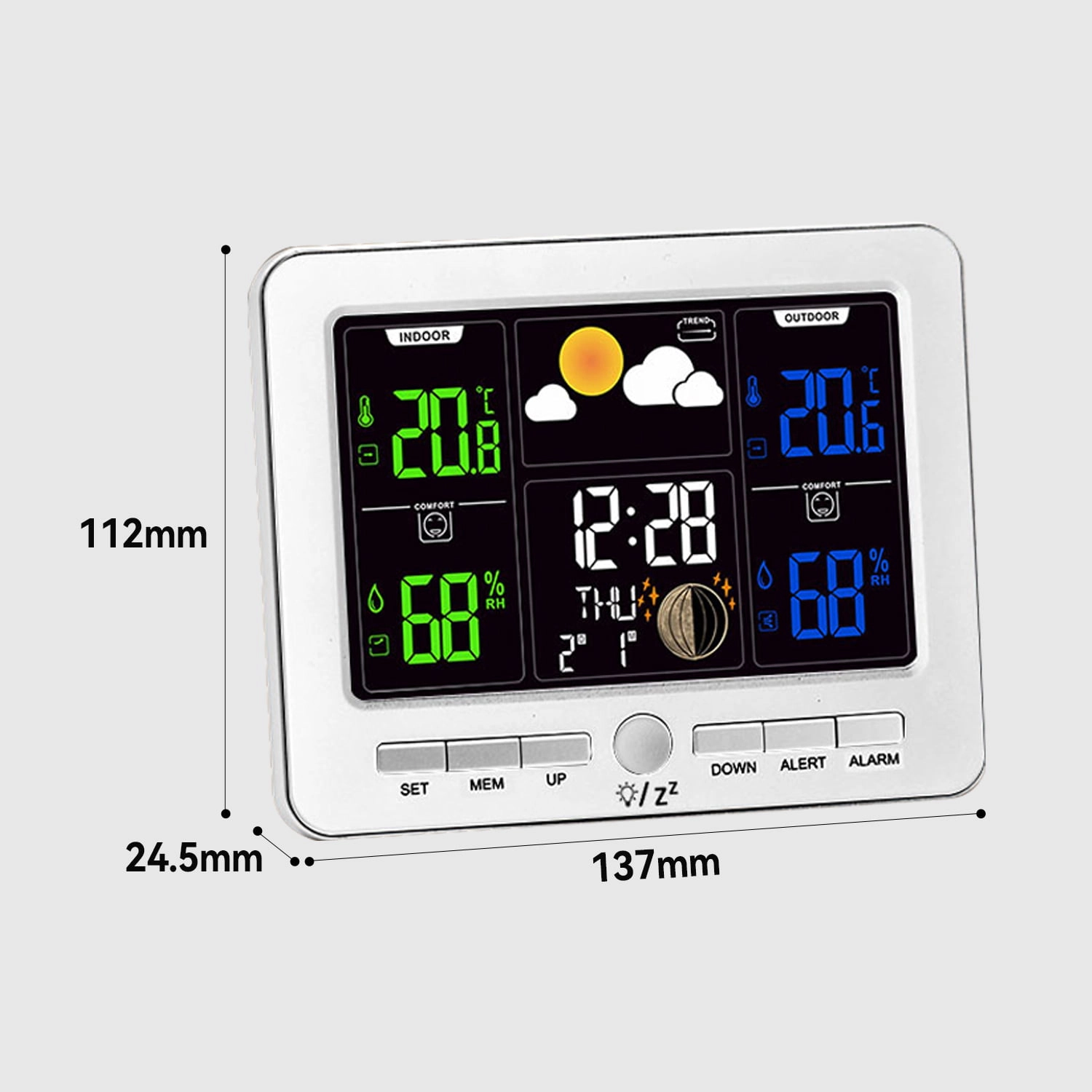
Bulk Digital Weather Clocks: Sourcing Solutions for Businesses
Compliance: Certifications for Pomodoro Timers (CE RoHS FCC)
Wholesale digital timer for kitchen manufacturer and supplier
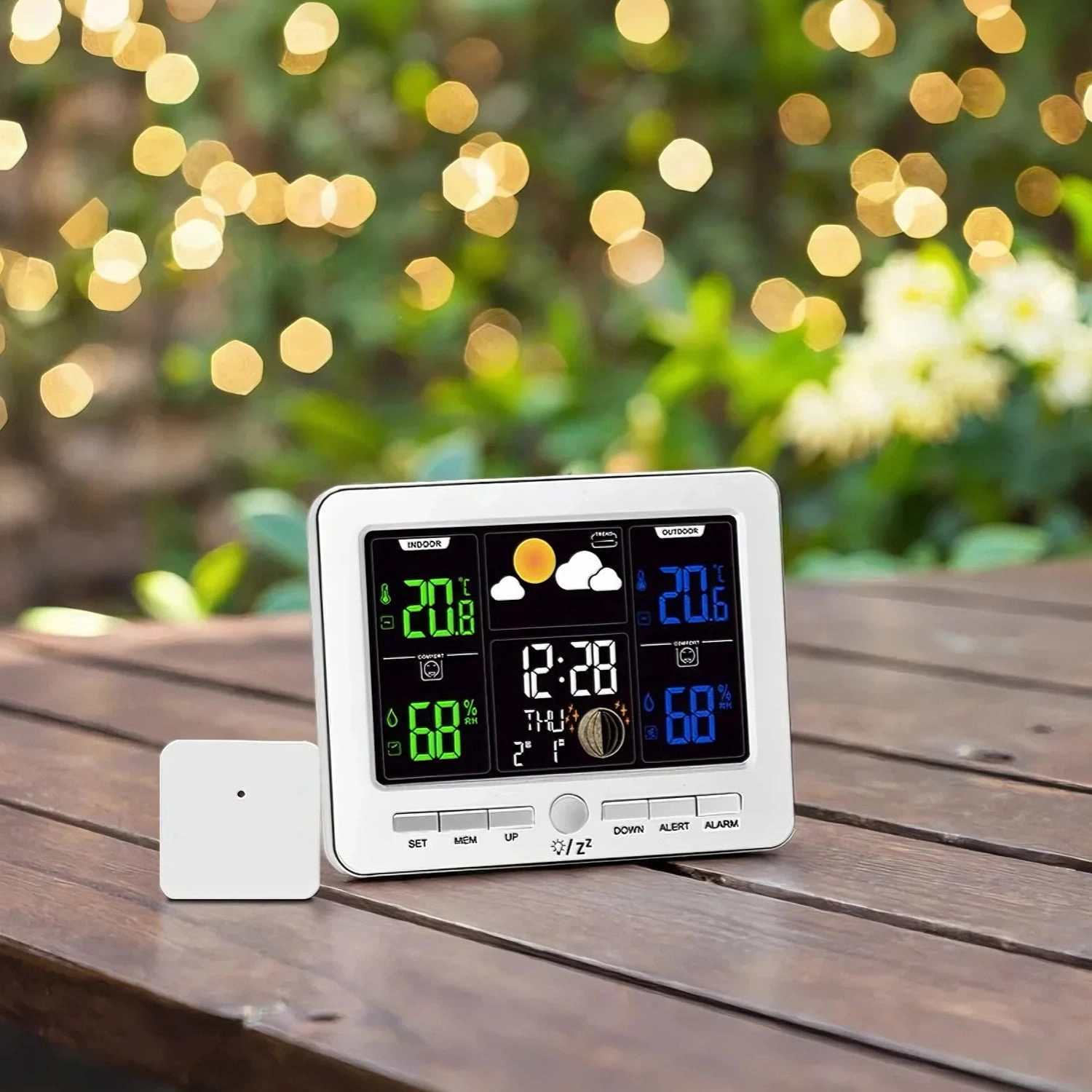
Daylight Savings Clocks: Seamless Time & Weather Management
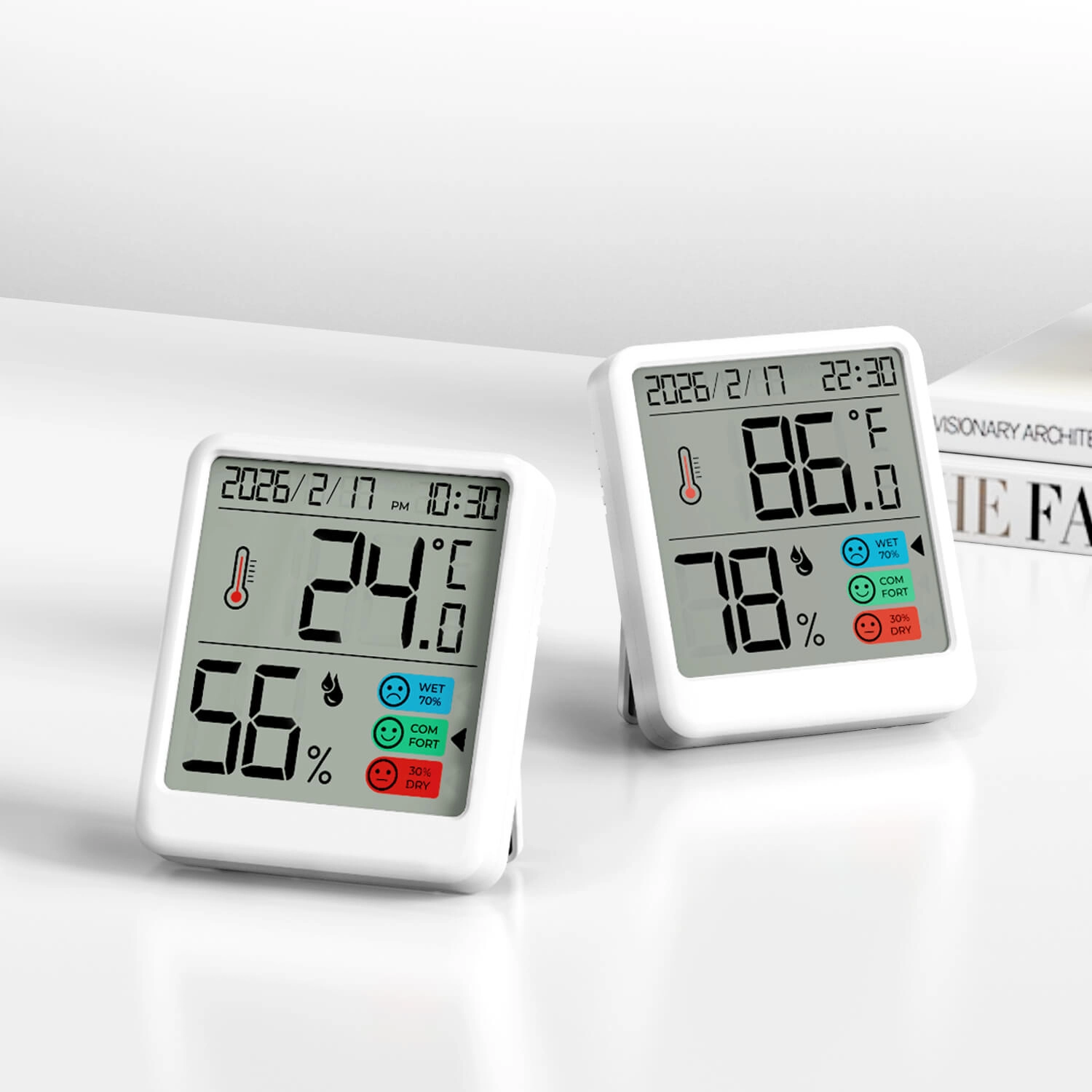
Digital Indoor Thermometer Hygrometer Temperature Humidity Monitor With Calendar Clock
The X-WSDJ312 Indoor Thermometer Hygrometer is a compact and multifunctional temperature and humidity monitor designed for home and office environments. It features a clear LCD screen displaying temperature, humidity, time, calendar, and comfort level at a glance.
Equipped with a high-sensitivity sensor, the device provides accurate real-time environmental monitoring to help maintain a comfortable indoor climate. The thermometer hygrometer supports 12/24-hour time format and ℃/℉ switching, making it convenient for global users.
Designed for flexible placement, it comes with a foldable desktop stand, magnetic back, and wall hanging hole, allowing installation on desks, refrigerators, or walls.
Powered by one AAA battery, the device operates with low power consumption and is ideal for homes, offices, greenhouses, classrooms, and storage environments.
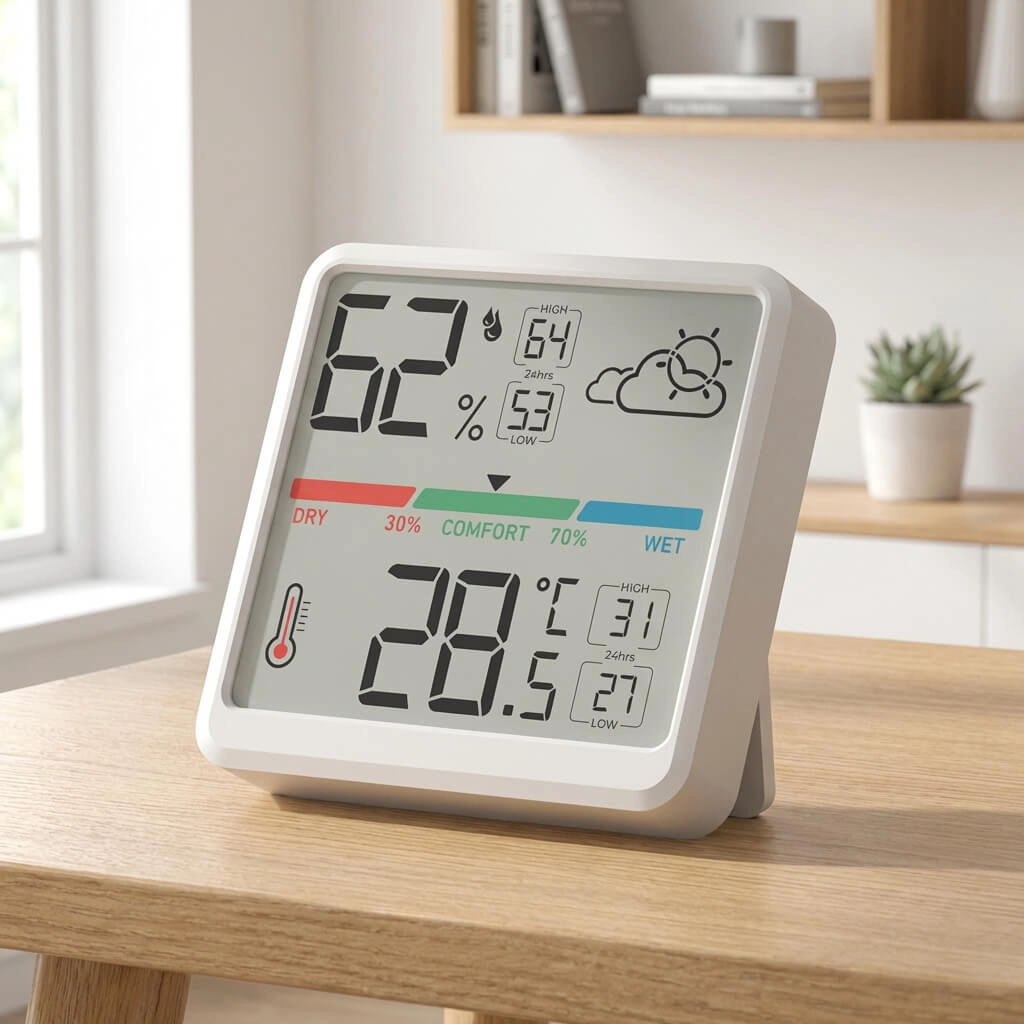
Digital Indoor Thermometer Hygrometer LCD Temperature Humidity Monitor
The Digital Indoor Thermometer Hygrometer is designed for accurate and reliable monitoring of indoor temperature and humidity. Featuring a clear LCD display, it provides real-time readings along with 24-hour maximum and minimum records for both temperature and humidity. The built-in comfort indicator clearly shows dry, comfortable, or humid conditions, helping users maintain a healthier indoor environment.
With a temperature measurement range from -20°C to 60°C (-4°F to 140°F) and humidity range from 10%RH to 99%RH, this device ensures consistent performance with high accuracy. The sensor updates every 10 seconds for real-time monitoring, while manual reset and unit switching (°C/°F) offer added convenience. Compact and versatile, it includes a foldable stand and magnetic back for flexible placement in homes, kitchens, offices, or warehouses.
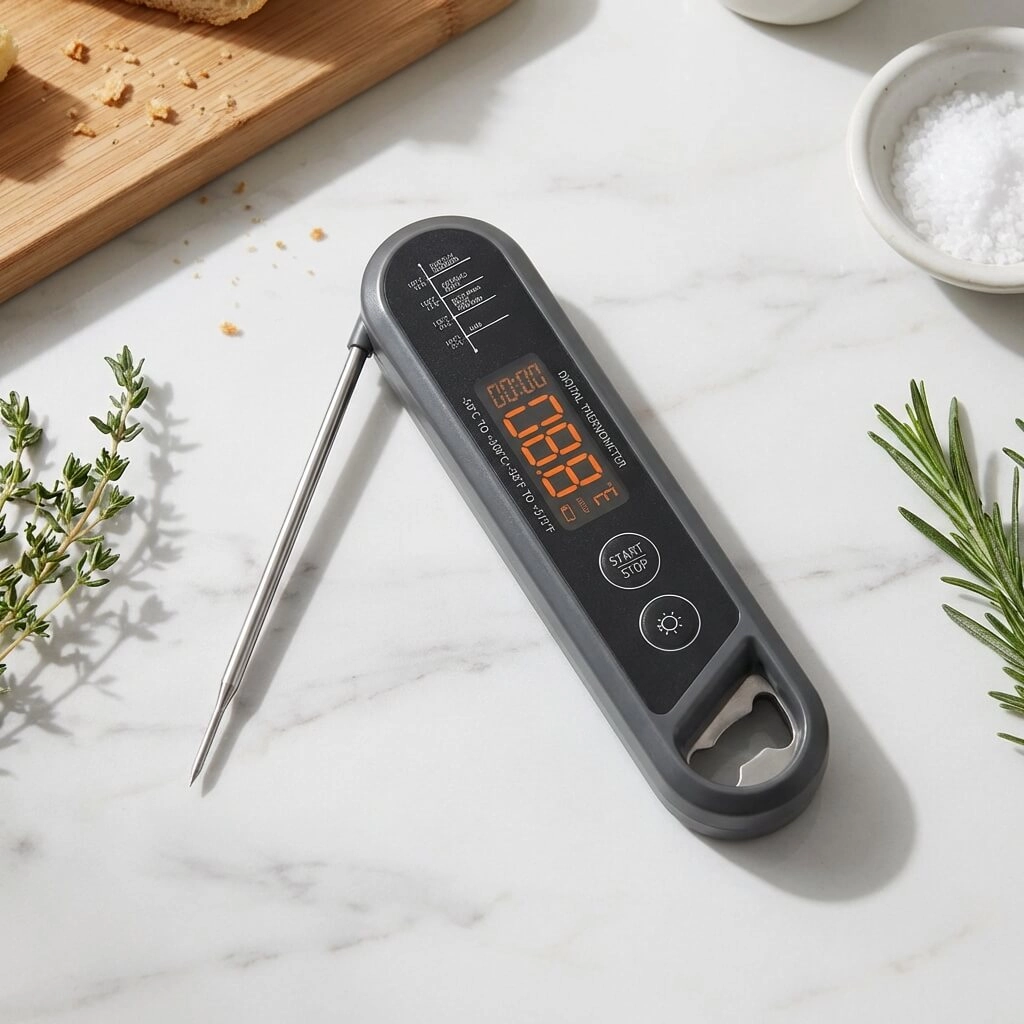
Instant Read Digital Meat Thermometer Food Thermometers With Count Up Timer Grill Oven
X-SPWDJ315-1 is a professional digital meat thermometer designed for B2B buyers such as e-commerce sellers, wholesalers, and OEM clients. Its foldable stainless steel probe ensures safe and compact storage while measuring temperatures from -50°C to 300°C with ±0.1°C accuracy. The thermometer features an integrated countdown timer (up to 59:59) and START/STOP control for precise cooking. An ergonomic handle with a built-in bottle opener adds multifunctional convenience. Powered by a single CR2450 battery, it is ideal for grilling, baking, restaurant kitchens, catering, and bulk supply, providing reliable performance and customization options for commercial customers.
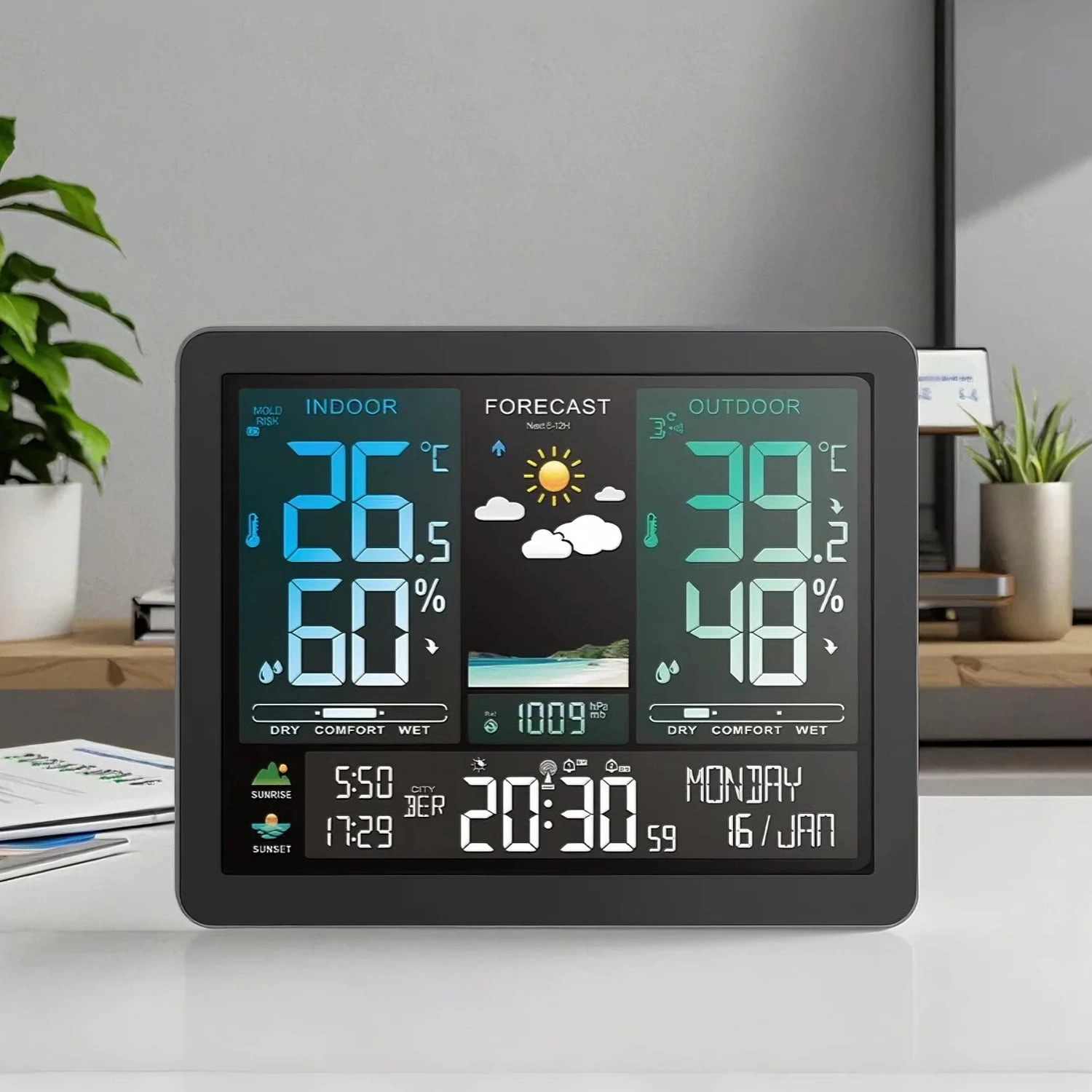
Custom USB Powered Daylight Savings Desktop Wall Alarm Clock Indoor and Outdoor Sensor Calendar Weather Thermometer Hygrometer Barometer
The X-WSDJ012 Smart Digital LED Alarm Clock is a multi-functional home device combining timekeeping with environmental monitoring.
It features a large LED display for time (12/24H), week, and date and integrates indoor/outdoor sensors to track temperature, humidity, atmospheric pressure, and weather trends.
Powered by USB (for a bright, always-on display) or batteries, it includes a waterproof outdoor sensor and offers customizable alarms, backlight control, and 8 language options.
Designed with a foldable stand or hanging hole, it fits desks, walls, or nightstands—ideal for home, garden, or office use.

Youben life
Youben life