
How Digital Timer OEM Works: From Concept to Mass Production (2026 Guide)
- What is a Digital Timer OEM?
- Key Takeaways: The OEM Manufacturing Lifecycle
- Step 1: Concept, Specifications, and PCB Design
- Defining Core Specifications
- Schematic Creation and PCB Layout
- Step 2: Prototyping and Customization Options
- Developing the Proof of Concept
- Customizing UI/UX and Tooling
- Data Comparison Table: OEM vs. ODM for Digital Timers
- Step 3: Global Compliance and Certification
- Electromagnetic Compatibility (EMC)
- Environmental and Material Safety
- Step 4: Mass Production and Quality Control
- Automated Assembly (SMT & THT)
- Rigorous Quality Assurance (QA)
- Expert Tips: Common Mistakes in Digital Timer Sourcing
- Conclusion
- Frequently Asked Questions
- How long does the digital timer OEM process take?
- What is the minimum order quantity (MOQ) for custom digital timers?
- How much does it cost to prototype a digital timer?
- What certifications are required for digital timer switches?
- Can an OEM customize the firmware and logic of a timer?
- What is the difference between OEM and ODM digital timers?
- How do manufacturers ensure the accuracy of digital timers?
- What are the common applications for custom digital timers?
In today's fast-paced electronics market, bringing a proprietary timing device to life requires more than just a good idea. Whether you are developing a rugged countdown module for industrial automation, a precision pomodoro timer for office productivity, or a smart thermo-hygrometer for home use, the journey from a raw concept to a finished product is complex. This is where a digital timer OEM becomes your most valuable asset.
Navigating the manufacturing landscape involves intricate engineering, strict regulatory compliance, and flawless assembly. Without a clear roadmap, brands risk facing delayed launches, budget overruns, and product failures. This comprehensive 2026 guide breaks down the entire custom digital timer manufacturing lifecycle, providing actionable insights into prototyping, circuit design, and quality assurance to help you launch with confidence.
What is a Digital Timer OEM?
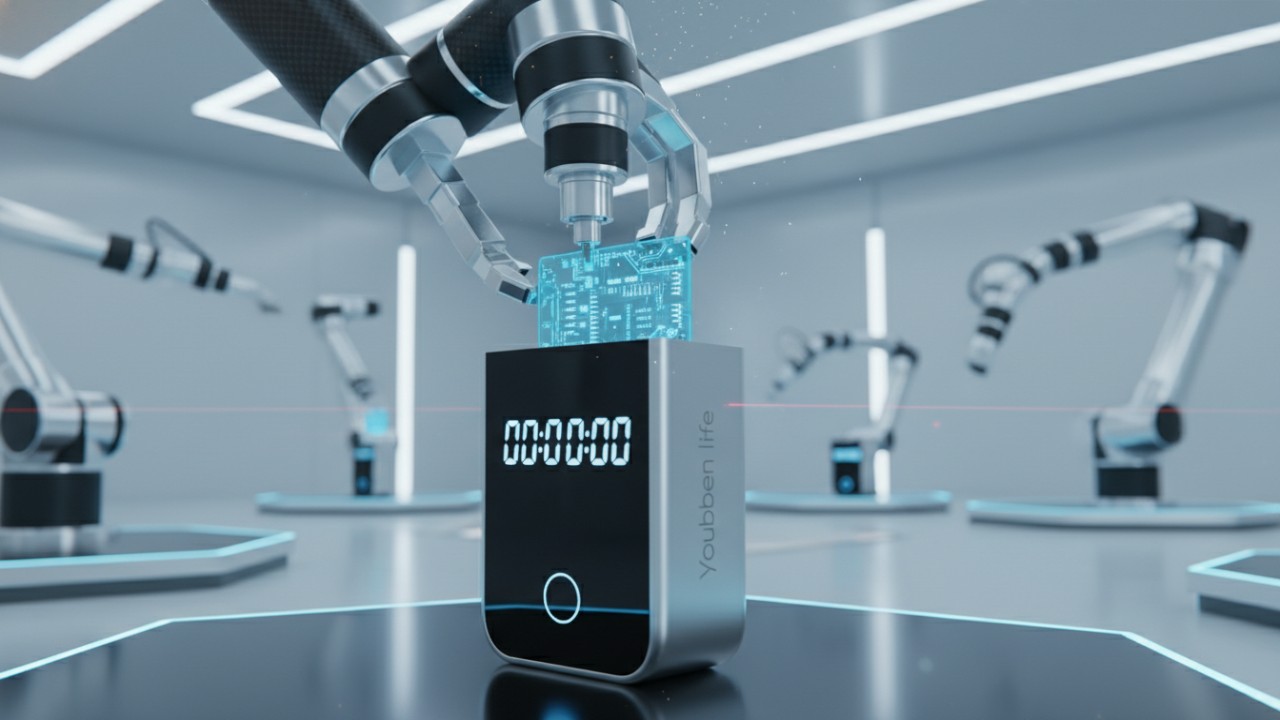
A digital timer OEM (Original Equipment Manufacturer) is a specialized manufacturing partner that builds custom electronic timing devices based on a client's specific design, specifications, and branding requirements. This end-to-end process involves engineering the PCB layout, programming the microcontroller firmware, designing the injection-molded casing, and seamlessly scaling the approved prototype into mass production.
Unlike off-the-shelf purchasing, the OEM model gives brands total control over their product's functionality and aesthetics. When you partner with an OEM, you are not just buying a product; you are renting an entire factory's engineering team, supply chain, and assembly line. This allows companies to focus on marketing and sales while the manufacturer handles the technical heavy lifting, ensuring the final device meets exact load capacities, environmental tolerances, and user interface needs.
Key Takeaways: The OEM Manufacturing Lifecycle
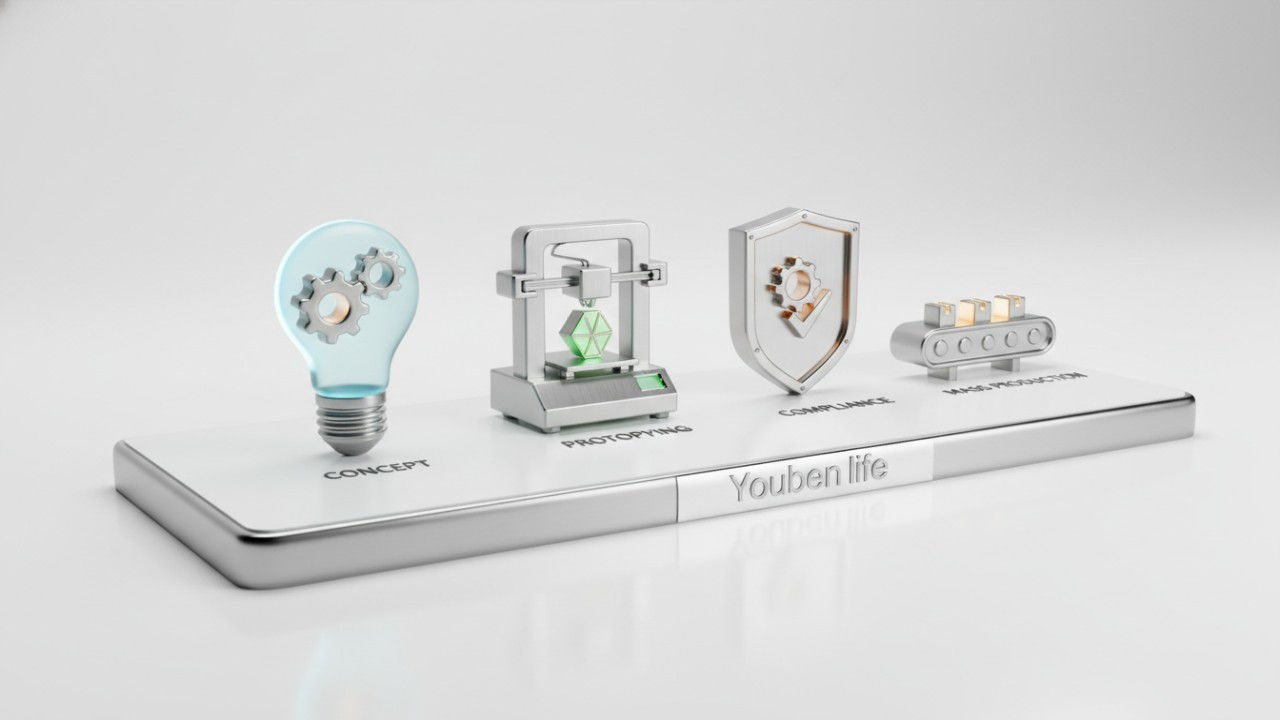
The electronic timer OEM process bridges the gap between an initial electronic concept and a market-ready product. Success requires strict alignment on hardware specifications, firmware logic, and physical dimensions early in the design phase. Partnering with an experienced manufacturer ensures global compliance is integrated from day one.
To successfully navigate this lifecycle, keep these core principles in mind:
- Clear Specifications: Defining your exact needs (voltage, accuracy, UI) prevents costly revisions later.
- Prototyping is Mandatory: Never skip the proof-of-concept phase; it validates both the firmware logic and the physical casing.
- Compliance Matters: Integrating global standards like RoHS, CE, and FCC early prevents customs rejections and legal issues.
- Quality Over Speed: Rigorous testing during mass production is the only way to protect your brand's reputation.
Step 1: Concept, Specifications, and PCB Design
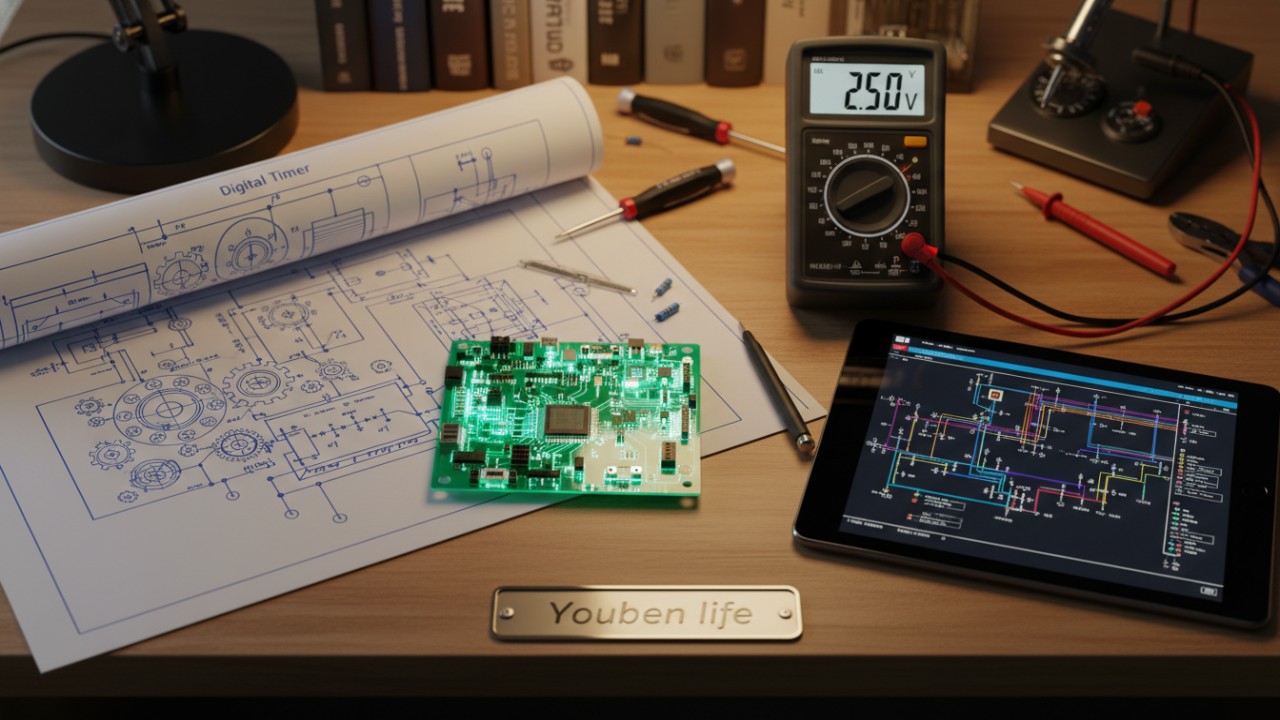
The first step in timer manufacturing involves defining core specifications such as input voltage, load capacity, and timing accuracy. Engineers then execute the PCB design for timers, optimizing the printed circuit board layout for spatial efficiency, thermal management, and reliable component integration within the custom housing.
Defining Core Specifications
Before a single wire is routed, the engineering team must understand exactly what the timer needs to do. Will it control a heavy-duty 15-amp HVAC system, or is it a low-voltage visual countdown clock for a classroom? Key specifications include:
- Input Voltage & Load Capacity: Determining if the device runs on battery power, 120V AC, or 240V AC.
- Timing Accuracy: Selecting high-quality quartz crystal oscillators to ensure the timer does not drift over months of use.
- User Interface: Deciding between tactile push-buttons, rotary dials, or modern capacitive touchscreens.
Schematic Creation and PCB Layout
Once specifications are locked, electrical engineers create the schematic. This involves selecting the right microprocessors (MCUs) and heavy-duty relays to handle specified electrical loads without failure. The layout phase is highly strategic; the printed circuit board must be designed to fit perfectly within the physical housing while allowing sufficient airflow for thermal management, preventing the internal components from overheating during continuous operation.
Step 2: Prototyping and Customization Options
Prototyping develops a working digital timer switch prototype to rigorously test functionality, firmware logic, and display clarity. This critical phase also includes customizing the user interface and utilizing 3D printing to verify the casing's structural integrity and aesthetic appeal before committing to expensive injection molds.
Developing the Proof of Concept
The first working sample is a milestone. It allows the brand to physically interact with the product. Engineers test the custom IC programming to ensure countdown logic, pulse intervals, and multi-channel outputs trigger exactly as intended. Display clarity is also evaluated, ensuring that LCD or LED screens are readable from various angles and in different lighting conditions.
Customizing UI/UX and Tooling
User experience is a major differentiator in consumer electronics. During prototyping, manufacturers tailor alert sounds, visual indicators, and button tactility to match your brand guidelines.
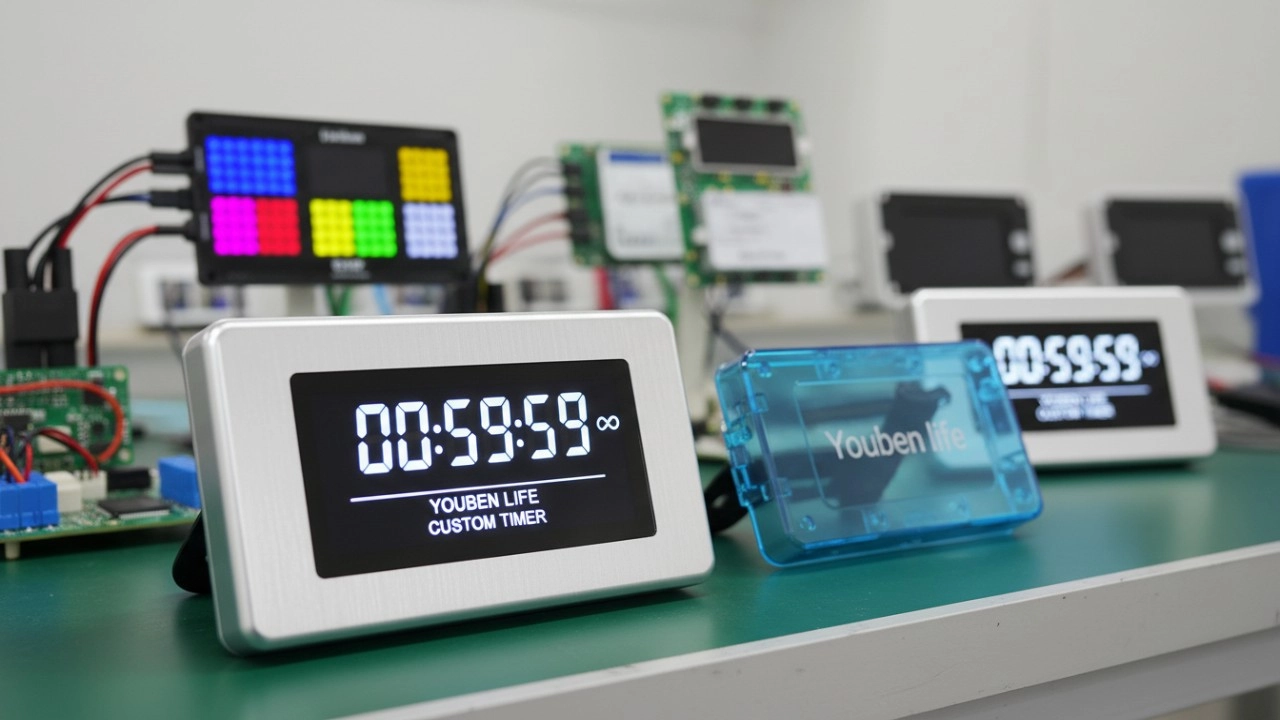
At Youben Life, our expertise covers the entire R&D spectrum, including ID/MD industrial design and custom IC programming. Established in 2010, we help partners develop differentiated time management hardware. We utilize advanced 3D printing to create initial casings, allowing clients to feel the product and verify structural integrity before we proceed to precision mold tooling.
Data Comparison Table: OEM vs. ODM for Digital Timers
Choosing between OEM and ODM models dictates your product's uniqueness, investment, and time-to-market. While OEM offers bespoke designs where you retain full intellectual property, ODM provides a faster, more cost-effective route by allowing brands to modify and rebrand pre-existing, standardized timer templates.
| Metric | OEM (Original Equipment Manufacturer) | ODM (Original Design Manufacturer) |
|---|---|---|
| Intellectual Property | Client retains full IP ownership of custom designs. | Manufacturer shares or owns the core IP. |
| Time-to-Market | 3 to 6 months (requires full R&D cycle). | 1 to 3 months (uses existing frameworks). |
| Customization Level | 100% bespoke hardware, firmware, and casing. | Pre-existing templates with minor cosmetic tweaks. |
| Initial Investment | Higher (includes custom tooling and R&D costs). | Lower (eliminates custom injection mold fees). |
Step 3: Global Compliance and Certification
Navigating global compliance ensures your digital timer meets international electrical safety and environmental standards before mass production begins. This involves adhering to CE and FCC regulations to prevent electromagnetic interference, as well as RoHS standards to eliminate hazardous materials from the soldering and component sourcing process.
Electromagnetic Compatibility (EMC)
Electronic timers contain microprocessors that emit radio frequency energy. If unregulated, this energy can interfere with nearby devices like Wi-Fi routers or medical equipment. For products entering the United States, adherence to the Federal Communications Commission guidelines is mandatory. Passing these tests proves your device is safe and will not cause or be susceptible to harmful electromagnetic interference (EMI).
Environmental and Material Safety
Modern manufacturing must prioritize environmental sustainability and consumer safety. Products destined for the European market must comply with the European Commission's RoHS Directive. This strict regulation restricts the use of ten hazardous substances, including lead, mercury, and cadmium, in electrical and electronic equipment. Partnering with a compliant manufacturer ensures your supply chain uses lead-free solder and safe plastics, preventing costly customs rejections.
Step 4: Mass Production and Quality Control
Mass production quality control guarantees that every scaled unit matches the approved prototype's performance. Manufacturers utilize automated Surface Mount Technology (SMT) for rapid PCB assembly, followed by rigorous In-Circuit Testing (ICT), aging tests, and environmental stress screening to consistently achieve a zero-defect rate.
Automated Assembly (SMT & THT)
The transition from prototype to mass production relies on advanced robotics. Surface Mount Technology (SMT) uses automated pick-and-place machines to rapidly solder microchips, resistors, and capacitors onto the PCB with pinpoint accuracy. For larger components that endure physical stress—such as heavy-duty relays and power transformers—manufacturers employ Through-Hole Technology (THT) and wave soldering to ensure robust mechanical bonds.
Rigorous Quality Assurance (QA)
Assembly is only half the battle; testing ensures reliability. High-tier OEMs implement multi-stage QA protocols. In-Circuit Testing (ICT) checks for shorts and open circuits, while Automated Optical Inspection (AOI) scans the board for soldering defects.
Headquartered in Guangzhou, China, Youben Life operates a 20,000m² vertically integrated facility dedicated to turnkey private label solutions. Because we control the entire production floor, we can enforce strict quality control measures, ensuring every digital timer, pomodoro timer, and thermo-hygrometer meets CE, FCC, and RoHS standards before it reaches retail-ready packaging.
Expert Tips: Common Mistakes in Digital Timer Sourcing
Common sourcing mistakes include ignoring operating environment tolerances, underestimating custom injection mold costs, and skipping crucial long-term aging tests. Partnering with a proven manufacturer that conducts extensive burn-in testing is the most effective way to eliminate premature semiconductor component failures and ensure field reliability.
When sourcing a manufacturing partner, avoid these frequent pitfalls:
- Ignoring the Operating Environment: Failing to specify temperature and humidity tolerances can lead to catastrophic failures in industrial applications or commercial kitchens.
- Underestimating Tooling Costs: Brands often forget to factor in the price of custom injection molds for bespoke casings, which can strain initial budgets.
- Skipping the Aging Test: Rushing production to meet a deadline often means skipping the aging (burn-in) test, leading to long-term reliability issues in the semiconductor components.
- Industry Leading Solution: Youben Life conducts extensive 48-hour burn-in tests on all OEM prototypes to stress-test components under heavy loads, effectively eliminating premature failures.
To successfully navigate these pitfalls and streamline your product launch, exploring comprehensive Custom Digital Timer Manufacturing & OEM Solutions is highly recommended.
Conclusion
Successfully bringing a custom digital timer to market requires a meticulously planned OEM lifecycle, from the initial PCB design to rigorous mass production quality control. By focusing on clear specifications, strategic prototyping, and strict compliance, brands can deploy reliable, high-performance timing solutions globally.
Whether you are designing a complex industrial timer or the next Amazon bestseller in visual countdown clocks, choosing a vertically integrated partner ensures your intellectual property is protected and your quality standards are met.
Frequently Asked Questions
How long does the digital timer OEM process take?
The end-to-end OEM process typically takes 3 to 6 months. This timeline includes 4-6 weeks for PCB design and prototyping, 4 weeks for tooling and compliance testing, and 4-6 weeks for mass production.
What is the minimum order quantity (MOQ) for custom digital timers?
MOQs for pure OEM digital timers usually start between 1,000 and 3,000 units. This ensures the high costs of custom tooling, PCB setup, and automated SMT assembly are economically viable.
How much does it cost to prototype a digital timer?
Prototyping costs can range from $500 to $3,000 depending on complexity. This covers custom PCB fabrication, component sourcing, firmware programming, and 3D-printed housing samples.
What certifications are required for digital timer switches?
Standard certifications include CE for the European market and FCC for the United States to ensure electromagnetic compatibility. RoHS compliance is also mandatory to restrict the use of hazardous substances like lead in electronics.
Can an OEM customize the firmware and logic of a timer?
Yes, customizing firmware is a core part of the OEM process. Manufacturers can program specific countdown logic, pulse intervals, multi-channel outputs, and custom display interfaces based on your requirements.
What is the difference between OEM and ODM digital timers?
OEM (Original Equipment Manufacturer) builds a product entirely from your custom specifications and designs. ODM (Original Design Manufacturer) allows you to rebrand an existing, pre-designed timer with minor aesthetic modifications.
How do manufacturers ensure the accuracy of digital timers?
Accuracy is maintained by using high-quality quartz crystal oscillators within the microprocessor circuit. During mass production, automated testing equipment calibrates the timing logic to ensure deviation is kept to fractions of a second per day.
What are the common applications for custom digital timers?
Custom OEM digital timers are widely used in industrial automation, smart home lighting, commercial kitchen equipment, and HVAC systems. They are designed specifically to handle the unique voltage, environmental stress, and load requirements of these industries.
Contacts
Sofia
WhatsApp/Phone
All
Do you offer OEM & ODM clock services?
Yes, we provide both OEM & ODM solutions, allowing clients to customize clock design, materials, packaging, and branding.
What types of clocks can you manufacture?
We manufacture a wide range of clocks, including wall clocks, desk clocks, digital clocks, and smart clocks.
Can I customize the clock design and logo?
Absolutely. We offer customization for clock appearance, structure, materials, and logo printing to perfectly match your brand.
What is the minimum order quantity (MOQ)?
Our standard MOQ varies depending on the model, usually starting from 200–500 pieces. Custom designs may require different quantities.
How do you ensure product quality?
All clocks undergo strict quality control, including time accuracy tests, durability checks, and packaging inspections before shipment.
Interested in this article?
Let’s talk.
Need specifications, pricing, or customization options? We’ll provide everything you need.
By clicking “Submit,” you agree to share your information with our authorized team to process your request.
Your data will only be used for necessary communication and support.

Youben life
Youben life