
Integrating Pomodoro Digital Timers into Smart Home Systems
- Why smart homes benefit from dedicated time-management devices
- Understanding pomodoro digital timer and consumer intent
- Key integration patterns for pomodoro digital timer in smart home systems
- Three common architectures and when to choose each
- 1. Local hub integration
- 2. Direct Wi-Fi or Bluetooth integration
- 3. Cloud-to-cloud and voice assistant integration
- Choosing the right communication protocol
- Protocol comparison for pomodoro digital timer implementations
- Practical device design and UX considerations
- Hardware and interaction design tips for the pomodoro digital timer
- Software UX patterns
- Implementation steps: from prototype to market-ready device
- Roadmap for bringing a pomodoro digital timer to market
- Security, privacy, and compliance
- Security best practices for connected timers
- Certifications and why they matter
- Business models and OEM/ODM considerations
- How brands can commercialize pomodoro digital timer solutions
- Youben Life: manufacturing partner overview and product fit
- Why choose Youben Life for customized digital timer solutions
- Youben Life competitive strengths
- Main products and how they align with pomodoro digital timer projects
- Real-world use cases and ROI
- Use cases that drive purchase decisions
- Measuring impact and return on investment
- Integration checklist for engineers and product managers
- Step-by-step checklist
- FAQ
- 1. What is a pomodoro digital timer and how does it differ from a regular timer?
- 2. Can I integrate a pomodoro digital timer with Google Home, Alexa, or HomeKit?
- 3. Is it better to use Wi-Fi or Bluetooth for a pomodoro digital timer?
- 4. How do manufacturers ensure the timer remains secure?
- 5. Can an OEM partner customize the look and functionality of the timer?
- 6. What certifications should I expect for international sales?
- Contact and next steps
- References and further reading
Why smart homes benefit from dedicated time-management devices
Understanding pomodoro digital timer and consumer intent
The term pomodoro digital timer describes a hardware or software device that implements the Pomodoro Technique: focused work intervals typically 25 minutes long followed by short breaks. With remote work and blended living spaces increasing, users look to buy pomodoro digital timer solutions that are both reliable and easy to integrate into existing smart home systems. Typical includes buying a pomodoro digital timer, integrating timers with Google Home or Alexa, and customizing devices for brands or workplaces.
Key integration patterns for pomodoro digital timer in smart home systems
Three common architectures and when to choose each
Designers and product managers should evaluate integration patterns depending on privacy, latency, interoperability, and scalability requirements. Here are the three practical architectures:
1. Local hub integration
Devices connect through a local smart home hub or controller using protocols like Zigbee, Z-Wave, or Thread. Benefits include low latency, continued operation when the cloud is down, and improved privacy. Best for households that prioritize local control and multi-device synchronization, for example syncing room timers in a co-working space at home.
2. Direct Wi-Fi or Bluetooth integration
Wi-Fi or Bluetooth Low Energy (BLE) allow direct pairing with a home router or a smartphone. Wi-Fi is ideal for rich cloud features and over-the-air updates. BLE is suitable for low-power, battery-operated timers. This architecture is common when a standalone pomodoro digital timer needs mobile app control or push notifications.
3. Cloud-to-cloud and voice assistant integration
Cloud-to-cloud integration connects the device cloud to platforms like Amazon Alexa, Google Assistant, or Apple Siri. This enables voice control, routines, and cross-manufacturer automation. Useful when users expect multi-vendor ecosystems or want voice-based commands like start pomodoro session or set custom intervals across multiple devices.
Choosing the right communication protocol
Protocol comparison for pomodoro digital timer implementations
Below is a concise comparison to help engineers and product owners choose the appropriate protocol for their pomodoro digital timer projects.
| Protocol | Typical Range | Power Profile | Primary Ecosystem | Best for |
|---|---|---|---|---|
| Zigbee | 10-100 m (mesh) | Low | Smart home hubs, Home Assistant | Battery or mains timers requiring mesh networking |
| Z-Wave | 30-100 m (mesh) | Low | Established smart home controllers | Reliable home automation with mature ecosystem |
| Wi-Fi | Up to router range | High | Cloud services, mobile apps | Feature-rich timers with OTA updates |
| Bluetooth LE | 10-50 m | Very low | Mobile-first devices | Portable timers with mobile app pairing |
| Thread / Matter | Mesh, similar to Zigbee | Low | New cross-vendor standard | Future-proof, interoperable smart home devices |
| MQTT (local/cloud) | Depends on network | Variable | DIY, Home Assistant, enterprise | Local-first, privacy-focused integrations |
Sources for protocol properties are included in the references section below. When building a pomodoro digital timer product, factor in power budget, expected user journeys, and whether the timer must be discoverable by ecosystems like Google Home or Amazon Alexa.
Practical device design and UX considerations
Hardware and interaction design tips for the pomodoro digital timer
Successful physical timers combine clear visual cues, simple controls, and dependable alerts. Recommended design elements:
- High-contrast, readable display with remaining-time visualization
- Multi-modal alerts: buzzer, configurable chime, LED ring, and push notifications
- Dedicated physical start/pause/skip buttons for quick use without a phone
- Battery and mains variants; consider energy saving for BLE devices
- Accessibility features such as adjustable volume, vibration, and high-contrast mode
Software UX patterns
Mobile and voice controls should mirror the physical experience. Key patterns include quick actions for common intervals, saved presets for recurring tasks, and synchronization across devices so multi-room timers keep sessions aligned. Provide an API or local MQTT bridge to support power users and integrators who want to incorporate timers into automations.
Implementation steps: from prototype to market-ready device
Roadmap for bringing a pomodoro digital timer to market
- Define product requirements: battery life, audiovisual alerts, connectivity, wall-mount or desktop form factor.
- Select communication protocol based on previous comparison and target ecosystems.
- Prototype hardware and firmware, prioritize OTA update capability for long-term maintenance.
- Integrate with popular smart home platforms: Home Assistant, Amazon Alexa, Google Assistant, and consider Matter for future compatibility.
- Perform usability and accessibility testing with target users to refine presets and controls.
- Obtain necessary certifications: CE, FCC, and RoHS to access major markets.
- Plan OEM/ODM or private-label manufacturing for scaling, with clear specs for customization and packaging.
Security, privacy, and compliance
Security best practices for connected timers
Even a modest device like a pomodoro digital timer must follow secure development life cycle practices. Recommendations:
- Use secure boot and encrypted firmware updates
- Enforce secure local communication and TLS for cloud connections
- Limit data collection to what is necessary; provide clear privacy settings
- Support local control options (LAN or MQTT) so users retain functionality if cloud is unavailable
Certifications and why they matter
CE, FCC, and RoHS compliance are commonly required to sell hardware in major markets. Certifications demonstrate product safety, electromagnetic compatibility, and restriction of hazardous substances, and reassure integrators and brands that the product meets regulatory requirements.
Business models and OEM/ODM considerations
How brands can commercialize pomodoro digital timer solutions
Branded hardware, private-label products, and white-label OEM/ODM are viable routes. Companies seeking differentiation should work with manufacturing partners that can deliver industrial design, firmware customization, and packaging design. From a perspective, potential buyers search for terms like buy pomodoro digital timer or pomodoro digital timer OEM, so product pages should emphasize customization capabilities and certification credentials.
Youben Life: manufacturing partner overview and product fit
Why choose Youben Life for customized digital timer solutions
Youben Life, founded in 2010, is a leading home electronics manufacturer and supplier specializing in customized digital products. The company focuses on digital timers, smart alarm clocks, and household thermometers. Headquartered in Guangzhou, China, Youben Life provides complete OEM, ODM, and private-label solutions, including product functionality, industrial design, appearance customization, packaging design, and logo personalization.
Youben Life competitive strengths
- End-to-end manufacturing: from concept to certified mass production
- Rich experience in digital timer hardware and firmware, reducing time to market
- Compliance with CE, FCC, and RoHS so products are export-ready
- Flexible customization: enclosure, screen types, audio feedback, and connectivity options such as Wi-Fi, BLE, or Thread
- Proven capabilities in OEM and ODM projects for international brands
Main products and how they align with pomodoro digital timer projects
Youben Life produces a range of relevant products including Digital Timer, Digital Alarm Clock, and Household Thermometer. These lines demonstrate core competencies in low-power displays, audio feedback, and precise timing circuits, making Youben Life well-suited to produce a tailored pomodoro digital timer for both retail and B2B channels.
Real-world use cases and ROI
Use cases that drive purchase decisions
- Remote workers and home offices seeking focus tools integrated into routines and voice assistants
- Families managing kids screen time with synchronized timers across rooms
- Kitchens and hobby spaces where tactile timers are preferred over phones
- Co-working operators offering branded timers to members as a value-add
Measuring impact and return on investment
Quantifying productivity gains depends on baseline workflows, but organizations that implement structured time-blocking often report improvements in task completion and reduced context switching. For product teams, success metrics include device adoption rates, monthly active devices, engagement with presets, and conversion of users from trial modes to full-featured or customized devices.
Integration checklist for engineers and product managers
Step-by-step checklist
- Confirm target ecosystems and required protocols
- Define required certifications and regional market entry
- Choose power source and projected battery life targets
- Design UX flows for quick-start and voice commands
- Plan for OTA and secure update mechanisms
- Set KPIs for user engagement and manufacturing cost targets
FAQ
1. What is a pomodoro digital timer and how does it differ from a regular timer?
A pomodoro digital timer is designed specifically to implement Pomodoro Technique intervals, often providing presets for work and break durations, session counters, and features to help structure focus sessions. It differs from a regular timer through workflow-oriented UX, session tracking, and integrations with productivity apps and smart home systems.
2. Can I integrate a pomodoro digital timer with Google Home, Alexa, or HomeKit?
Yes. Integration methods include cloud-to-cloud skill/action development for Alexa and Google Assistant, direct local integration for HomeKit via HomeKit Accessory Protocol or Matter, and local bridges with Home Assistant. The specific approach depends on the timer's connectivity and certification choices.
3. Is it better to use Wi-Fi or Bluetooth for a pomodoro digital timer?
Use Wi-Fi when you need cloud features, OTA updates, or push notifications. Choose Bluetooth Low Energy when you prioritize battery life and local mobile control. For mesh-enabled, multi-device setups, Zigbee, Z-Wave, or Thread may be preferable.
4. How do manufacturers ensure the timer remains secure?
Manufacturers implement secure boot, encrypted firmware updates, use TLS for cloud communications, minimize data collection, and offer local control options. Security audits and compliance testing are also recommended before market launch.
5. Can an OEM partner customize the look and functionality of the timer?
Yes. OEM and ODM manufacturers like Youben Life provide customization in industrial design, firmware features, branding, packaging, and regulatory testing to meet the needs of brands and retailers.
6. What certifications should I expect for international sales?
Common requirements include CE for the European market, FCC for the United States, and RoHS for restriction of hazardous substances. Additional local certifications may be necessary depending on the region.
Contact and next steps
If you are planning to develop, customize, or source a pomodoro digital timer for retail or B2B distribution, consult with manufacturing partners early. For OEM, ODM, or private-label projects, consider Youben Life as a partner to accelerate development and ensure compliance. Contact a sales representative to request samples, technical dossiers, and customization options.
Visit product catalog or contact Youben Life for consultations on Digital Timer, Digital Alarm Clock, or Household Thermometer manufacturing and customization.
References and further reading
- Pomodoro technique - Wikipedia. https://en.wikipedia.org/wiki/Pomodoro_Technique. Accessed 2025-12-23.
- Home Assistant documentation. https://www.home-assistant.io/docs/. Accessed 2025-12-23.
- Matter standard - Connectivity Standards Alliance. https://csa-iot.org/all-solutions/matter/. Accessed 2025-12-23.
- Zigbee - Wikipedia. https://en.wikipedia.org/wiki/Zigbee. Accessed 2025-12-23.
- Z-Wave - Wikipedia. https://en.wikipedia.org/wiki/Z-Wave. Accessed 2025-12-23.
- Bluetooth Low Energy - Bluetooth SIG. https://www.bluetooth.com/learn-about-bluetooth/technology/low-energy/. Accessed 2025-12-23.
- MQTT - OASIS / mqtt.org. https://mqtt.org/. Accessed 2025-12-23.
- CE marking - European Commission. https://ec.europa.eu/growth/single-market/ce-marking_en. Accessed 2025-12-23.
- FCC compliance - Federal Communications Commission. https://www.fcc.gov/engineering-technology. Accessed 2025-12-23.
- RoHS - European Commission. https://ec.europa.eu/environment/topics/waste-and-recycling/rohs-directive_en. Accessed 2025-12-23.
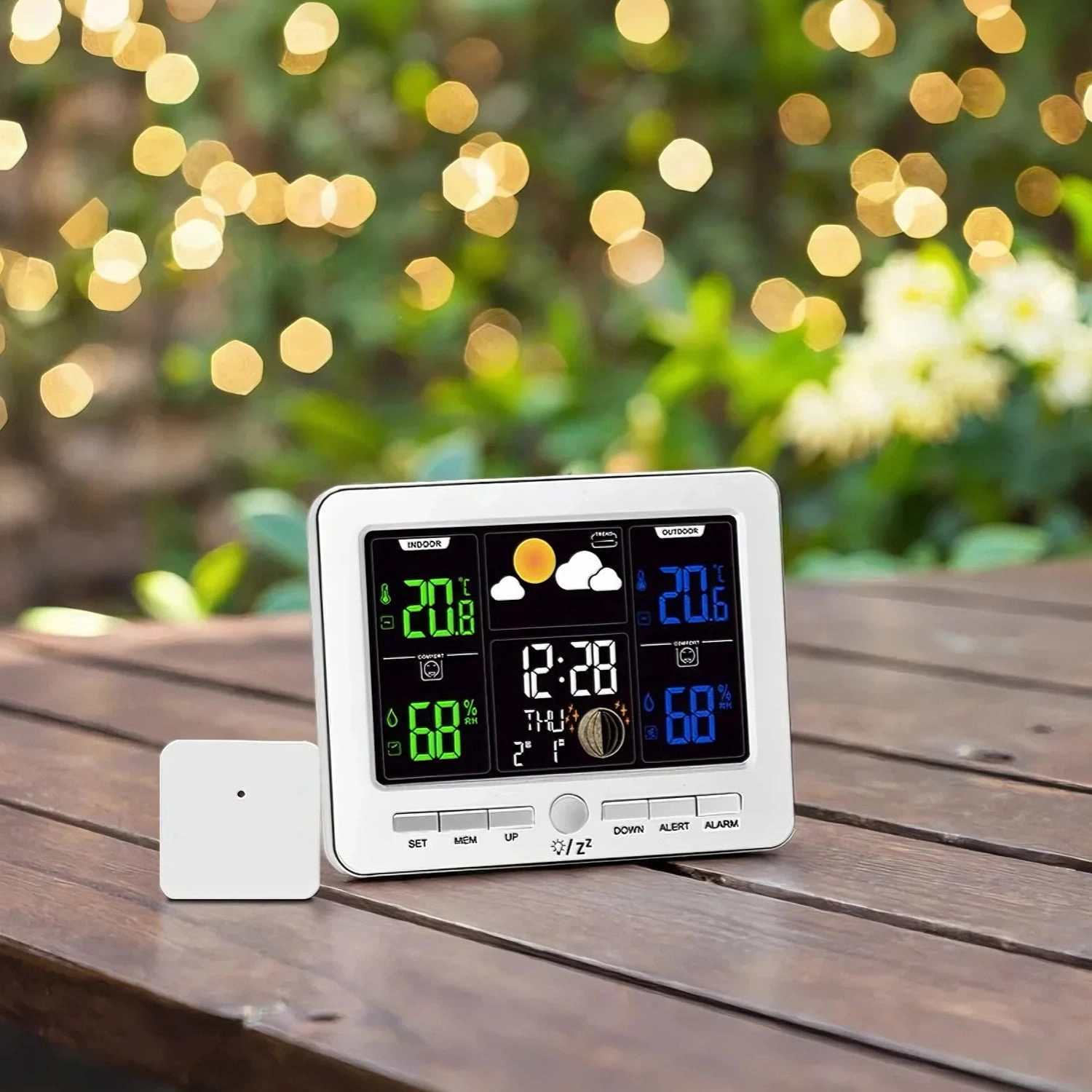
Smart Digital Weather Clocks: Beyond Time, Your Environment Monitor
Case Studies: Successful Brands Using Private Label Timers
Classroom Digital Timers: Essential Tools for Teachers and Education Brands
Top 10 digital alarm clock Manufacturers and Supplier Brands
Digital Timers
Can the timer’s packaging be customized?
Yes—we offer full packaging customization as part of our comprehensive branding services. As a direct manufacturer, we support customization of packaging materials, colors, dimensions, and branding elements (e.g., logos, slogans, or instructional graphics). Share your packaging preferences (e.g., eco-friendly materials, specific color schemes), and our in-house design team will align the packaging with your brand identity. This ensures your product arrives in packaging that reinforces your market presence—from retail shelves to wholesale distribution.
About customization
What is the R&D process?
Custom Development Process:
① Client Requests → Preliminary Quotation → Client Pays Prototyping Fee
② Product Appearance Design & Functional Design
③ Client Confirmation → Prototyping → Mold Tooling Fee Payment
④ Mold Tooling → Pre-Production Sample Confirmation
⑤ Order Confirmation → Mass Production ⑥ Product Inspection → Shipment
Indoor Thermometer
Do you support private label branding?
A: Absolutely. We support private labeling, including logo printing on the product, customized packaging, and branded manuals.
Can you develop exclusive models for our brand?
A: Yes, we can develop exclusive designs, molds, and features to help you build differentiated products in your market.
About product
What products do you mainly deal in?
We are a professional manufacturer of digital timers,alarm clocks,and digital temperature/humidity meters.
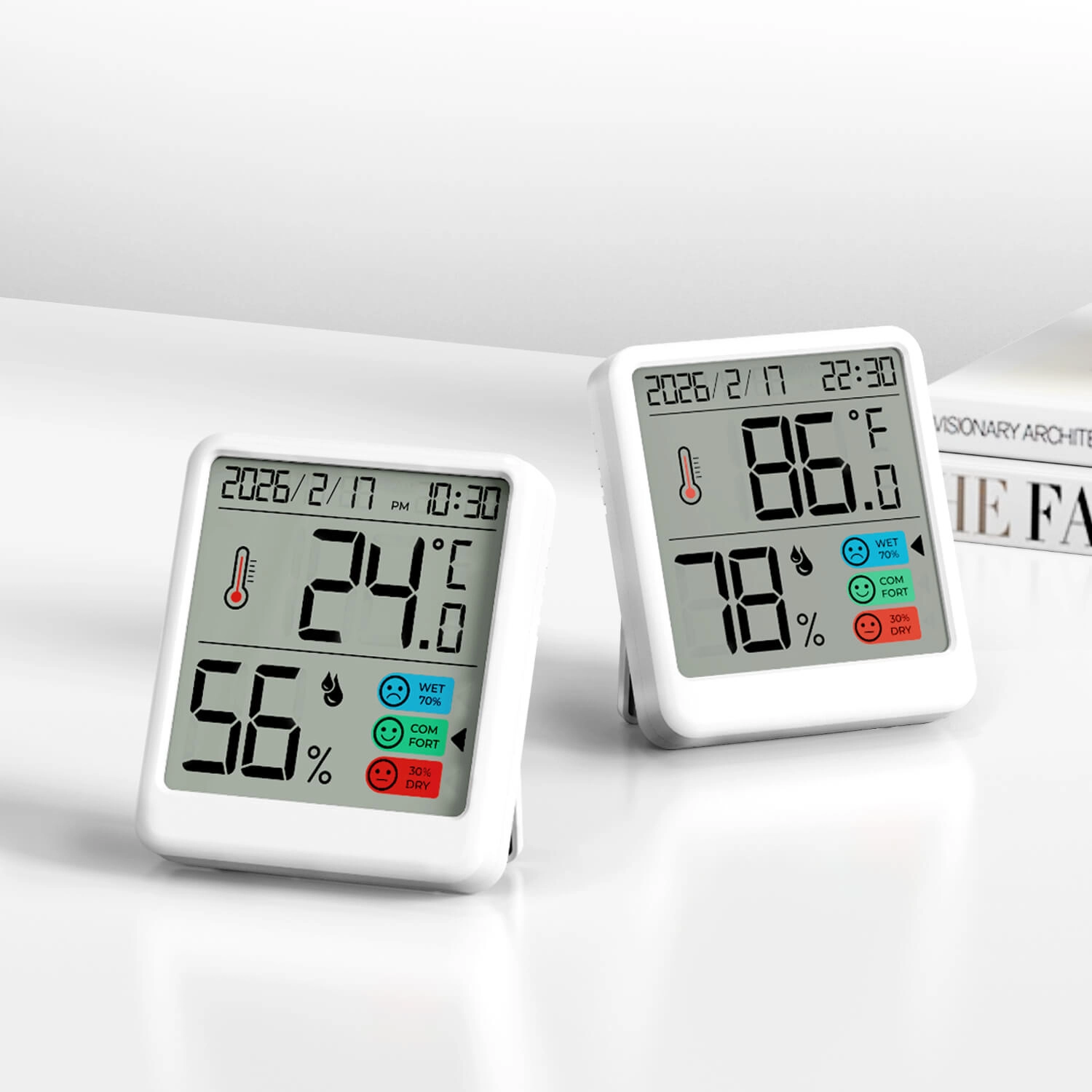
Digital Indoor Thermometer Hygrometer Temperature Humidity Monitor With Calendar Clock
The X-WSDJ312 Indoor Thermometer Hygrometer is a compact and multifunctional temperature and humidity monitor designed for home and office environments. It features a clear LCD screen displaying temperature, humidity, time, calendar, and comfort level at a glance.
Equipped with a high-sensitivity sensor, the device provides accurate real-time environmental monitoring to help maintain a comfortable indoor climate. The thermometer hygrometer supports 12/24-hour time format and ℃/℉ switching, making it convenient for global users.
Designed for flexible placement, it comes with a foldable desktop stand, magnetic back, and wall hanging hole, allowing installation on desks, refrigerators, or walls.
Powered by one AAA battery, the device operates with low power consumption and is ideal for homes, offices, greenhouses, classrooms, and storage environments.
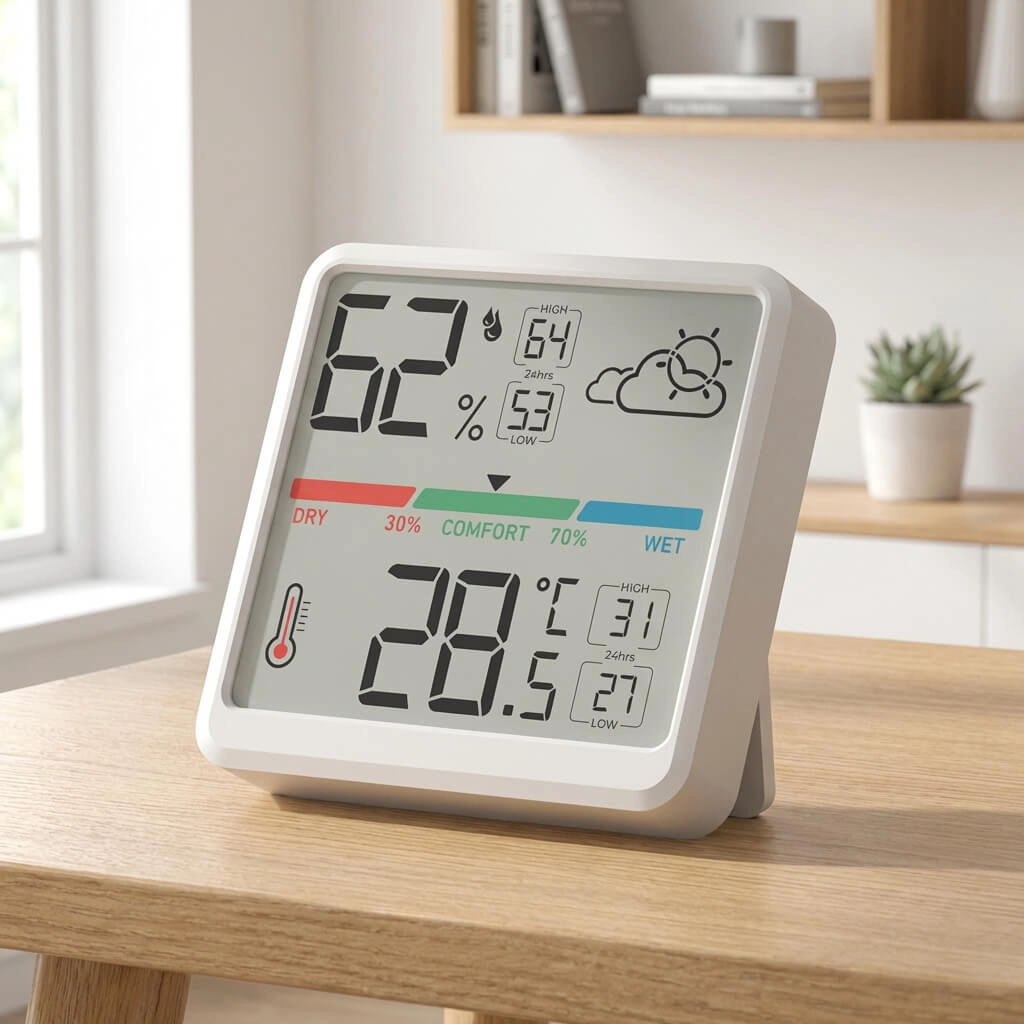
Digital Indoor Thermometer Hygrometer LCD Temperature Humidity Monitor
The Digital Indoor Thermometer Hygrometer is designed for accurate and reliable monitoring of indoor temperature and humidity. Featuring a clear LCD display, it provides real-time readings along with 24-hour maximum and minimum records for both temperature and humidity. The built-in comfort indicator clearly shows dry, comfortable, or humid conditions, helping users maintain a healthier indoor environment.
With a temperature measurement range from -20°C to 60°C (-4°F to 140°F) and humidity range from 10%RH to 99%RH, this device ensures consistent performance with high accuracy. The sensor updates every 10 seconds for real-time monitoring, while manual reset and unit switching (°C/°F) offer added convenience. Compact and versatile, it includes a foldable stand and magnetic back for flexible placement in homes, kitchens, offices, or warehouses.
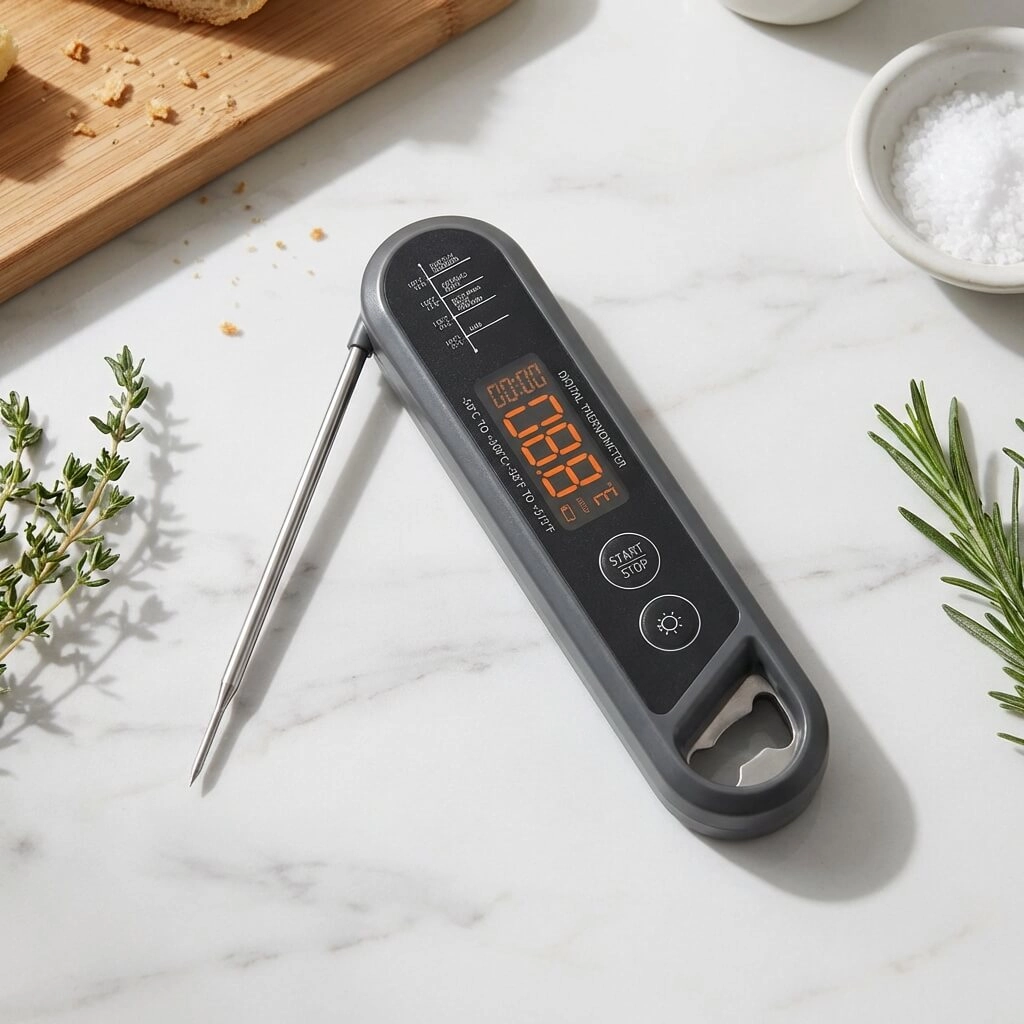
Instant Read Digital Meat Thermometer Food Thermometers With Count Up Timer Grill Oven
X-SPWDJ315-1 is a professional digital meat thermometer designed for B2B buyers such as e-commerce sellers, wholesalers, and OEM clients. Its foldable stainless steel probe ensures safe and compact storage while measuring temperatures from -50°C to 300°C with ±0.1°C accuracy. The thermometer features an integrated countdown timer (up to 59:59) and START/STOP control for precise cooking. An ergonomic handle with a built-in bottle opener adds multifunctional convenience. Powered by a single CR2450 battery, it is ideal for grilling, baking, restaurant kitchens, catering, and bulk supply, providing reliable performance and customization options for commercial customers.
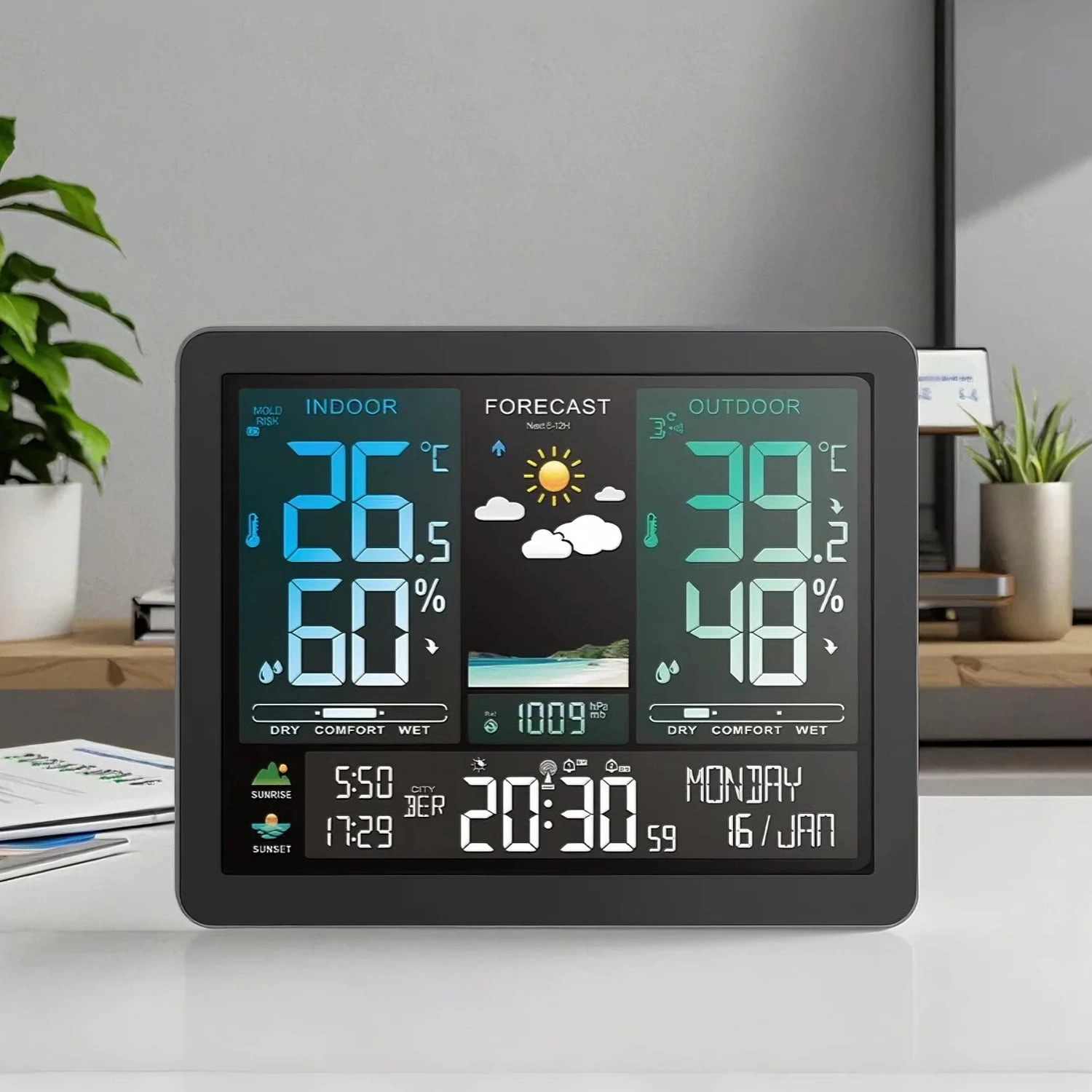
Custom USB Powered Daylight Savings Desktop Wall Alarm Clock Indoor and Outdoor Sensor Calendar Weather Thermometer Hygrometer Barometer
The X-WSDJ012 Smart Digital LED Alarm Clock is a multi-functional home device combining timekeeping with environmental monitoring.
It features a large LED display for time (12/24H), week, and date and integrates indoor/outdoor sensors to track temperature, humidity, atmospheric pressure, and weather trends.
Powered by USB (for a bright, always-on display) or batteries, it includes a waterproof outdoor sensor and offers customizable alarms, backlight control, and 8 language options.
Designed with a foldable stand or hanging hole, it fits desks, walls, or nightstands—ideal for home, garden, or office use.

Youben life
Youben life