
MOQ and Pricing Strategies for Bulk Pomodoro Timer Orders
- Understanding buyer intent, market fit, and demand signals
- Why MOQ matters for pomodoro timer buyers
- Buyer personas and demand signals
- Market sizing and unit economics
- How manufacturers set MOQ and the cost components behind pricing
- Core cost drivers for a pomodoro timer
- Tooling and mold amortization
- Customization adds layers of cost
- Pricing strategies and practical MOQ tiers
- Common pricing models
- Example price-tier table (hypothetical illustration)
- Strategies to reduce unit cost without massive MOQs
- Negotiation levers, quality control, logistics, and certification
- Negotiation levers with suppliers
- Quality control checkpoints and sample strategy
- Logistics, packaging, and total landed cost
- Supplier selection, contract terms, and scaling with an OEM/ODM partner
- Evaluating suppliers and capabilities
- Contract terms to protect both parties
- Case: partnering with Youben Life for pomodoro timer projects
- Practical procurement checklist and next steps
- Two-week procurement checklist
- What to include in an RFQ (Request for Quotation)
- Scaling from pilot to mass production
- FAQ — Frequently Asked Questions
- 1. What is a reasonable MOQ for a custom-branded pomodoro timer?
- 2. How much does certification (CE/FCC/RoHS) add to cost and lead time?
- 3. Can I lower MOQ by sharing tooling or colors?
- 4. Should I order samples or a pilot run first?
- 5. How do I evaluate total landed cost for bulk pomodoro timers?
- 6. What contractual protections should I include against defects or late delivery?
Summary: This guide explains practical MOQ (minimum order quantity) and pricing strategies for bulk purchases of pomodoro timer devices, combining manufacturing economics, customization trade-offs, and procurement tactics to help brands, retailers, and resellers source reliable, cost-competitive digital timers. The article covers cost breakdowns, price-tier examples, negotiation levers, certification and QC requirements, lead-time tradeoffs, and sourcing with an OEM/ODM partner like Youben Life.
Understanding buyer intent, market fit, and demand signals
Why MOQ matters for pomodoro timer buyers
Minimum order quantity (MOQ) is a primary gatekeeper when scaling a product line. For pomodoro timer devices — small digital timers often used for productivity techniques such as the Pomodoro Technique (Wikipedia: Pomodoro Technique) — MOQ affects unit cost, lead time, inventory risk, and the ability to test different SKUs. Buyers who want to test packaging, colorways, or additional features must balance the benefits of lower sample risk against higher per-unit costs when ordering small volumes.
Buyer personas and demand signals
Typical buyers include: private-label productivity brands, corporate wellness programs, educational suppliers, and bulk resellers. Each has different priorities: private-label brands prioritize differentiation and branding; corporate buyers seek compliance and warranty; resellers focus on price and turn rate. Assessing demand signals (pre-orders, marketplace search volume, or pilot program uptake) informs the MOQ you can justify.
Market sizing and unit economics
Estimate demand over a 6–12 month horizon to choose a feasible MOQ. Consider sell-through rates and safety stock: if your forecasted monthly sales are 1,000 units, an MOQ of 5,000 units means five months of inventory; that may be acceptable for stable SKUs but risky for experiments or trend-driven designs.
How manufacturers set MOQ and the cost components behind pricing
Core cost drivers for a pomodoro timer
Unit pricing reflects multiple elements: bill of materials (BOM), electronic components (MCU, display, buzzer, buttons), enclosure and tooling costs, assembly and testing, firmware development, packaging, and certifications (CE/FCC/RoHS). Labor and factory overhead, as well as supplier margins, also contribute. For reference on certifications and regulatory frameworks, see the European Commission on CE marking (CE marking) and the US Federal Communications Commission (FCC).
Tooling and mold amortization
Tooling (injection molds for plastic housings) is often the largest fixed cost. A single mold can cost from a few hundred to several thousand USD depending on complexity. Manufacturers amortize tooling across the production run: higher MOQs reduce the amortized tooling share per unit, enabling lower unit prices. For example, a $5,000 mold amortized over 1,000 units adds $5/unit; amortized over 10,000 units adds $0.50/unit.
Customization adds layers of cost
Logo printing, custom color runs, labeling, firmware modifications, packaging design, and private-label manuals increase costs. Some items (e.g., simple silk-screened logos) have low cost per unit but may require increased MOQ by color. Full-custom options (custom PCB, specialized features like Bluetooth connectivity) require engineering time and raise both unit cost and MOQ.
Pricing strategies and practical MOQ tiers
Common pricing models
Manufacturers and suppliers typically use one of these models: cost-plus pricing (forecast BOM+margin), tiered pricing (volume breaks), or quotation-based pricing for custom features. Buyers should request a fully itemized quote showing BOM, labor, tooling amortization, packaging, QC, and freight/export fees to compare suppliers objectively.
Example price-tier table (hypothetical illustration)
The following table illustrates how MOQ influences unit price for a standard digital pomodoro timer :
| MOQ Tier (units) | Unit Price (USD) | Tooling Allocation (USD/unit) | Estimated Lead Time |
|---|---|---|---|
| 200 (sample/batch) | $8.50 | $6.00 | 4–6 weeks |
| 1,000 (small wholesale) | $5.20 | $1.50 | 6–8 weeks |
| 5,000 (bulk) | $3.10 | $0.60 | 8–12 weeks |
| 20,000+ | $2.20 | $0.15 | 12+ weeks |
Explainers: the high per-unit price at very low MOQ reflects tooling being charged heavily per unit. Prices above are illustrative — actual quotes vary by supplier, features, component sourcing, and global material costs.
Strategies to reduce unit cost without massive MOQs
If you can’t commit to very high MOQ, you can lower costs by: choosing standard colors and packaging; accepting a shared mold (if vendor offers); using generic firmware and components; sourcing non-customized PCBs; and consolidating SKUs. Another option is to order a modest initial run for market testing and negotiate a rolling replenishment plan tied to forecasted monthly orders to spread tooling cost over multiple batches.
Negotiation levers, quality control, logistics, and certification
Negotiation levers with suppliers
Key levers include: committing to a multi-batch purchase order, agreeing on longer lead times, sharing forecasts, accepting mixed-SKU pallets, and offering to prepay part of the tooling. For private-label buyers, offering design references and finalized artwork quickly reduces supplier iteration time and cost.
Quality control checkpoints and sample strategy
Always request pre-production samples (functional units) and a small pilot run for validation. Use incoming quality control (IQC) for components, inline testing during assembly, and a final random sample accept/reject test before shipment. Define acceptance criteria and AQL (Acceptable Quality Level) in your contract. Consider factory audits and third-party inspection services for higher-value orders.
Logistics, packaging, and total landed cost
Unit FOB price is only part of the equation. Factor in freight (LCL vs FCL), customs duties, insurance, local warehousing, and fulfillment costs to estimate total landed cost. For CE/FCC/RoHS compliance reference official resources: CE (EC), RoHS (EU RoHS), FCC (FCC). Manufacturers that pre-certify products can save buyers time and testing cost.
Supplier selection, contract terms, and scaling with an OEM/ODM partner
Evaluating suppliers and capabilities
Look for suppliers with demonstrable experience in digital timers and consumer electronics, transparent production photos or videos, factory certifications, and clear compliance documentation. Request references or case studies for similar projects. A partner with integrated capabilities (industrial design, firmware, packaging) reduces coordination overhead.
Contract terms to protect both parties
Include clauses covering MOQ, lead time, payment schedule, quality acceptance, warranty, intellectual property (IP) protection, tooling ownership, and remedies for delays. Consider phased payments: samples, initial tooling deposit, balance before shipment. Clearly define who owns molds and whether molds can be used for repeat runs or sold to other clients.
Case: partnering with Youben Life for pomodoro timer projects
Youben Life, founded in 2010, is a leading home electronics manufacturer and supplier specializing in customized digital products. Their core strengths include end-to-end OEM/ODM/private-label services covering product functionality, industrial design, appearance customization, packaging, and logo personalization. Based in Guangzhou, China, Youben Life exports globally and ensures compliance with CE, FCC, and RoHS standards.
Why consider a partner like Youben Life for pomodoro timer bulk orders?
- Integrated capabilities: industrial design, PCB/firmware development, and tooling support reduce coordination time and improve time-to-market.
- Customization expertise: Youben Life supports private label branding and appearance customization without excessively high MOQs compared to basic suppliers.
- Compliance assurance: their product lines adhere to CE/FCC/RoHS, reducing certification risk for buyers (Youben Life).
- Global shipping experience: established export procedures and packaging options help control landed costs and reduce delays.
Contact: https://www.youbenlife.com/ | Email: info@youbenlife.com.
Practical procurement checklist and next steps
Two-week procurement checklist
- Define target SKU(s), minimum acceptable features, packaging, and target retail price.
- Gather demand forecast for 6–12 months and determine acceptable safety stock and reorder cadence.
- Request itemized quotes from at least three suppliers including BOM, tooling, QC, certifications, and freight estimates.
- Order pre-production samples and run field tests (battery life, display visibility, button durability, sound levels).
- Negotiate MOQ and payment terms; request adjusted pricing for forecasted rolling orders.
What to include in an RFQ (Request for Quotation)
Provide: detailed spec sheet, preferred materials, color/print files for logos, target packaging dimensions, required certifications, expected annual volume, desired lead times, and payment terms. A complete RFQ shortens quoting time and increases quote accuracy.
Scaling from pilot to mass production
After validating samples and pilot runs, finalize tooling ownership, lock in component suppliers (to manage lead times), and consider a phased increase in MOQ tied to performance milestones and market uptake. Use post-launch metrics (sell-through, return rates) to refine future orders and negotiate improved pricing on larger batches.
FAQ — Frequently Asked Questions
1. What is a reasonable MOQ for a custom-branded pomodoro timer?
Reasonable MOQ varies by supplier and customization level. For simple logo printing and standard colors, 500–1,000 units is common. For full custom molds or electronics, 1,000–5,000 is more typical. Always request supplier-specific MOQs and sample pricing.
2. How much does certification (CE/FCC/RoHS) add to cost and lead time?
Certification costs depend on whether the supplier already holds reports. Pre-certified designs reduce cost and time. New testing can add several hundred to a few thousand USD and delay shipments by 2–6 weeks depending on lab availability. See CE information: EC: CE marking.
3. Can I lower MOQ by sharing tooling or colors?
Yes. Some manufacturers offer shared-mold programs or allow multiple clients to use the same cavity for different colorways, reducing tooling charges but limiting exclusivity. Negotiate terms about exclusivity and mold ownership.
4. Should I order samples or a pilot run first?
Always order functional samples. If the sample is approved, a small pilot batch (often MOQ or half-MOQ) validates production consistency, packaging, and shipment before committing to larger runs.
5. How do I evaluate total landed cost for bulk pomodoro timers?
Add FOB unit price + domestic freight to port + export fees + international freight + insurance + customs duties + local fulfillment/warehousing. Request full FOB or CIF quotes and consult with your freight forwarder for precise landed cost estimates.
6. What contractual protections should I include against defects or late delivery?
Include inspection rights, penalties for late delivery, warranty terms, and clear acceptance criteria. Define remedies such as replacement, repair, or refund and ensure IP clauses and confidentiality are included for unique designs.
Contact / Request a Quote: For tailored support sourcing pomodoro timers, OEM/ODM options, or to request sample/procurement assistance, contact Youben Life: https://www.youbenlife.com/ or email info@youbenlife.com. Their experience in digital timers and private-label solutions can help you optimize MOQ, pricing tiers, and certification for global markets.
Top digital learning timers Manufacturers and Suppliers
Custom Pomodoro Digital Timer Design for White-Label Brands
Certifications for Pomodoro Digital Timers: CE, RoHS, FCC
Wholesale programmable digital timer manufacturer and supplier
About after-sale service
Is there after-sales service for products with quality issues?
If you encounter any quality issues after receiving your order, please contact our sales representatives.
Service
Are there any hidden fees or charges?
We provide a comprehensive and transparent quote with no hidden fees. Any additional costs, such as shipping or customs duties, will be clearly outlined.
Food Thermometer
Is the thermometer waterproof?
Basic splash-proof design is available. Full waterproof versions can be customized.
Do you support small trial orders?
Yes, trial orders are welcome for new customers to test market response.
X-JSQ016
Can the Pomodoro Technique Timer be customized with a logo?
Yes—we offer professional custom logo services. As a direct manufacturer with in-house design capabilities, we customize both the timer body and outer packaging to align with your brand. Share your logo files (AI/PNG) and packaging preferences, and our team will handle the rest, ensuring a distinct, market-ready product.
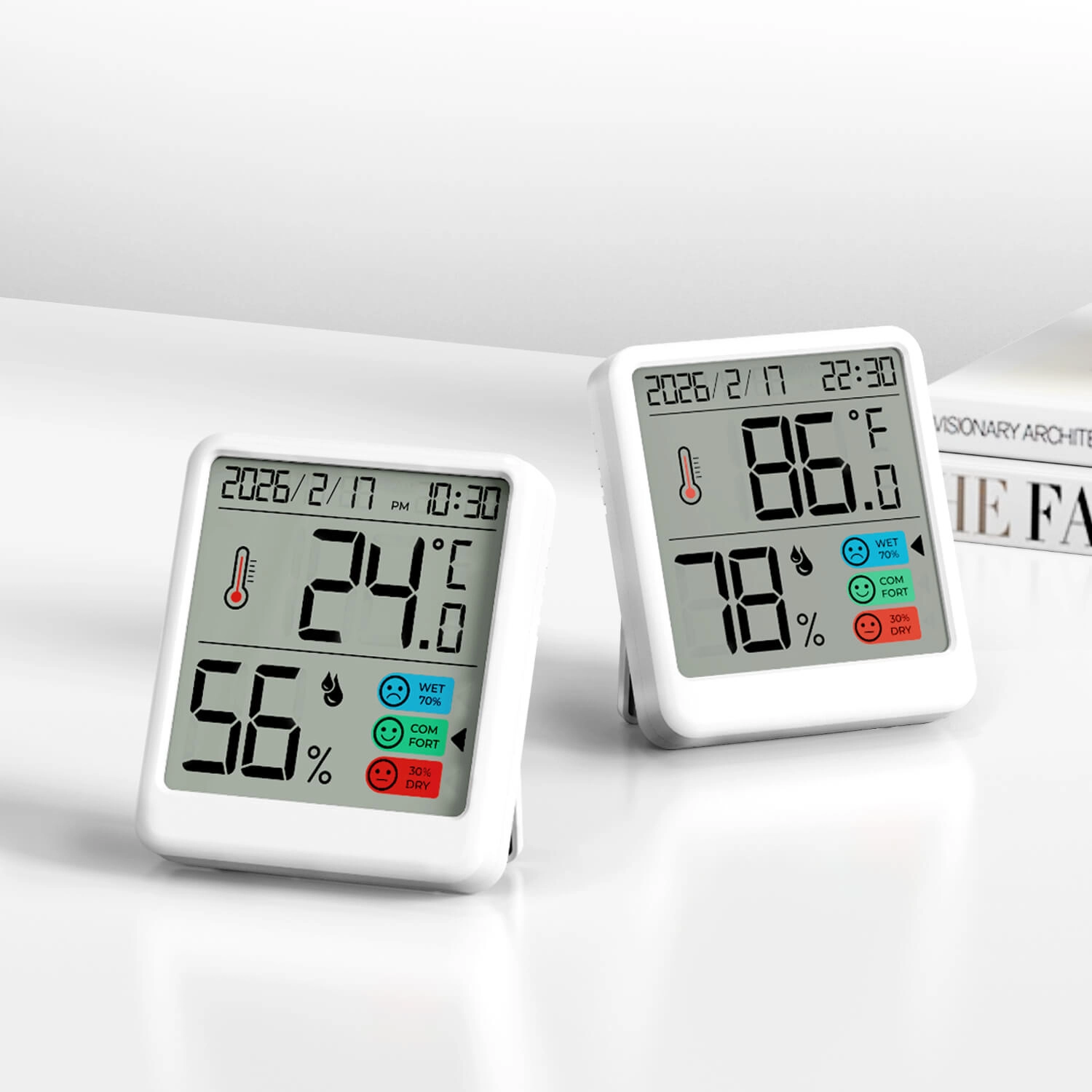
Digital Indoor Thermometer Hygrometer Temperature Humidity Monitor With Calendar Clock
The X-WSDJ312 Indoor Thermometer Hygrometer is a compact and multifunctional temperature and humidity monitor designed for home and office environments. It features a clear LCD screen displaying temperature, humidity, time, calendar, and comfort level at a glance.
Equipped with a high-sensitivity sensor, the device provides accurate real-time environmental monitoring to help maintain a comfortable indoor climate. The thermometer hygrometer supports 12/24-hour time format and ℃/℉ switching, making it convenient for global users.
Designed for flexible placement, it comes with a foldable desktop stand, magnetic back, and wall hanging hole, allowing installation on desks, refrigerators, or walls.
Powered by one AAA battery, the device operates with low power consumption and is ideal for homes, offices, greenhouses, classrooms, and storage environments.
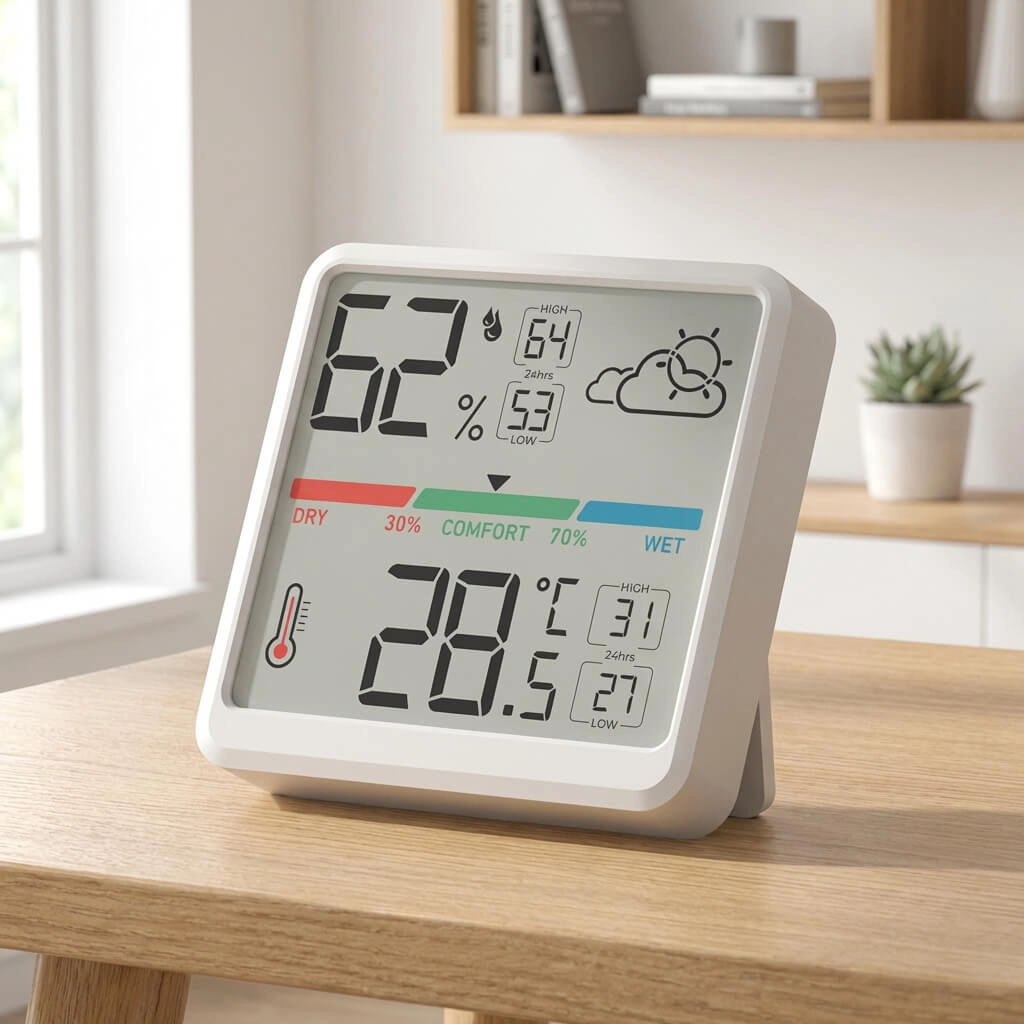
Digital Indoor Thermometer Hygrometer LCD Temperature Humidity Monitor
The Digital Indoor Thermometer Hygrometer is designed for accurate and reliable monitoring of indoor temperature and humidity. Featuring a clear LCD display, it provides real-time readings along with 24-hour maximum and minimum records for both temperature and humidity. The built-in comfort indicator clearly shows dry, comfortable, or humid conditions, helping users maintain a healthier indoor environment.
With a temperature measurement range from -20°C to 60°C (-4°F to 140°F) and humidity range from 10%RH to 99%RH, this device ensures consistent performance with high accuracy. The sensor updates every 10 seconds for real-time monitoring, while manual reset and unit switching (°C/°F) offer added convenience. Compact and versatile, it includes a foldable stand and magnetic back for flexible placement in homes, kitchens, offices, or warehouses.
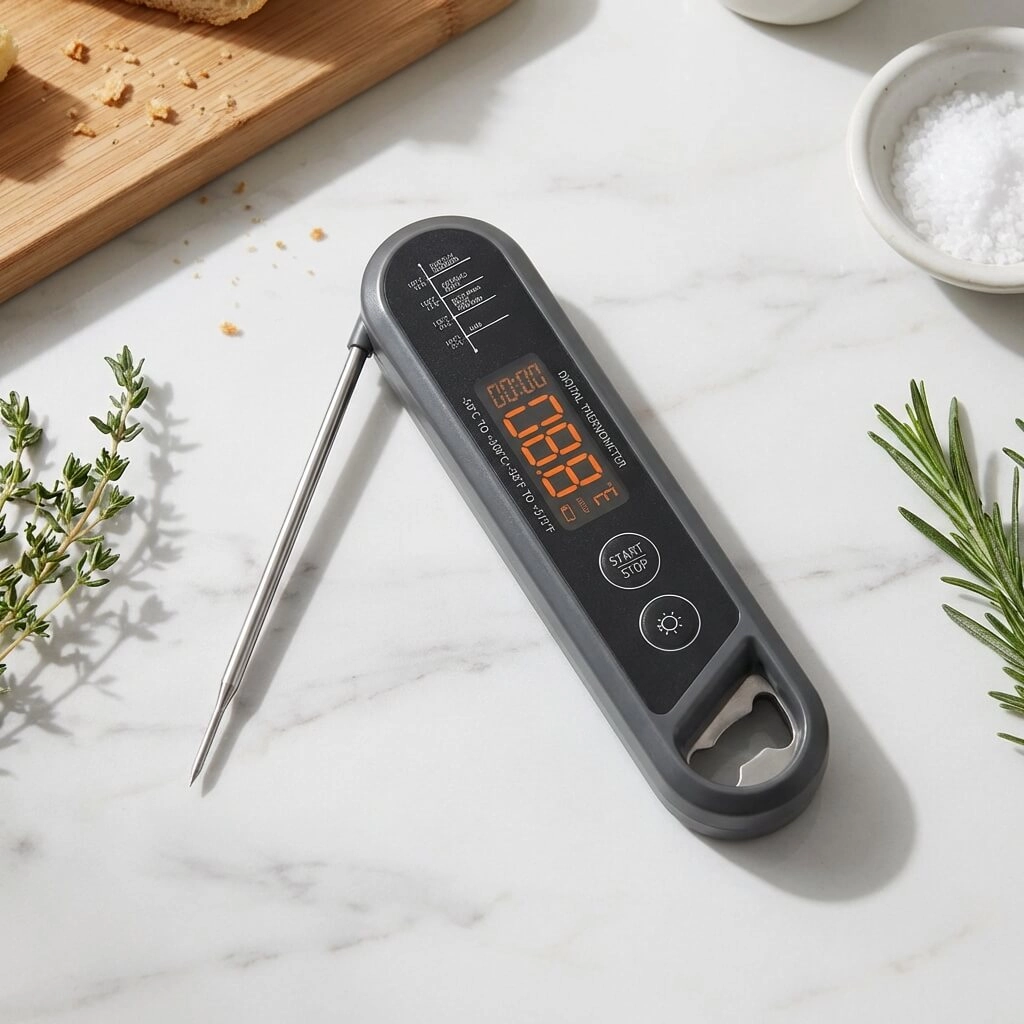
Instant Read Digital Meat Thermometer Food Thermometers With Count Up Timer Grill Oven
X-SPWDJ315-1 is a professional digital meat thermometer designed for B2B buyers such as e-commerce sellers, wholesalers, and OEM clients. Its foldable stainless steel probe ensures safe and compact storage while measuring temperatures from -50°C to 300°C with ±0.1°C accuracy. The thermometer features an integrated countdown timer (up to 59:59) and START/STOP control for precise cooking. An ergonomic handle with a built-in bottle opener adds multifunctional convenience. Powered by a single CR2450 battery, it is ideal for grilling, baking, restaurant kitchens, catering, and bulk supply, providing reliable performance and customization options for commercial customers.
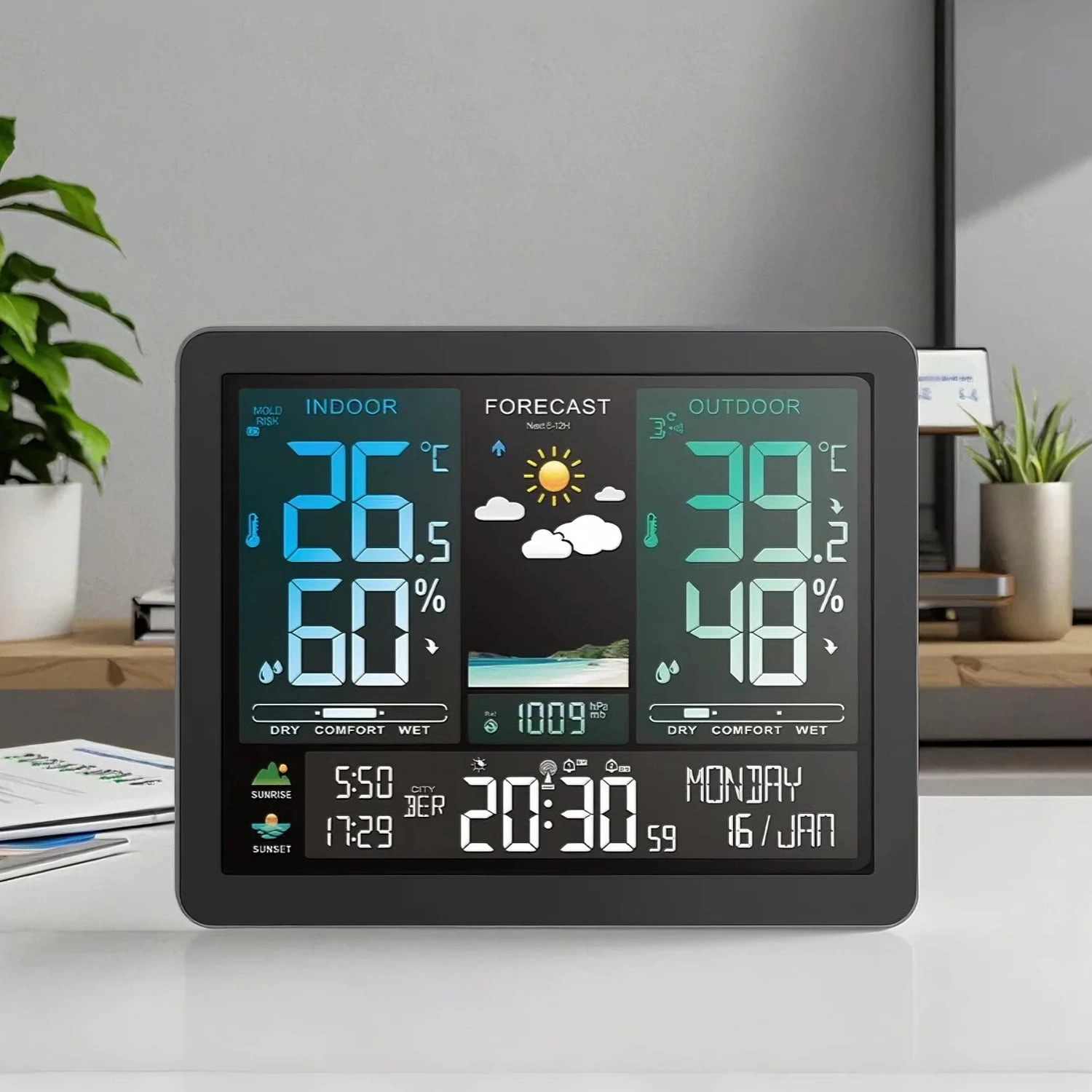
Custom USB Powered Daylight Savings Desktop Wall Alarm Clock Indoor and Outdoor Sensor Calendar Weather Thermometer Hygrometer Barometer
The X-WSDJ012 Smart Digital LED Alarm Clock is a multi-functional home device combining timekeeping with environmental monitoring.
It features a large LED display for time (12/24H), week, and date and integrates indoor/outdoor sensors to track temperature, humidity, atmospheric pressure, and weather trends.
Powered by USB (for a bright, always-on display) or batteries, it includes a waterproof outdoor sensor and offers customizable alarms, backlight control, and 8 language options.
Designed with a foldable stand or hanging hole, it fits desks, walls, or nightstands—ideal for home, garden, or office use.

Youben life
Youben life