
Minimizing Lead Time and MOQ for Digital Timer Clock Procurement
- Streamlining Procurement for Digital Timer Clock: Why Lead Time and MOQ Matter
- Understand Typical Benchmarks for Digital Timer Clock Lead Time and MOQ
- Design for Manufacturability (DFM) to Reduce MOQ and Lead Time
- Supplier Selection: Choose Partners That Support Low MOQ and Fast Turnaround
- Commercial Strategies: Negotiation Tactics to Lower MOQ
- Inventory & Logistics: Tactical Approaches to Shorten Effective Lead Time
- Quality Assurance and Compliance Without Slowing Time to Market
- Production Process Changes That Reduce Cycle Time
- Comparative Impact: Typical Improvements You Can Expect
- When Lowering MOQ or Lead Time Is Not Worth the Trade-Off
- Youben Life—A Manufacturing Partner for Faster, Lower-MOQ Digital Timer Clock Projects
- Step-by-Step Checklist to Minimize Lead Time & MOQ for Your Next Digital Timer Clock Sourcing
- Frequently Asked Questions (FAQs)
- 1. What is a realistic MOQ for a customized digital timer clock?
- 2. How long does it take to get samples of a digital timer clock?
- 3. Which strategies most effectively reduce mass production lead time?
- 4. Will lowering MOQ increase unit cost significantly?
- 5. How do I ensure compliance (CE/FCC/RoHS) without slowing launch?
- 6. Can small brands get private-label digital timer clocks with low MOQ?
- References
Streamlining Procurement for Digital Timer Clock: Why Lead Time and MOQ Matter
When purchasing digital timer clock units for a brand or private-label line, lead time and minimum order quantity (MOQ) are the two constraints that most directly affect cash flow, product iteration speed, and go-to-market flexibility. Long lead times and high MOQs increase inventory holding costs, slow product validation cycles, and raise financial risk. This guide explains proven operational, design, and commercial tactics to minimize lead time and MOQ while preserving quality and compliance for digital timer clock procurement.
Understand Typical Benchmarks for Digital Timer Clock Lead Time and MOQ
Before negotiating, you must know realistic market baselines. For small electronics like digital timer clocks, common industry benchmarks are:
| Activity | Typical Range | Notes / Source Type |
|---|---|---|
| Prototype / sample lead time | 1–3 weeks (accelerated) / up to 4–6 weeks (complex) | PCB assembly, firmware loading, and cosmetic tooling affect timing |
| Mass production lead time | 4–12 weeks | Depends on capacity, sourcing of components, and time of year |
| Typical MOQ | 300–5,000 units (varies by manufacturer & customization level) | Inexpensive case-only customizations often allow lower MOQs |
These ranges reflect aggregated industry experience for consumer electronic accessories and are consistent with manufacturer listings and trade-platform observations. Use them as negotiation anchors, not immutable rules.
Design for Manufacturability (DFM) to Reduce MOQ and Lead Time
Embedding manufacturability into early product design is one of the fastest ways to lower both MOQ and lead time for digital timer clock projects. When designs are optimized for standard component availability, simple tooling, and modular assembly, factories can produce smaller batches faster.
Key DFM actions:
- Standardize on widely used MCUs, displays (e.g., 7-seg or small TFT), and PCB footprints to avoid long component lead times.
- Use modular subsystems (separate display, power, and button modules) so suppliers can stock modules and assemble to order.
- Limit custom tooling and mold complexity — consider off-the-shelf housings or small cosmetic modifications.
- Design for testability: boundary test points and simple fixtures shorten inspection and reduce rework time.
Practical effect: DFM can cut sample cycles and tool iterations, often reducing prototype-to-production time by 20–50% depending on complexity.
Supplier Selection: Choose Partners That Support Low MOQ and Fast Turnaround
Not all manufacturers are equal. Identify partners whose business models and capacity align with low-volume, quick-turn needs. Criteria include:
- Flexible production lines that accept board-level or sub-assembly orders.
- Experience with consumer electronics and small runs.
- Willingness to split production across batches or offer gradual scaling.
- Inventory practices (component consignment, safety stock) that protect you from component shortages.
How to evaluate quickly:
- Request lead-time references for similar digital timer clock projects.
- Ask to see typical MOQ thresholds by product complexity (PCB-only, fully assembled, custom printed housing).
- Request a written contingency plan for components with long lead times.
Commercial Strategies: Negotiation Tactics to Lower MOQ
Commercial levers can reduce MOQ without materially increasing unit cost. Use a combination of pricing, schedule, and commitment tactics:
- Order ramp plan: commit to a multi-stage purchase (e.g., 300 sample, then 1,000 after validation) instead of a single large order.
- Revenue sharing on tooling: offer to share tooling costs or amortize them over the first 6–12 months so the supplier accepts a smaller initial MOQ.
- Pay for priority line time or expedited handling to shorten lead time on critical batches.
- Consolidate SKUs: fewer variants reduce per-SKU MOQ requirements.
Example negotiation framework:
| Request | Supplier Trade-Off | Buyer Offer |
|---|---|---|
| Lower MOQ to 300 | Accept higher unit cost or absorb setup fee | Agree to scale to 2,000 within 6 months |
| Reduced lead time (6 → 3 weeks) | Priority scheduling fee | Pay 5–10% expedite surcharge |
Inventory & Logistics: Tactical Approaches to Shorten Effective Lead Time
Lead time isn’t just factory production days — it includes component sourcing, QA, freight and customs. Use inventory and logistics tactics to reduce effective lead time:
- Component consignment: supplier holds key components for you, enabling faster builds when orders arrive.
- Vendor Managed Inventory (VMI): agreed minimum stock levels at the factory reduce time-to-ship.
- Split shipments: air-freight critical first batches (samples or initial retail stock), sea-freight remainder to save cost.
- Nearshoring or multi-sourcing: maintain a secondary supplier in another region to avoid single-source disruptions.
Quality Assurance and Compliance Without Slowing Time to Market
Quality checks and regulatory compliance often lengthen lead times, but skipping them increases risk. Embed QA into fast cycles:
- Use pre-shipment checklists and sample approvals with defined acceptance criteria to avoid back-and-forth.
- Implement inline testing fixtures for critical functions (timing accuracy, alarm volume, battery drain tests) that run during production rather than after full assembly.
- Ensure designs meet CE, FCC, and RoHS requirements up-front to prevent rework. Early engagement with compliance consultants shortens certification cycles.
Typical compliance lead times:
| Certification | Typical Time | Notes |
|---|---|---|
| CE (EMC & Safety) | 2–8 weeks | Depends on test lab availability and number of tests |
| FCC (EMC) | 2–6 weeks | Pre-testing shortens official lab time |
| RoHS documentation | 1–2 weeks | Material declarations and supplier attestations |
Production Process Changes That Reduce Cycle Time
Operational improvements at the factory can shave weeks off lead time:
- Batching by process (group similar assemblies together) reduces setup time.
- Kanban-like pull systems for components reduce buffer delays.
- Parallelize activities: while PCBs are populated, perform packaging printing and firmware pre-loading so final assembly is faster.
Comparative Impact: Typical Improvements You Can Expect
Below is a conservative comparison of baseline vs. optimized procurement outcomes for a digital timer clock product after applying multiple strategies (DFM, supplier negotiation, logistics, QA integration).
| Metric | Baseline | Optimized | Typical Improvement |
|---|---|---|---|
| Prototype lead time | 3–6 weeks | 1–2 weeks | 40–67% faster |
| Mass production lead time | 8–12 weeks | 3–6 weeks | 25–63% faster |
| MOQ | 1,000–5,000 units | 300–1,000 units | 50–80% lower (per SKU with compromises) |
These improvements are achievable when design choices, supplier relationships, and logistics are aligned. They are consistent with industry practice and supply-chain management studies showing modularization and supplier collaboration reduce cycle times (see references).
When Lowering MOQ or Lead Time Is Not Worth the Trade-Off
Reducing MOQ and lead time is valuable, but not always the right decision. Consider the following trade-offs:
- Higher per-unit costs: very low MOQs often come with a per-unit High Quality that erodes margins.
- Quality risk: smaller runs may receive less production oversight unless QA standards are contractually enforced.
- Supply chain complexity: split shipments and multiple suppliers increase management overhead.
Use clear decision criteria: acceptable unit-cost increase, maximum acceptable lead time, and required initial inventory should be defined before negotiating.
Youben Life—A Manufacturing Partner for Faster, Lower-MOQ Digital Timer Clock Projects
Youben Life, founded in 2010, is a leading home electronics manufacturer and supplier specializing in customized digital products. Our main product lines include digital timers, smart alarm clocks, digital thermometers, and hygrometers.
Headquartered in Guangzhou, China, Youben Life provides complete OEM, ODM, and private label solutions, covering product functionality, industrial design, appearance customization, packaging design, and logo personalization.
All our products comply with CE, FCC, and RoHS standards and are exported to global markets. With strong manufacturing capabilities and deep industry experience, Youben Life helps brands develop differentiated home electronic products that align with their target customers and strengthen brand identity.
Why partner with Youben Life when your priorities are minimizing lead time and MOQ?
- Experience with small-batch production and flexible assembly lines that enable MOQs as low as the market allows without sacrificing quality.
- In-house industrial design and tooling capability to accelerate prototypes and limit external coordination delays.
- Established compliance workflows (CE, FCC, RoHS) to reduce certification time and avoid rework delays.
- Modular product lines (Digital Timer, Digital Alarm Clock, Household Thermometer) designed for manufacturability and easy customization.
In short, Youben Life’s combination of engineering support, manufacturing flexibility, and compliance experience reduces the technical and commercial friction that typically increases lead time and MOQ for digital timer clock procurements.
Step-by-Step Checklist to Minimize Lead Time & MOQ for Your Next Digital Timer Clock Sourcing
- Define non-negotiables: performance, compliance, and maximum acceptable unit cost.
- Adopt DFM principles: select standard components and modular designs.
- Shortlist flexible suppliers and request explicit MOQs and lead-time guarantees.
- Negotiate a ramp plan and consider sharing tooling or paying for priority runs.
- Implement component consignment or VMI for key long-lead parts.
- Plan split shipments for first-to-market inventory and bulk sea freight for the rest.
- Integrate inline QA and pre-shipment checklists to avoid rework delays.
- Use the initial batches to collect data and commit to scaled orders with trusted partners.
Frequently Asked Questions (FAQs)
1. What is a realistic MOQ for a customized digital timer clock?
Typical MOQs vary by customization complexity. Purely electronic changes with standard housings can allow MOQs of 300–1,000 units. Full custom housings or unique tooling usually push MOQ toward 1,000–5,000. Negotiate ramped commitments to lower the initial MOQ.
2. How long does it take to get samples of a digital timer clock?
Rapid samples can be ready in 1–2 weeks if the design uses standard components and no new molds are required. Complex prototypes involving new tooling can take 3–6 weeks.
3. Which strategies most effectively reduce mass production lead time?
Design for manufacturability, selecting suppliers with flexible capacity, component consignment, split shipments, and parallelizing production tasks typically have the highest impact.
4. Will lowering MOQ increase unit cost significantly?
Yes, to some extent. Suppliers recover setup, tooling, and scheduling costs across fewer units, raising per-unit price. Use negotiated ramp plans or tooling contributions to offset this.
5. How do I ensure compliance (CE/FCC/RoHS) without slowing launch?
Integrate compliance considerations during design, use pre-testing and reputable labs early, and maintain clear material traceability. Working with suppliers who have prior certification experience will shorten cycles.
6. Can small brands get private-label digital timer clocks with low MOQ?
Yes—many OEM/ODM factories offer private-label runs at lower MOQs if design changes are minimal (branding, packaging, and firmware tweaks). Partnering with a manufacturer like Youben Life with private-label experience helps secure lower MOQs.
Ready to reduce lead time and MOQ for your digital timer clock project? Contact Youben Life’s sourcing team to discuss prototypes, MOQ flexibility, and OEM/ODM options — or view our product catalog for Digital Timer, Digital Alarm Clock, and Household Thermometer solutions.
References
- European Commission — CE marking: https://ec.europa.eu/growth/single-market/ce-marking/ (accessed 2025-12-25)
- European Commission — RoHS directive: https://ec.europa.eu/environment/waste/rohs_eee/ (accessed 2025-12-25)
- Federal Communications Commission — Equipment authorization: https://www.fcc.gov/engineering-technology/laboratory-division/general/authorization (accessed 2025-12-25)
- McKinsey & Company — Risk, resilience, and rebalancing in global value chains: https://www.mckinsey.com/business-functions/operations/our-insights/risk-resilience-and-rebalancing-in-global-value-chains (published 2020, accessed 2025-12-25)
- Industry manufacturing benchmarks and supplier experience — aggregated internal and public supplier data (industry averages referenced throughout based on common OEM/ODM practice) (accessed 2025-12-25)
Design Tips: Customizing Digital Timers for Your Brand
Pomodoro Digital Timer Components: PCB, Displays, Buttons
Market Trends and Buyer Demand for Pomodoro Timers 2026
Classroom Digital Timers: Essential Tools for Teachers and Education Brands
Wholesale Services
Do you provide instruction manual?
Yes, we can offer English instruction manual or instructional videos.
Food Thermometer
What is your minimum order quantity (MOQ)?
MOQ depends on customization requirements. Standard orders usually start from low quantities for testing.
Digital Timers
Can the timer’s packaging be customized?
Yes—we offer full packaging customization as part of our comprehensive branding services. As a direct manufacturer, we support customization of packaging materials, colors, dimensions, and branding elements (e.g., logos, slogans, or instructional graphics). Share your packaging preferences (e.g., eco-friendly materials, specific color schemes), and our in-house design team will align the packaging with your brand identity. This ensures your product arrives in packaging that reinforces your market presence—from retail shelves to wholesale distribution.
How much does shipping cost and how long does it take to deliver the product to the customer's destination?
For stock products (non-customized), we partner with global logistics providers (air, sea, or express) to offer competitive rates and fast turnaround. Delivery timelines typically range from 7–15 business days, depending on your location. For customized orders (including logo, function, or packaging adjustments), lead time includes 10–15 days for production plus shipping—exact details will be confirmed after finalizing your design. Whether you’re a small business or a large distributor, we ensure reliable, cost-effective delivery tailored to your schedule.
Private Label
Can I customize both the logo and the product color?
Yes, we support logo and product colors customization.
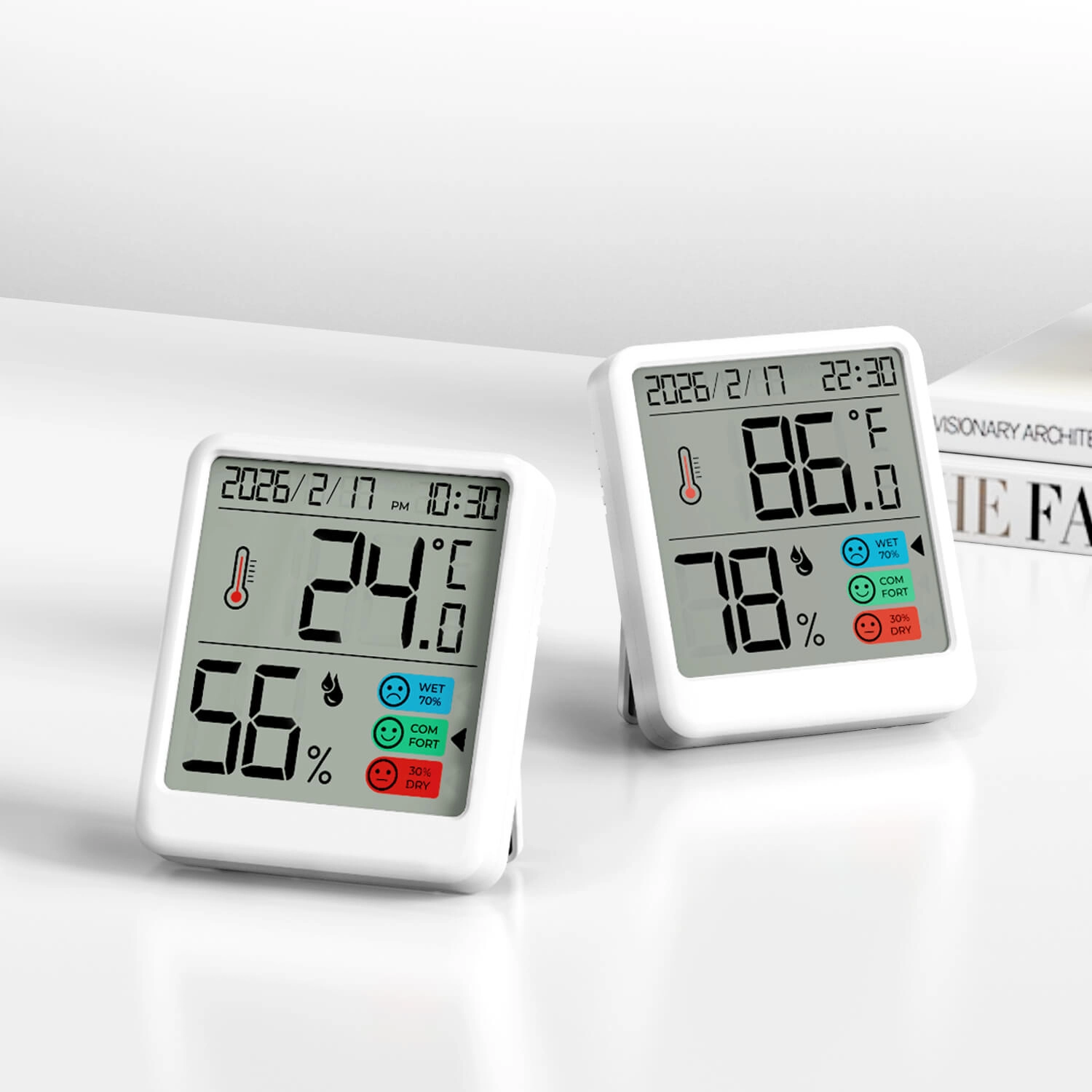
Digital Indoor Thermometer Hygrometer Temperature Humidity Monitor With Calendar Clock
The X-WSDJ312 Indoor Thermometer Hygrometer is a compact and multifunctional temperature and humidity monitor designed for home and office environments. It features a clear LCD screen displaying temperature, humidity, time, calendar, and comfort level at a glance.
Equipped with a high-sensitivity sensor, the device provides accurate real-time environmental monitoring to help maintain a comfortable indoor climate. The thermometer hygrometer supports 12/24-hour time format and ℃/℉ switching, making it convenient for global users.
Designed for flexible placement, it comes with a foldable desktop stand, magnetic back, and wall hanging hole, allowing installation on desks, refrigerators, or walls.
Powered by one AAA battery, the device operates with low power consumption and is ideal for homes, offices, greenhouses, classrooms, and storage environments.
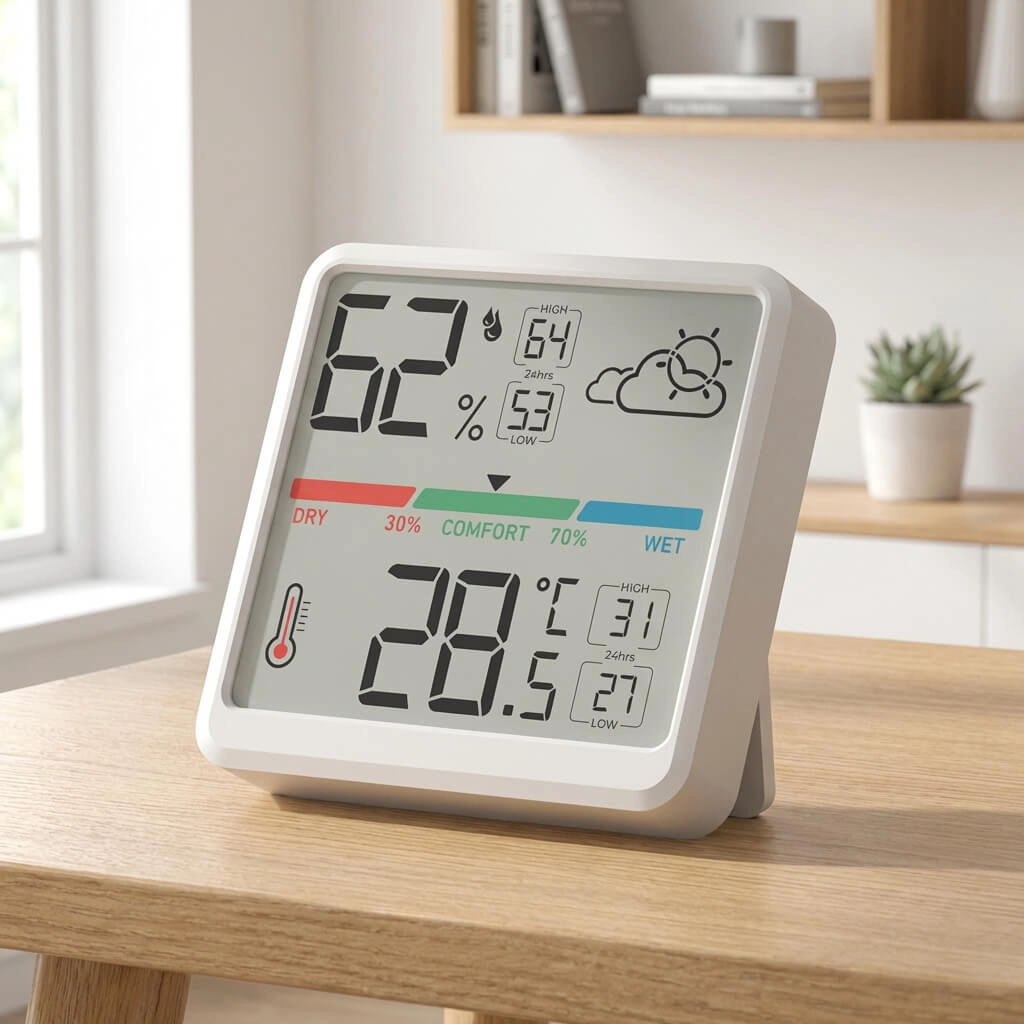
Digital Indoor Thermometer Hygrometer LCD Temperature Humidity Monitor
The Digital Indoor Thermometer Hygrometer is designed for accurate and reliable monitoring of indoor temperature and humidity. Featuring a clear LCD display, it provides real-time readings along with 24-hour maximum and minimum records for both temperature and humidity. The built-in comfort indicator clearly shows dry, comfortable, or humid conditions, helping users maintain a healthier indoor environment.
With a temperature measurement range from -20°C to 60°C (-4°F to 140°F) and humidity range from 10%RH to 99%RH, this device ensures consistent performance with high accuracy. The sensor updates every 10 seconds for real-time monitoring, while manual reset and unit switching (°C/°F) offer added convenience. Compact and versatile, it includes a foldable stand and magnetic back for flexible placement in homes, kitchens, offices, or warehouses.
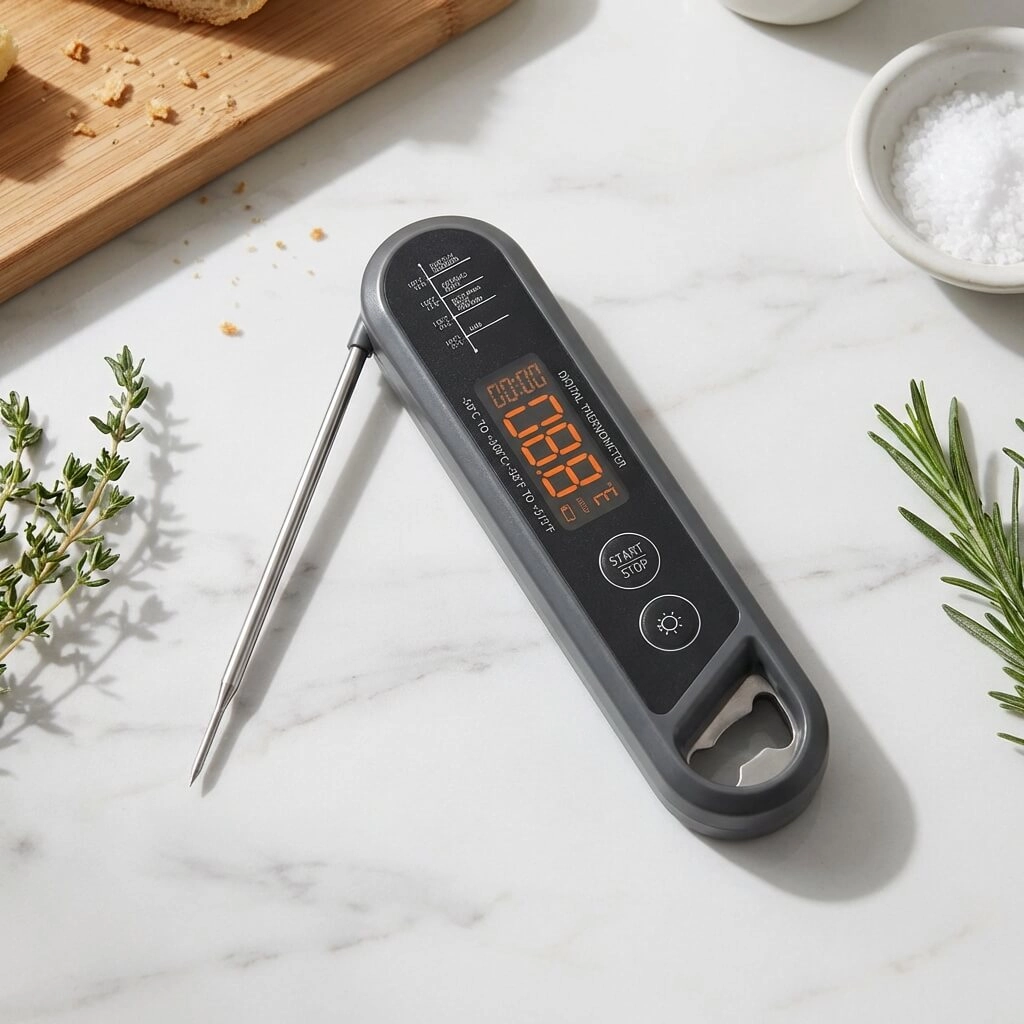
Instant Read Digital Meat Thermometer Food Thermometers With Count Up Timer Grill Oven
X-SPWDJ315-1 is a professional digital meat thermometer designed for B2B buyers such as e-commerce sellers, wholesalers, and OEM clients. Its foldable stainless steel probe ensures safe and compact storage while measuring temperatures from -50°C to 300°C with ±0.1°C accuracy. The thermometer features an integrated countdown timer (up to 59:59) and START/STOP control for precise cooking. An ergonomic handle with a built-in bottle opener adds multifunctional convenience. Powered by a single CR2450 battery, it is ideal for grilling, baking, restaurant kitchens, catering, and bulk supply, providing reliable performance and customization options for commercial customers.
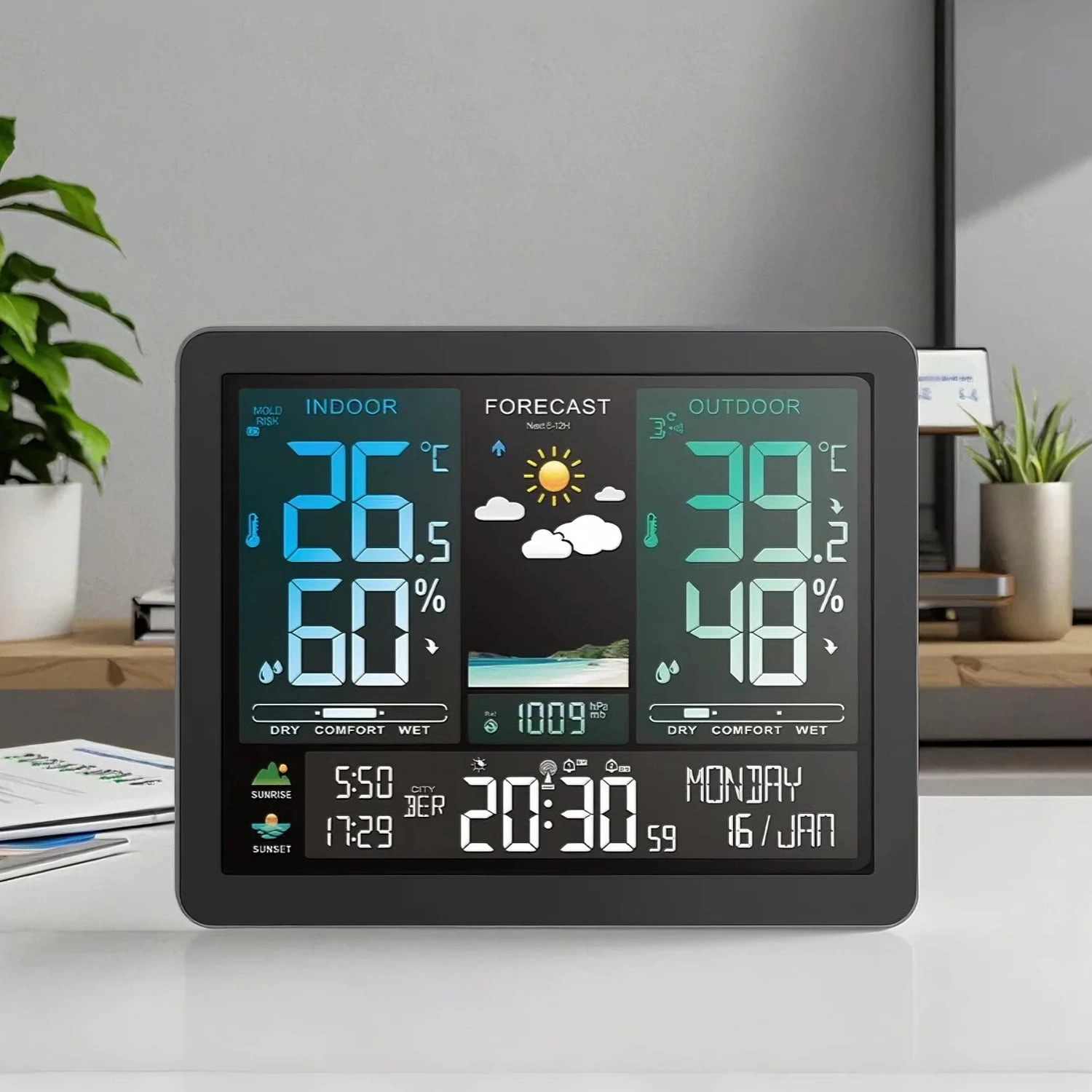
Custom USB Powered Daylight Savings Desktop Wall Alarm Clock Indoor and Outdoor Sensor Calendar Weather Thermometer Hygrometer Barometer
The X-WSDJ012 Smart Digital LED Alarm Clock is a multi-functional home device combining timekeeping with environmental monitoring.
It features a large LED display for time (12/24H), week, and date and integrates indoor/outdoor sensors to track temperature, humidity, atmospheric pressure, and weather trends.
Powered by USB (for a bright, always-on display) or batteries, it includes a waterproof outdoor sensor and offers customizable alarms, backlight control, and 8 language options.
Designed with a foldable stand or hanging hole, it fits desks, walls, or nightstands—ideal for home, garden, or office use.

Youben life
Youben life