
Digital Learning Timers: Why They Matter in Modern Education Products
- Time Management Tools for Today’s Learners
- What are digital learning timers and how are they used in education?
- Why digital learning timers improve learning outcomes (pedagogical evidence)
- Key features that matter when choosing digital learning timers
- Design considerations for manufacturers (OEM/ODM perspective)
- Comparing digital learning timers, analog visual timers, and apps
- Accessibility and equity: why hardware timers can be more inclusive
- Market trends and adoption: why now is the time to integrate digital learning timers
- How to evaluate suppliers: compliance, customization, and quality
- Youben Life — OEM/ODM partner for digital learning timers and related products
- Case scenarios: where digital learning timers add measurable value
- Selecting the right model: checklist for product teams and buyers
- Frequently Asked Questions (FAQ)
- 1. What is the difference between a digital learning timer and a regular kitchen timer?
- 2. Can digital learning timers help students with ADHD?
- 3. Are physical digital timers better than apps for classroom use?
- 4. What certifications should I expect from an OEM supplier?
- 5. How customizable can digital learning timers be through an ODM/OEM partner?
- 6. How do schools typically budget for and deploy digital timers?
- Contact & product inquiry (Call to Action)
- References
Time Management Tools for Today’s Learners
Modern classrooms and learning environments demand tools that help students manage attention, break tasks into achievable segments, and give teachers a predictable rhythm for instruction. Digital learning timers are more than countdown clocks — they are product features that can shape behavior, support equity in classrooms, and integrate with digital learning ecosystems. This article examines why digital learning timers matter, what features drive learning outcomes, how they compare with alternative solutions, and what to look for when sourcing or developing educational hardware. We also introduce Youben Life, a manufacturing partner experienced in OEM/ODM digital timer production for educational and home applications.
What are digital learning timers and how are they used in education?
Digital learning timers are electronic timing devices designed specifically for task management and time awareness in learning contexts. They can be physical devices (desktop timers, wall-mounted units, smart alarm clocks with learning modes) or dedicated hardware modules embedded in educational products. Common classroom uses include timed practice, transitions and routines, formative assessment windows, test timing, guided reading, and independent work sessions.
Why digital learning timers improve learning outcomes (pedagogical evidence)
Teachers and instructional designers use timers to structure lessons, scaffold executive function, and reduce off-task behavior. Evidence and practitioner reports describe several mechanisms by which timers support learning:
- Attention scaffolding: Visible countdowns reduce uncertainty about task duration and help learners sustain effort for a defined interval.
- Chunking and time-bound practice: Timers support distributed practice (short, focused sessions) which aligns with cognitive psychology findings on spacing and retrieval practice.
- Routine & classroom management: Consistent timing signals transition points and lowers friction in classroom logistics, improving instructional time efficiency.
- Self-regulation & executive function: Timers act as external supports for planning and monitoring task progress, especially for younger students or learners with attention challenges.
Practical guidance from education specialists and disability advocates highlights that visual and digital timers can be particularly effective for students with ADHD or other executive-function differences because they externalize time and reduce the cognitive load of timing a task internally (sources cited below).
Key features that matter when choosing digital learning timers
Not all digital timers are equal for educational use. When evaluating devices for classrooms, after-school programs, or edtech products, prioritize the following features:
- Clear visual display: large digits, optional color gradients, or progress bars visible from classroom seating distances.
- Auditory settings: configurable chimes, volume control, and silence modes for test environments.
- Multiple modes: countdown, count-up, interval/loop (useful for stations, Pomodoro-style cycles), and alarm settings.
- Durability and portability: rugged casing, battery backup for classrooms with limited power access.
- Accessibility options: tactile buttons, high-contrast modes, visual-only mode for sensory-sensitive learners, and compatibility with assistive tech.
- Connectivity and integration: Bluetooth or Wi-Fi for syncing with classroom management software, remote control, or multi-device synchronization.
- Customization & branding: for OEM/ODM partners, options for customized firmware, appearance, packaging, and private labeling.
Design considerations for manufacturers (OEM/ODM perspective)
For electronics manufacturers and product teams building educational hardware, design trade-offs impact price, reliability, and classroom suitability. Choose components that balance clarity (high-brightness displays) with power efficiency, and prioritize firmware flexibility to support multiple pedagogical workflows (e.g., teachers who need quick presets vs. students who use interval training). Regulatory compliance (CE/FCC/RoHS) and ease of mass customization are critical for global market adoption.
Comparing digital learning timers, analog visual timers, and apps
Educators often weigh hardware timers against smartphone/tablet apps or simple analog sand/glass timers. The table below summarizes strengths and weaknesses to guide procurement or product decisions.
| Feature | Digital learning timers (dedicated hardware) | Analog/visual timers (sand, color discs) | Apps & web timers |
|---|---|---|---|
| Visibility in classroom | High — large displays and LEDs designed for distance | High — intuitive visual cues but limited precision | Variable — depends on screen size and device placement |
| Distraction risk | Low — single-purpose device | Low — simple visual focus | High — multitasking on smartphones/tablets |
| Customization | High — programmable modes, branding, accessibility | Low — fixed behavior | High — flexible but inconsistent UX across devices |
| Durability & classroom wear | High — built for heavy use | Medium — fragile or imprecise | Low — dependent on user device policies |
| Cost | Medium — initial hardware investment | Low — inexpensive | Low — free/low-cost apps but hidden device management costs |
Accessibility and equity: why hardware timers can be more inclusive
Digital learning timers designed for education can be tailored to meet accessibility needs better than general-purpose apps. For example:
- Visual-only modes avoid auditory overstimulation for sensory-sensitive students.
- High-contrast displays and large fonts support low-vision learners.
- Dedicated devices eliminate the need for personal devices, reducing equity gaps where students lack smartphones or tablets.
Guidance from disability support organizations shows that externally visible, predictable timing supports learners with ADHD and executive-function challenges by reducing the hidden cognitive load of time estimation (see references).
Market trends and adoption: why now is the time to integrate digital learning timers
Several macro trends are driving renewed interest in purpose-built learning hardware, including digital learning timers:
- Rising investment in edtech and blended learning models where classroom routines are standardized.
- Increased attention to classroom management tools that reduce teacher workload and maximize instructional minutes.
- Growth in smart home and smart classroom devices that enable connected education ecosystems (market data indicates continued expansion of smart device markets worldwide).
Manufacturers and brand owners who deliver configurable, standards-compliant digital timers positioned for education can capture demand across schools, tutoring centers, and parents seeking structure for at-home learning.
How to evaluate suppliers: compliance, customization, and quality
When sourcing digital learning timers, evaluate suppliers on at least these dimensions:
- Regulatory compliance: CE, FCC, RoHS compliance is essential for international distribution.
- Customization capability: firmware, industrial design, logo/packaging personalization, and ability to deliver small-to-large MOQ ranges.
- Manufacturing & QA processes: lifecycle testing, drop tests, display longevity, battery safety, and EMC testing.
- After-sales support: spare parts, firmware updates, and local/global distribution channels.
Youben Life — OEM/ODM partner for digital learning timers and related products
Youben Life, founded in 2010 and headquartered in Guangzhou, China, is a leading home electronics manufacturer and supplier specializing in customized digital products. Their core strengths for education-focused brands include:
- Product lines: Digital Timer, Digital Alarm Clock, Household Thermometer, and Hygrometer — all adaptable for classroom or home learning contexts.
- Full-service OEM/ODM solutions: product functionality development, industrial and appearance design, packaging design, and logo personalization for private label projects.
- Compliance and global market readiness: products that meet CE, FCC, and RoHS standards, enabling export to major markets.
- Manufacturing capabilities & industry experience: scalable production, quality control processes, and experience developing differentiated home electronic products that align with brand positioning and target customers.
Why partner with a manufacturer like Youben Life for digital learning timers: they combine design flexibility (for classroom-specific modes and accessibility features) with regulatory knowledge and production scale to deliver reliable units for schools, tutoring centers, and consumer markets. Their offerings allow brands to focus on pedagogy and distribution while outsourcing hardware complexity.
Case scenarios: where digital learning timers add measurable value
Three common deployment scenarios demonstrate measurable benefits:
- Primary classrooms: timers enforce routine transitions (reading to math to recess) and reduce teacher talking time. Teachers report smoother transitions and higher on-task percentages when visible timers are used consistently.
- Special education settings: customized auditory/visual modes help learners with sensory and executive-function needs maintain engagement and independence.
- At-home blended learning: parents and tutors use timers to enforce study intervals, increasing adherence to study plans and reducing conflicts over time limits on tasks.
Selecting the right model: checklist for product teams and buyers
Use this quick checklist when evaluating digital learning timers for procurement or product development:
- Does the display remain readable from typical classroom distances (measurement in meters)?
- Are volume and alarm types configurable to meet testing or sensory-sensitive periods?
- Is the device durable and serviceable for daily school use?
- Can the device be branded and packaged for resale or institutional deployment?
- Does the supplier provide compliance certificates (CE/FCC/RoHS) and test reports?
- Are accessibility features (visual-only, high contrast, tactile controls) included or available?
Frequently Asked Questions (FAQ)
1. What is the difference between a digital learning timer and a regular kitchen timer?
Digital learning timers are designed with educational workflows in mind: larger and more visible displays, accessibility options, configurable interval modes (e.g., station rotation), lower distraction design, and often regulatory certification for institutional use. Kitchen timers prioritize food timing and may lack classroom visibility and customization.
2. Can digital learning timers help students with ADHD?
Yes. External visual and auditory timing supports can reduce the need for students with ADHD to internally track time. Organizations and clinicians recommend simple, consistent timers to scaffold task engagement and transitions (see references).
3. Are physical digital timers better than apps for classroom use?
Dedicated hardware timers typically reduce distraction risk, offer better visibility across the classroom, and remove dependence on student devices. Apps are flexible but can introduce multitasking and device management challenges.
4. What certifications should I expect from an OEM supplier?
For global distribution, ask for CE (Europe), FCC (U.S.) equipment authorization, and RoHS (restricted hazardous substances) compliance. These cover safety, electromagnetic compatibility, and materials restrictions important to institutional buyers.
5. How customizable can digital learning timers be through an ODM/OEM partner?
Customization can range from cosmetic (logo, color, packaging) to functional (custom presets, accessibility modes, connectivity features). Suppliers like Youben Life offer full OEM/ODM services including product functionality and industrial design.
6. How do schools typically budget for and deploy digital timers?
Schools may procure timers centrally for classrooms or include them in district-level instructional technology purchases. Consider per-classroom unit counts, spare units for breakage, and teacher training costs when budgeting.
Contact & product inquiry (Call to Action)
If you are developing educational products or sourcing digital learning timers for classrooms, Youben Life can provide customizable OEM/ODM solutions that meet regulatory standards and classroom needs. Contact Youben Life for product catalogs, sample requests, compliance documentation, and design consultations. Visit the company website or email their sales team to discuss private label options and technical specifications for Digital Timer, Digital Alarm Clock, and Household Thermometer product lines.
References
- Understood.org — How timers can help kids with ADHD. https://www.understood.org/articles/en/how-timers-can-help-kids-with-adhd (accessed 2025-12-26)
- ADDitude Magazine — Visual Timers to Help Kids Focus. https://www.additudemag.com/visual-timers-kids-focus/ (accessed 2025-12-26)
- Statista — Global smart home market size. https://www.statista.com/statistics/1101444/global-smart-home-market-size/ (accessed 2025-12-26)
- European Commission — CE marking overview. https://ec.europa.eu/growth/single-market/ce-marking_en (accessed 2025-12-26)
- Federal Communications Commission (FCC) — Equipment authorization. https://www.fcc.gov/general/equipment-authorization (accessed 2025-12-26)
- European Commission — RoHS Directive information. https://ec.europa.eu/environment/topics/waste-and-recycling/rohs-directive_en (accessed 2025-12-26)
- Edutopia — Visual timers in the classroom (practical guidance and teacher perspectives). https://www.edutopia.org/article/visual-timers-classroom (accessed 2025-12-26)
Author: A seasoned home electronics and education-products consultant with experience in product strategy, OEM/ODM manufacturing partnerships, and classroom technology deployments.
Top digital kitchen timers Manufacturers and Suppliers
Designing Energy-Efficient Pomodoro Timers for Mass Production
Comparing Bulk Pricing Strategies for Digital Timer Clock Orders
Top 10 home electronics Manufacturers and Supplier Brands
X-JSQ016
What are the shipping costs and delivery times?
For stock products: Competitive rates via air/sea/express, with delivery in 7–15 business days (location-dependent). For customized orders: Includes 10–15 days for production + shipping; exact timelines confirmed post-design finalization. We ensure reliable, cost-effective delivery tailored to your schedule.
All
Do you offer OEM & ODM clock services?
Yes, we provide both OEM & ODM solutions, allowing clients to customize clock design, materials, packaging, and branding.
What types of clocks can you manufacture?
We manufacture a wide range of clocks, including wall clocks, desk clocks, digital clocks, and smart clocks.
Indoor Thermometer
What quality control processes do you have?
A: We follow strict quality control procedures, including raw material inspection, in-line production checks, and final product testing before shipment.
What after-sales support do you provide?
A: We offer technical support, user manuals, and responsive after-sales service to ensure long-term cooperation and customer satisfaction.
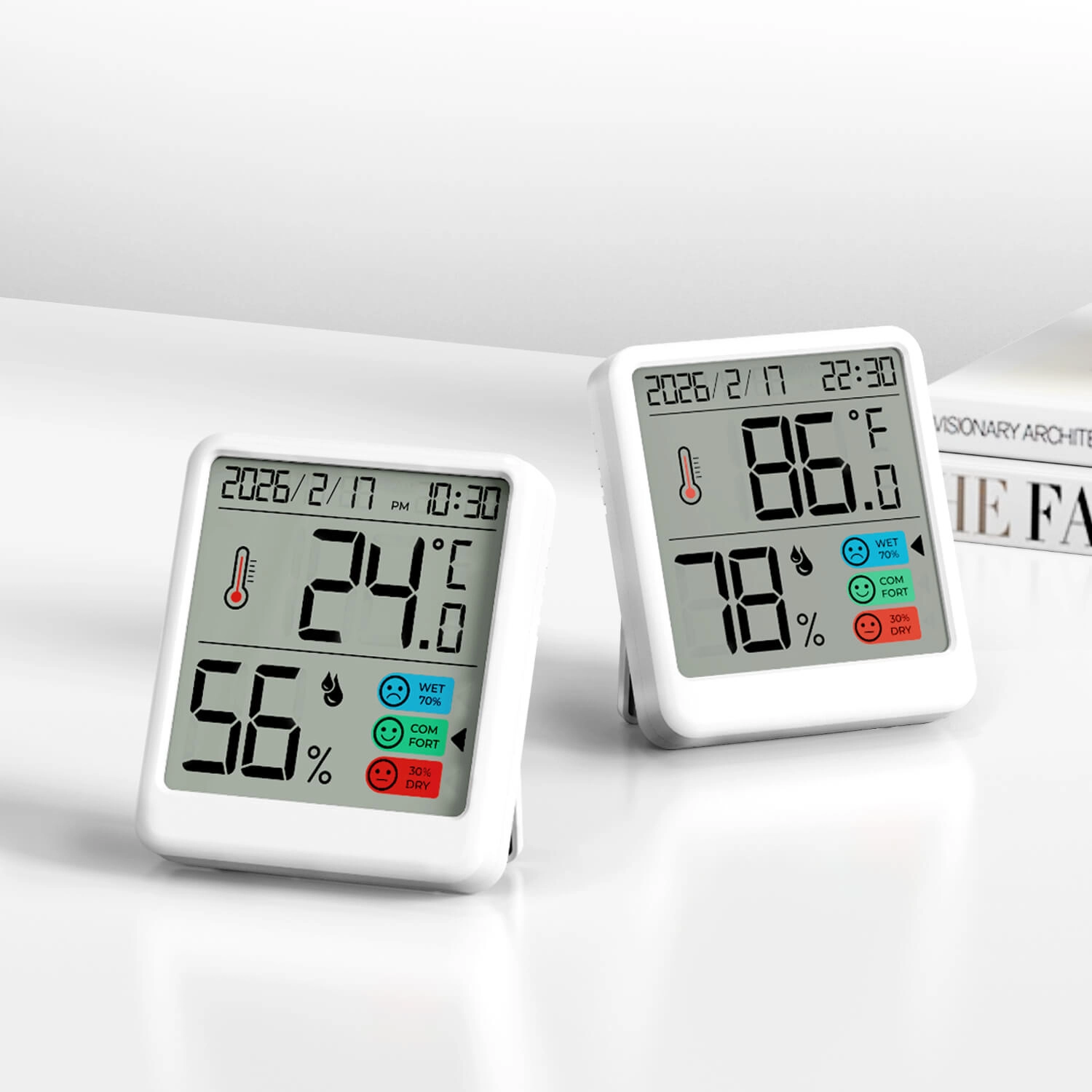
Digital Indoor Thermometer Hygrometer Temperature Humidity Monitor With Calendar Clock
The X-WSDJ312 Indoor Thermometer Hygrometer is a compact and multifunctional temperature and humidity monitor designed for home and office environments. It features a clear LCD screen displaying temperature, humidity, time, calendar, and comfort level at a glance.
Equipped with a high-sensitivity sensor, the device provides accurate real-time environmental monitoring to help maintain a comfortable indoor climate. The thermometer hygrometer supports 12/24-hour time format and ℃/℉ switching, making it convenient for global users.
Designed for flexible placement, it comes with a foldable desktop stand, magnetic back, and wall hanging hole, allowing installation on desks, refrigerators, or walls.
Powered by one AAA battery, the device operates with low power consumption and is ideal for homes, offices, greenhouses, classrooms, and storage environments.
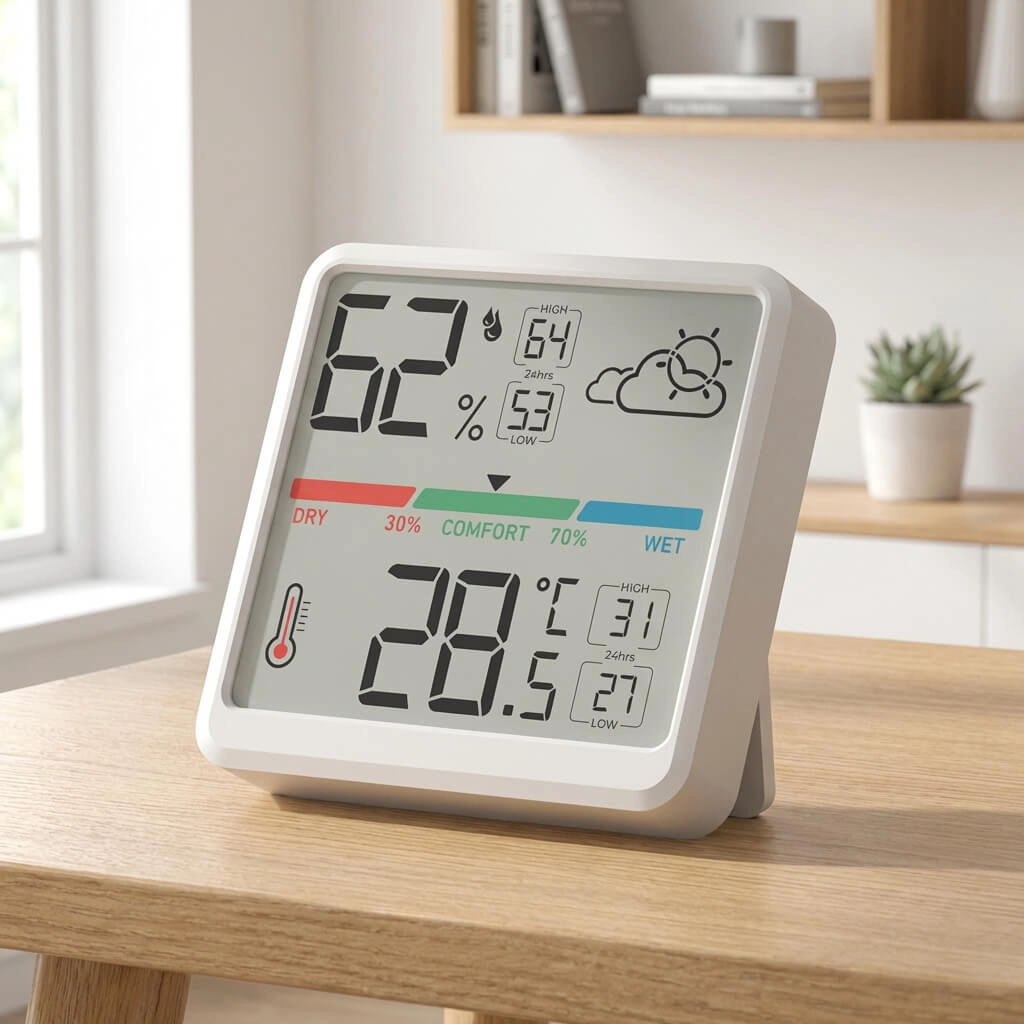
Digital Indoor Thermometer Hygrometer LCD Temperature Humidity Monitor
The Digital Indoor Thermometer Hygrometer is designed for accurate and reliable monitoring of indoor temperature and humidity. Featuring a clear LCD display, it provides real-time readings along with 24-hour maximum and minimum records for both temperature and humidity. The built-in comfort indicator clearly shows dry, comfortable, or humid conditions, helping users maintain a healthier indoor environment.
With a temperature measurement range from -20°C to 60°C (-4°F to 140°F) and humidity range from 10%RH to 99%RH, this device ensures consistent performance with high accuracy. The sensor updates every 10 seconds for real-time monitoring, while manual reset and unit switching (°C/°F) offer added convenience. Compact and versatile, it includes a foldable stand and magnetic back for flexible placement in homes, kitchens, offices, or warehouses.
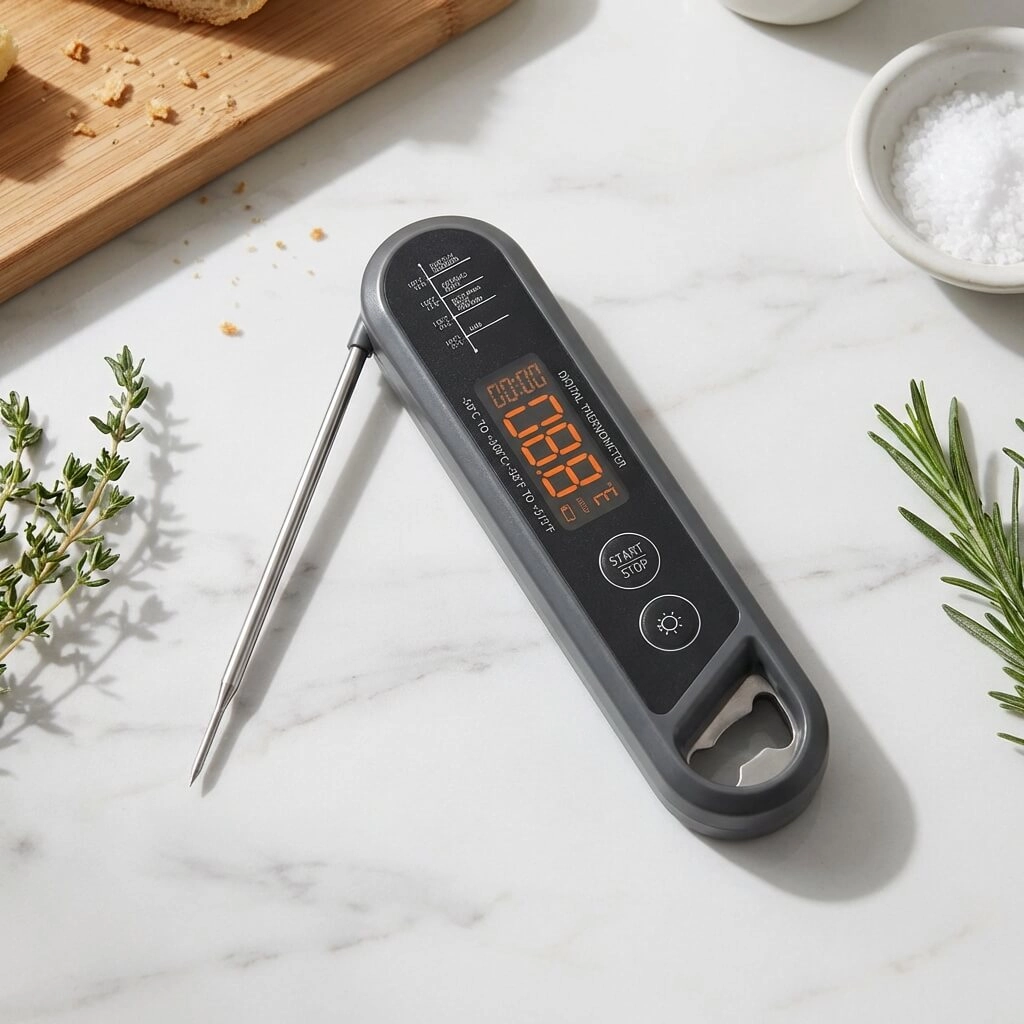
Instant Read Digital Meat Thermometer Food Thermometers With Count Up Timer Grill Oven
X-SPWDJ315-1 is a professional digital meat thermometer designed for B2B buyers such as e-commerce sellers, wholesalers, and OEM clients. Its foldable stainless steel probe ensures safe and compact storage while measuring temperatures from -50°C to 300°C with ±0.1°C accuracy. The thermometer features an integrated countdown timer (up to 59:59) and START/STOP control for precise cooking. An ergonomic handle with a built-in bottle opener adds multifunctional convenience. Powered by a single CR2450 battery, it is ideal for grilling, baking, restaurant kitchens, catering, and bulk supply, providing reliable performance and customization options for commercial customers.
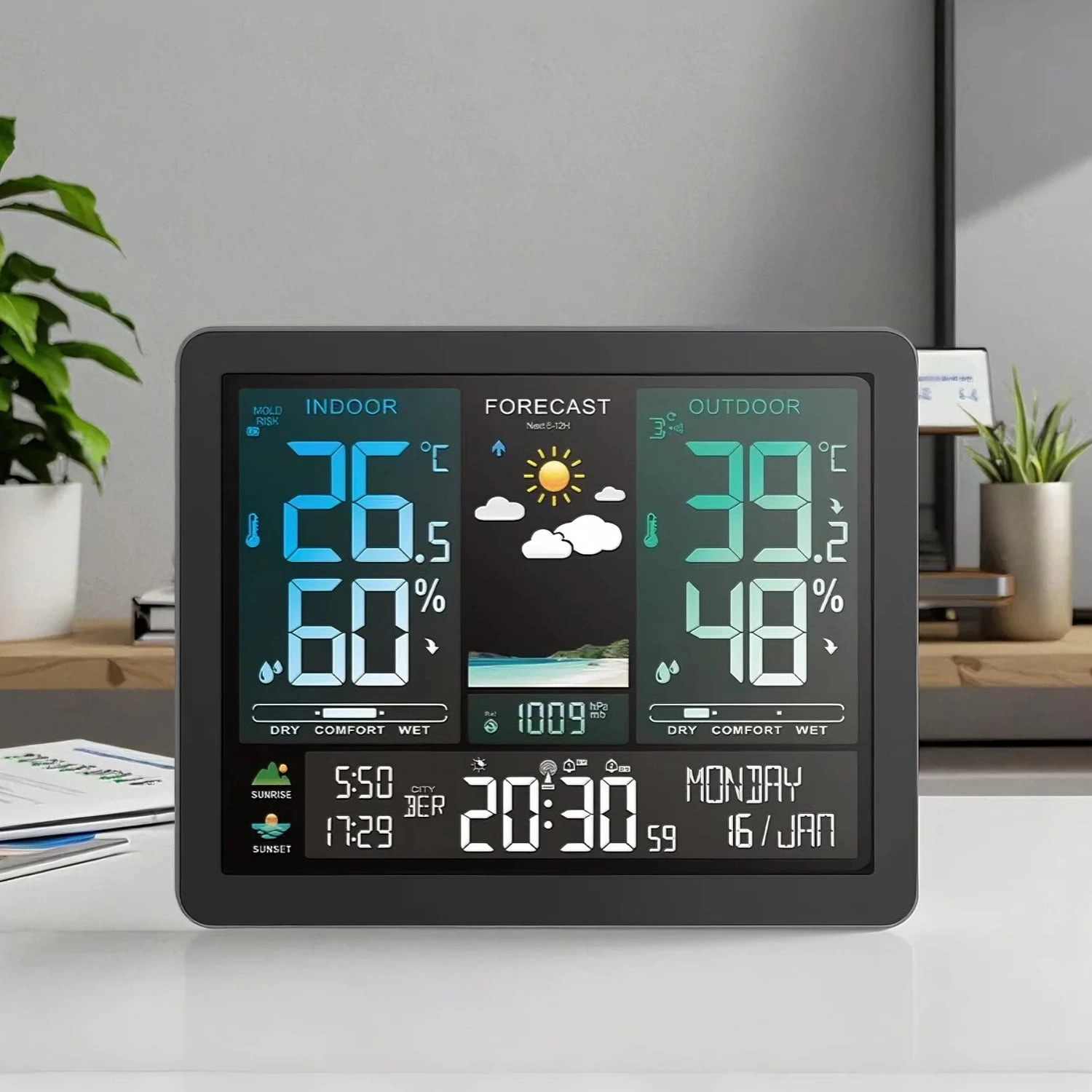
Custom USB Powered Daylight Savings Desktop Wall Alarm Clock Indoor and Outdoor Sensor Calendar Weather Thermometer Hygrometer Barometer
The X-WSDJ012 Smart Digital LED Alarm Clock is a multi-functional home device combining timekeeping with environmental monitoring.
It features a large LED display for time (12/24H), week, and date and integrates indoor/outdoor sensors to track temperature, humidity, atmospheric pressure, and weather trends.
Powered by USB (for a bright, always-on display) or batteries, it includes a waterproof outdoor sensor and offers customizable alarms, backlight control, and 8 language options.
Designed with a foldable stand or hanging hole, it fits desks, walls, or nightstands—ideal for home, garden, or office use.

Youben life
Youben life