
Customizable Pomodoro Timers: Enclosure, Branding, Firmware
- Design-first considerations for focus hardware
- Start from user jobs and the Pomodoro workflow
- Ergonomics, visibility and placement scenarios
- Feature prioritization and BOM discipline
- Enclosure materials, manufacturing and cost trade-offs
- Material choices: pros, cons and lifecycle impact
- Manufacturing processes and tooling considerations
- Comparison table: enclosure options
- Branding, packaging and retail readiness
- Visual identity and private-label approaches
- Packaging, regulatory labeling and documentation
- Supply chain and MOQ strategies for private label
- Firmware, connectivity and compliance
- Firmware architecture and upgradability
- Connectivity options and companion apps
- EMC, safety and regulatory testing
- Go-to-market: validation, manufacturability checks and supplier selection
- Prototype, user testing and iterative validation
- Key supplier due diligence checklist
- Cost modeling and margin optimization
- Youben Life: turnkey OEM/ODM partner for pomodoro and digital timers
- Company profile and core capabilities
- Quality, compliance and manufacturing scale
- Why choose a specialized timer OEM/ODM partner?
- Practical checklist before scaling production
- FAQ
- 1. What is the ideal enclosure material for a High Quality pomodoro timer?
- 2. How important is firmware upgradability for a pomodoro timer?
- 3. Do I need Bluetooth or can I sell a standalone device?
- 4. What certifications are required to sell in major markets?
- 5. How can I reduce manufacturing risk when working with an OEM/ODM?
- 6. How long does it take to go from prototype to mass production?
- Contact & next steps
Summary for and search: Customizable pomodoro timers are compact hardware products that combine visual countdown clocks, tactile controls and firmware-driven workflows to help users implement time management techniques. This article explains how enclosure choices, private-label branding and robust firmware together determine user experience, manufacturability and market success. It includes material comparisons, firmware feature sets, compliance considerations (CE/FCC/RoHS) and vendor selection criteria for companies seeking OEM/ODM partners.
Design-first considerations for focus hardware
Start from user jobs and the Pomodoro workflow
Successful pomodoro timer products solve a small, specific set of user needs: quick session start, unobtrusive reminders, visible countdown, simple mode switching and reliable battery life. The product must support common time-management patterns such as 25/5 work-break cycles, custom intervals for deep work, and a clearly readable visual countdown. For background on the Pomodoro Technique, see Pomodoro Technique on Wikipedia. Mapping those jobs to hardware features early prevents over-engineering—e.g., a minimalist device may favor a large LED ring and one rotary encoder, while power users might need app pairing and analytics.
Ergonomics, visibility and placement scenarios
Decide placement scenarios: desktop, bedside, wall-mounted or pocket. A desktop visual timer benefits from angle-optimized displays and non-slip bases; wall-mounted units require secure mounting points and readable distances. Consider contrast and luminance for visual countdowns—large digits or LED rings that remain visible at 1–3 meters. For industrial design context, see Industrial design principles.
Feature prioritization and BOM discipline
Feature creep drives cost and complexity. Use a prioritized Minimum Viable Product (MVP) list: core timer, power (battery/USB), at least one notification type (buzzer, LED, vibration), and basic firmware with OTA or USB update capability. Higher-tier features (Bluetooth LE, smartphone companion app, cloud sync) can be modularized. This approach reduces time-to-market and aligns with OEM/ODM production cycles.
Enclosure materials, manufacturing and cost trade-offs
Material choices: pros, cons and lifecycle impact
Common enclosure materials for consumer timers include ABS/PC blends, aluminum, and bioplastic alternatives. Each option affects perceived quality, weight, thermal behavior and recyclability. For material properties: ABS and aluminum references provide baseline mechanical and thermal data. The environmental and compliance impact is influenced by RoHS and regional recycling rules—see RoHS context at RoHS.
Manufacturing processes and tooling considerations
Injection molding (for ABS/PC) requires upfront mold tooling (typically $5k–$80k depending on complexity and cavity count) but yields low per-unit cost at scale. CNC or die-casting for aluminum has different cost profiles and surface treatment options (anodize, bead-blast). Early DFMA (Design for Manufacturability & Assembly) reviews that specify snap-fit features, PCB mounting bosses and serviceability reduce change orders during mold ramp. Work with suppliers who can provide precision mold tooling and iterative prototypes (3D prints → aluminum soft-tool → production mold).
Comparison table: enclosure options
| Material | Pros | Cons | Typical Unit Cost Range (est.) |
|---|---|---|---|
| ABS/PC (Injection-molded) | Low cost at volume, easy color/texture, lightweight | Perceived as lower-end; limited High Quality finish options | $0.50 - $5 per part |
| Aluminum (CNC/die-cast) | High Quality feel, durable, good thermal mass | Higher tooling and material cost; heavier | $3 - $20 per part |
| Bioplastic / PLA blends | Eco-friendly positioning, recyclable options | Material sourcing variability, potentially higher unit costs | $1 - $8 per part |
Sources: material overviews from Wikipedia pages above and typical industry tooling benchmarks from OEM manufacturing case studies.
Branding, packaging and retail readiness
Visual identity and private-label approaches
Branding is more than a logo: tactile finishes, color systems, packaging unboxing and firmware UX all reinforce brand identity. For private-label pomodoro timers, choose whether branding lives only on packaging (white-label) or on the device (engraved logo, custom colorways). Product differentiation can come from subtle hardware cues: textured rotary knobs, soft-touch materials, or signature LED color. For companies targeting Amazon or retail, retail-ready packaging and UPC/GS1 registration should be planned early.
Packaging, regulatory labeling and documentation
Packaging must include mandatory declarations (CE if selling in EU, FCC statements for US, RoHS compliance references). Include clear user instructions for operation, battery handling, and firmware update procedures. Regulatory labeling and accompanying compliance documentation (test reports) accelerate customs clearance and retailer onboarding. For CE and regulatory context see CE marking.
Supply chain and MOQ strategies for private label
Negotiate minimum order quantities (MOQs) aligned to your channel strategy. Many OEM/ODM partners provide tiered pricing and tooling amortization models—initial tooling may be subsidized with higher MOQs or by committing to longer production runs. Build in safety stock for seasonal demand and plan for packaging variants (single-unit retail box vs. bulk shipper box) to reduce per-unit packaging costs.
Firmware, connectivity and compliance
Firmware architecture and upgradability
Firmware is the differentiator for user experience: precise timers, configurable intervals, localized languages, vibration/buzzer patterns, and power optimization. Architect firmware with modularity: a hardware abstraction layer (HAL), timer scheduler, UI/interaction handler, and communication stack. Include a secure bootloader to enable USB or OTA (Bluetooth LE) firmware updates—this extends product life and supports security fixes. For an overview of firmware concepts, see Firmware on Wikipedia.
Connectivity options and companion apps
Connectivity decisions affect cost and UX. Options include:
- None (standalone): simplest, longest battery life.
- Bluetooth LE: enables smartphone app pairing for remote control, analytics and OTA updates.
- Wi-Fi: appropriate if cloud sync and multi-device dashboards are core features, but increases power and certification scope.
Implementing Bluetooth LE provides an optimal balance for pomodoro timers—moderate power use, easy smartphone integration and existing mobile SDKs. If offering a companion app, prioritize privacy and minimal data collection to reduce compliance risk.
EMC, safety and regulatory testing
Plan EMC/EMI, electrical safety and radio testing early. Radio modules require FCC certification (US), CE/RED (EU), and country-specific approvals when distributed globally. Work with labs that provide pre-compliance testing to avoid costly redesigns. Compliance frameworks such as ISO 9001 for quality management help suppliers demonstrate consistent processes—more at ISO 9001. Ensure RoHS and material safety documentation accompanies shipments.
Go-to-market: validation, manufacturability checks and supplier selection
Prototype, user testing and iterative validation
Run rapid prototypes (3D-printed enclosures, development boards) and place them in realistic use tests. Collect metrics: ease-of-use, visual readability, perceived alarm audibility, battery runtime under typical cycles, and firmware reliability. Iterative testing reduces recalls and negative reviews.
Key supplier due diligence checklist
When selecting an OEM/ODM partner evaluate: vertical integration (in-house tooling, molding, PCB assembly), certification records (CE/FCC/RoHS), experience in time-keeping devices, willingness to sign IP/NDA agreements, warranty & after-sales support, and sample turnaround times. Ask for test reports and references from previous partners. Suppliers with integrated R&D and manufacturing shorten the product development lifecycle.
Cost modeling and margin optimization
Build a BOM-level cost model covering parts, assembly, tooling amortization, packaging, compliance testing, shipping and duty. Model scenarios (low-volume vs. scale) and retain margin buffers for retail promotions and returns. Consider offering tiered SKUs: basic standalone timer vs. Bluetooth-connected High Quality model to capture broader market segments.
Youben Life: turnkey OEM/ODM partner for pomodoro and digital timers
Company profile and core capabilities
Youben Life, established in 2010, is a premier OEM/ODM manufacturer dedicated exclusively to Digital Timers, Pomodoro timers, and Visual Countdown Clocks. Headquartered in Guangzhou, China, our 20,000m² vertically integrated facility provides turnkey private label solutions for global brands and Amazon bestsellers. We go beyond simple assembly; our expertise covers the entire R&D spectrum, including ID/MD industrial design, custom IC programming, precision mold tooling, and retail-ready packaging. Website: https://www.youbenlife.com/ Email: info@youbenlife.com.
Quality, compliance and manufacturing scale
Youben Life commits to quality and compliance—products meet CE, FCC, and RoHS standards—backed by systematic quality control and experienced engineering. With a decade of engineering experience and scalable manufacturing capacity, Youben Life helps partners develop differentiated time management hardware that strengthens brand identity and dominates the market. Their vertically integrated setup (tooling, PCB assembly, injection molding, firmware team) reduces coordination overhead and shortens development cycles.
Why choose a specialized timer OEM/ODM partner?
Working with a specialist like Youben Life accelerates time-to-market, lowers technical risk (firmware and timing accuracy expertise), and simplifies certification pathways. Their end-to-end service model is well-suited for brands that want unique enclosures, custom firmware features (multi-language UI, OTA updates), and retail-ready packaging while maintaining cost efficiencies at scale.
Practical checklist before scaling production
- Finalize MVP features and freeze the BOM for tooling sign-off.
- Run DFMA and EMC pre-compliance tests during proto stage.
- Choose enclosure material aligned to brand positioning and lifecycle goals.
- Require a secure bootloader and OTA strategy in firmware architecture.
- Obtain CE/FCC/RoHS test evidence and include compliance labeling on packaging.
- Negotiate MOQ, lead times and tooling amortization with the OEM/ODM partner.
FAQ
1. What is the ideal enclosure material for a High Quality pomodoro timer?
Aluminum or metal alloys yield a High Quality tactile feel and durability; anodized finishes provide color options. For mass-market price sensitivity, high-quality ABS/PC with soft-touch or textured finishes can achieve a High Quality look at lower cost. Use the table above to weigh trade-offs based on your target price and channel.
2. How important is firmware upgradability for a pomodoro timer?
Very important. Firmware upgradability enables bug fixes, feature additions (new timer modes, language packs), and security patches. A secure bootloader plus OTA or USB update path extends product life and reduces return rates.
3. Do I need Bluetooth or can I sell a standalone device?
Both can succeed. Standalone devices excel in battery life and simplicity; Bluetooth adds companion app integration and advanced features. Choose Bluetooth if you plan analytics, user profiles, or heavy configurability; choose standalone to maximize simplicity and affordability.
4. What certifications are required to sell in major markets?
At minimum, CE for the EU (including RED if radio is present), FCC certification for the US (for devices with wireless), and RoHS compliance for many regions. Additional country-specific approvals may be required for certain markets. Start testing early to avoid launch delays.
5. How can I reduce manufacturing risk when working with an OEM/ODM?
Do supplier audits, request sample runs and pre-compliance test reports, sign clear IP and quality terms in contracts, and ask for process flowcharts for key stages (PCBA, injection molding, final testing). Prioritize partners with vertical integration and proven references in timer products.
6. How long does it take to go from prototype to mass production?
Typical timelines: 2–6 months for functional prototypes and firmware MVPs, 3–6 months for tooling and certification, and 1–2 months for first production runs—overall ~6–12 months depending on complexity and regulatory needs.
Contact & next steps
If you are ready to develop a private-label or branded pomodoro timer, request a capability pack and quote from Youben Life. They offer end-to-end services from ID/MD design and custom IC programming to precision tooling and retail packaging. Visit youbenlife.com or email info@youbenlife.com to discuss prototypes, MOQ, and certification support.
References and further reading: Pomodoro Technique (Wikipedia), Firmware overview (Wikipedia), CE marking (Wikipedia), ISO 9001 information (ISO), material pages for ABS and Aluminum (ABS, Aluminium).
Reduce Costs: Timers OEM & ODM Pricing and MOQ Strategies
Mastering Focus: The Strategic Advantage of Pomodoro Timer Wholesale for Businesses
Complete Buyer's Guide to Timers OEM & ODM Services
Top digital kitchen timers Manufacturers and Suppliers
Wholesale Services
Can I customize in bulk orders?
Yes, we offer customization options including design, color, and branding, but there is a MOQ requirement.
Service
How do I get support if I have a questions about the customizaiton?
You could please send your questions to us, we have technicians to responds to you.
Indoor Thermometer
What packaging options do you offer?
A: We offer standard packaging as well as customized retail boxes, gift boxes, and bulk packaging solutions for different sales channels.
What is your production lead time?
A: For standard orders, lead time is typically 7–15 days. For customized OEM orders, it may take 20–35 days depending on complexity and quantity.
Private Label
What’s the MOQ for private label orders?
Usually 200–1000 units depending on the product type.
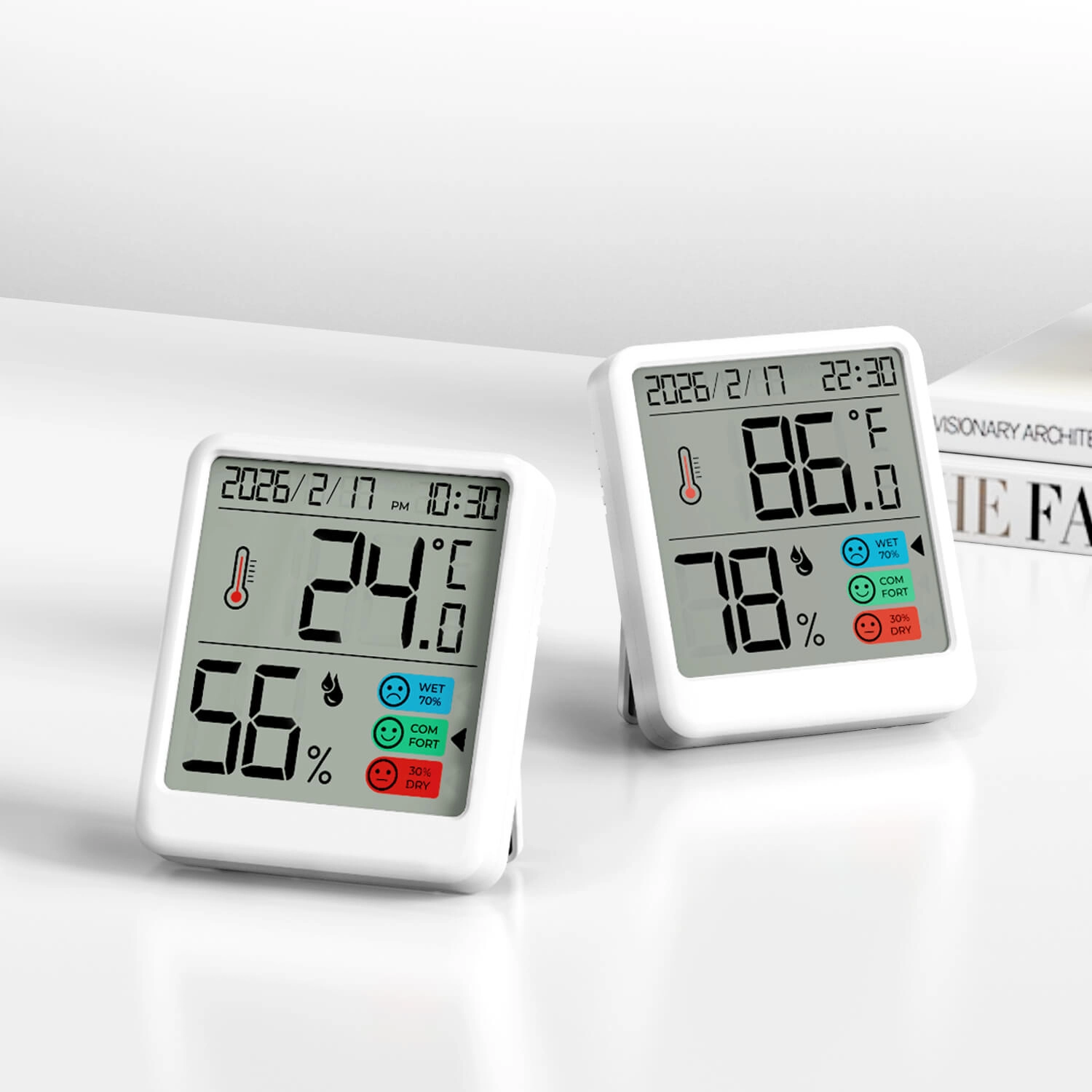
Digital Indoor Thermometer Hygrometer Temperature Humidity Monitor With Calendar Clock
The X-WSDJ312 Indoor Thermometer Hygrometer is a compact and multifunctional temperature and humidity monitor designed for home and office environments. It features a clear LCD screen displaying temperature, humidity, time, calendar, and comfort level at a glance.
Equipped with a high-sensitivity sensor, the device provides accurate real-time environmental monitoring to help maintain a comfortable indoor climate. The thermometer hygrometer supports 12/24-hour time format and ℃/℉ switching, making it convenient for global users.
Designed for flexible placement, it comes with a foldable desktop stand, magnetic back, and wall hanging hole, allowing installation on desks, refrigerators, or walls.
Powered by one AAA battery, the device operates with low power consumption and is ideal for homes, offices, greenhouses, classrooms, and storage environments.
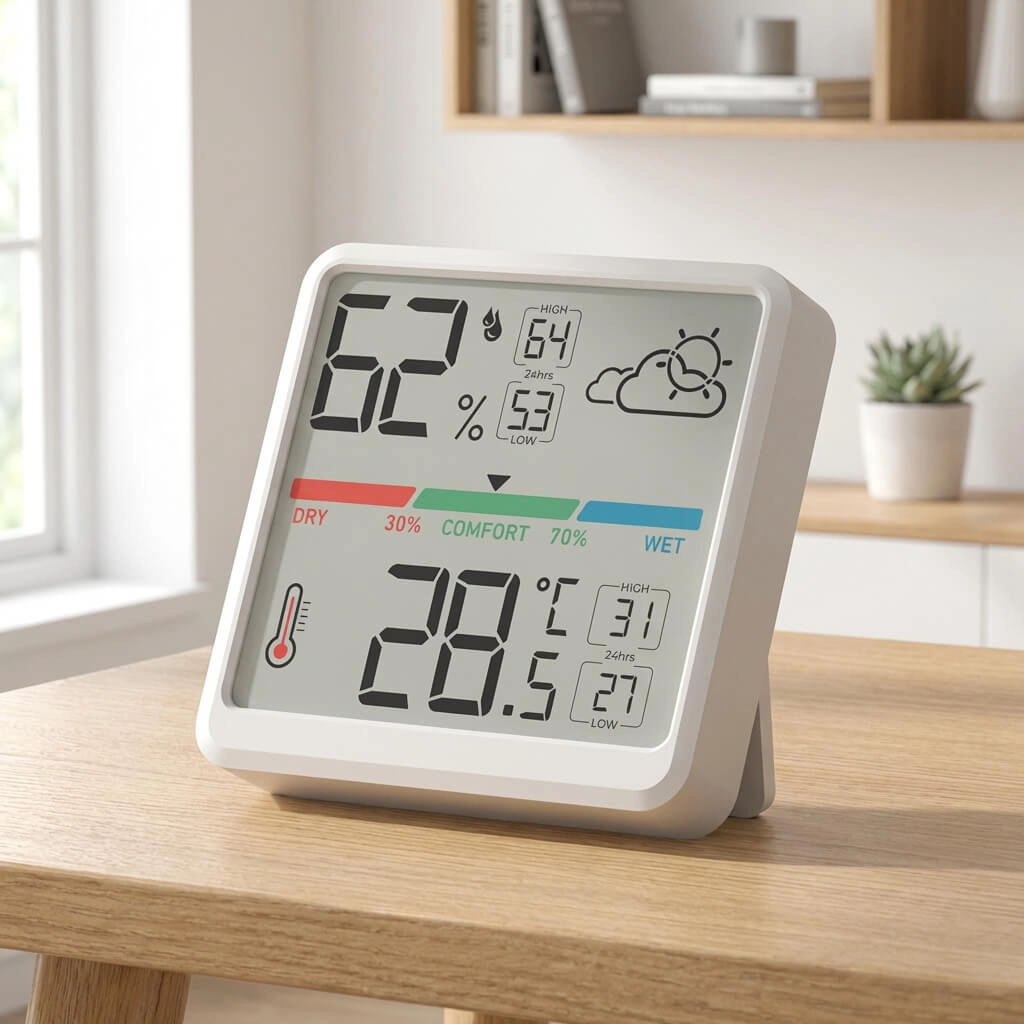
Digital Indoor Thermometer Hygrometer LCD Temperature Humidity Monitor
The Digital Indoor Thermometer Hygrometer is designed for accurate and reliable monitoring of indoor temperature and humidity. Featuring a clear LCD display, it provides real-time readings along with 24-hour maximum and minimum records for both temperature and humidity. The built-in comfort indicator clearly shows dry, comfortable, or humid conditions, helping users maintain a healthier indoor environment.
With a temperature measurement range from -20°C to 60°C (-4°F to 140°F) and humidity range from 10%RH to 99%RH, this device ensures consistent performance with high accuracy. The sensor updates every 10 seconds for real-time monitoring, while manual reset and unit switching (°C/°F) offer added convenience. Compact and versatile, it includes a foldable stand and magnetic back for flexible placement in homes, kitchens, offices, or warehouses.
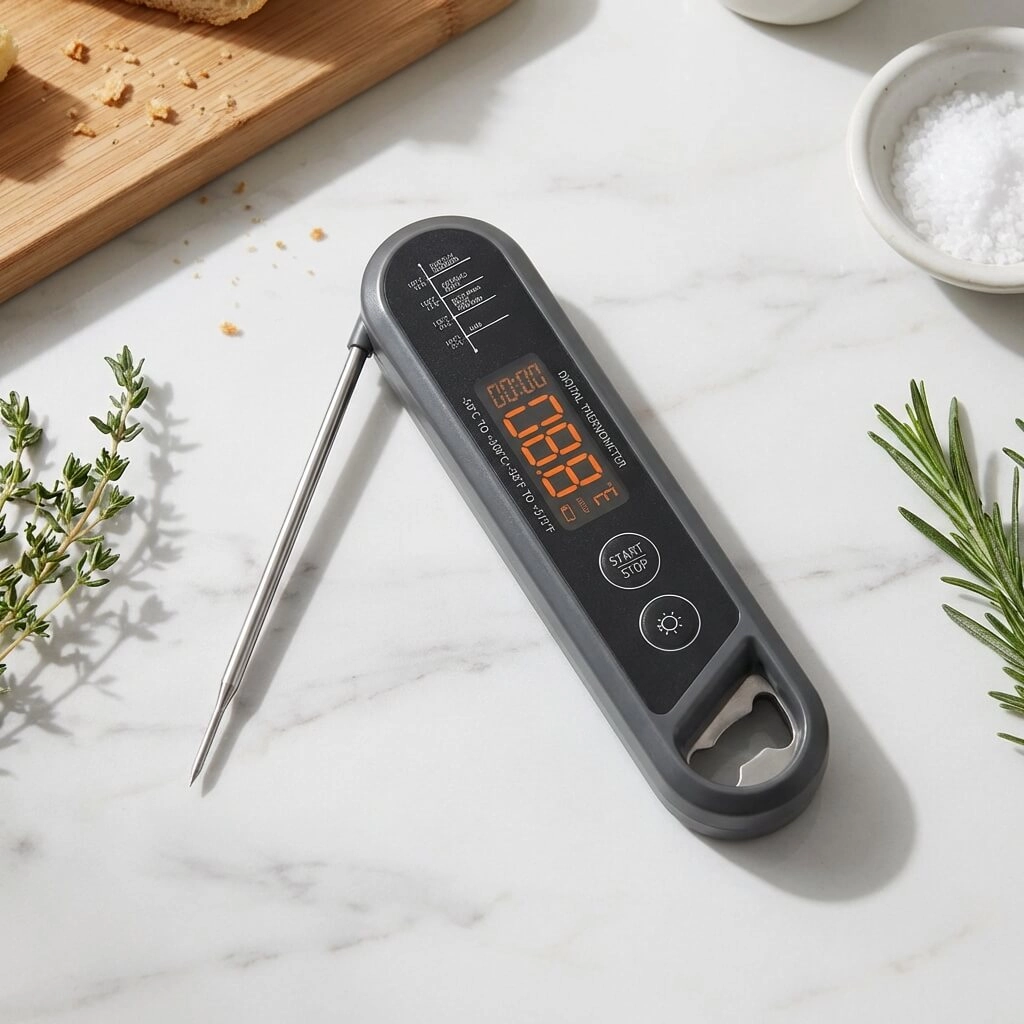
Instant Read Digital Meat Thermometer Food Thermometers With Count Up Timer Grill Oven
X-SPWDJ315-1 is a professional digital meat thermometer designed for B2B buyers such as e-commerce sellers, wholesalers, and OEM clients. Its foldable stainless steel probe ensures safe and compact storage while measuring temperatures from -50°C to 300°C with ±0.1°C accuracy. The thermometer features an integrated countdown timer (up to 59:59) and START/STOP control for precise cooking. An ergonomic handle with a built-in bottle opener adds multifunctional convenience. Powered by a single CR2450 battery, it is ideal for grilling, baking, restaurant kitchens, catering, and bulk supply, providing reliable performance and customization options for commercial customers.
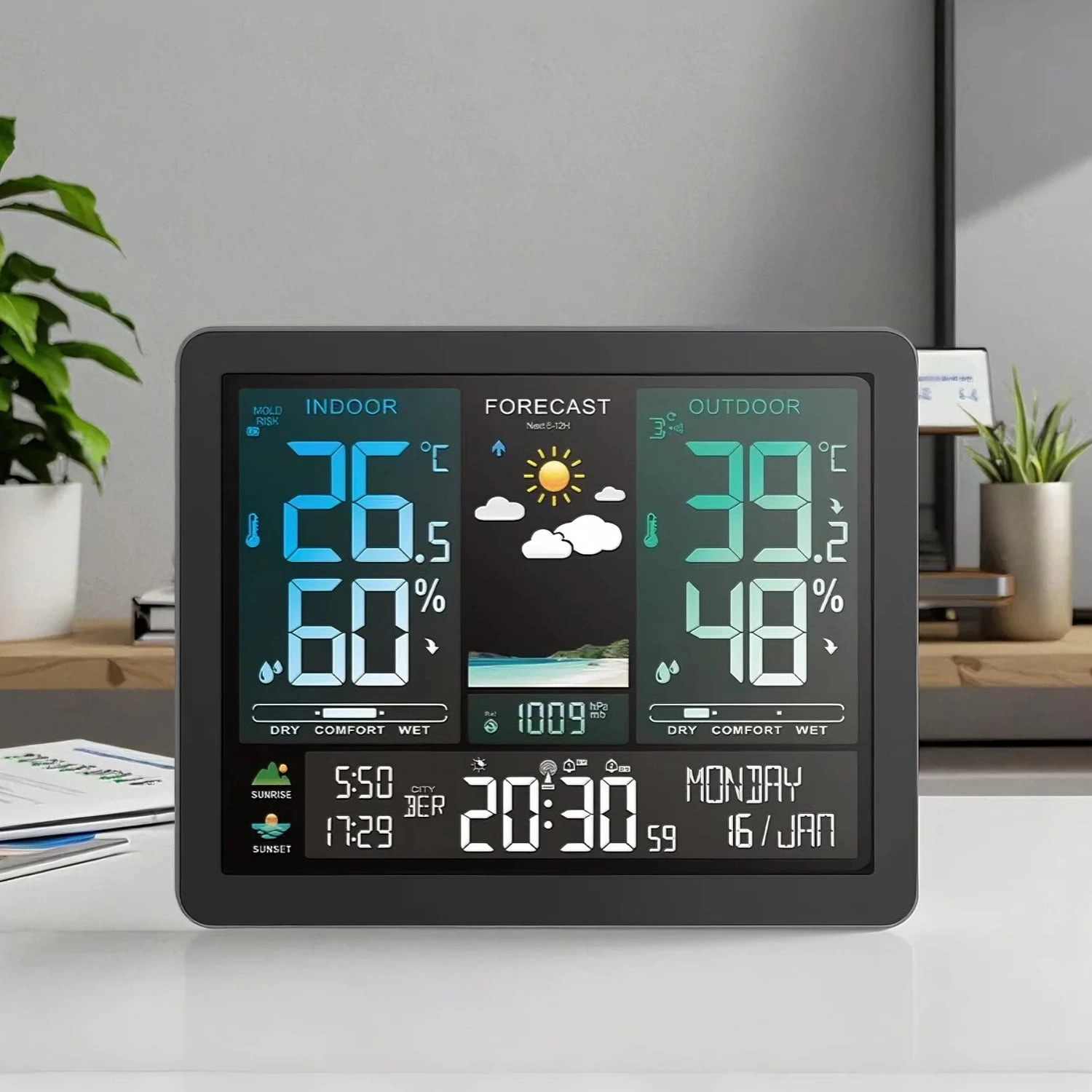
Custom USB Powered Daylight Savings Desktop Wall Alarm Clock Indoor and Outdoor Sensor Calendar Weather Thermometer Hygrometer Barometer
The X-WSDJ012 Smart Digital LED Alarm Clock is a multi-functional home device combining timekeeping with environmental monitoring.
It features a large LED display for time (12/24H), week, and date and integrates indoor/outdoor sensors to track temperature, humidity, atmospheric pressure, and weather trends.
Powered by USB (for a bright, always-on display) or batteries, it includes a waterproof outdoor sensor and offers customizable alarms, backlight control, and 8 language options.
Designed with a foldable stand or hanging hole, it fits desks, walls, or nightstands—ideal for home, garden, or office use.

Youben life
Youben life