
Reduce Costs: Timers OEM & ODM Pricing and MOQ Strategies
- Understanding Cost Structure for Timers OEM & ODM Projects
- Primary cost components: materials, BOM, and assembly
- Non-recurring engineering (NRE), tooling, and firmware development
- Compliance, certification and reliability testing
- MOQ Strategies to Reduce Unit Cost and Financial Risk
- Why MOQ matters: liquidity, inventory risk and pricing
- Common MOQ thresholds and how to negotiate
- Phased production and risk-sharing models
- Pricing Strategies — Negotiation, Cost Engineering, and Value Differentiation
- Cost engineering: design for manufacturing (DFM) and component choices
- Value-based pricing vs. commodity pricing
- Negotiation tactics and supplier selection criteria
- Operational Levers: Supply Chain, QC, and Scalability
- Strategic sourcing and multi-sourcing
- Quality assurance, yield improvement and cost per failure
- Logistics, tariffs and total landed cost
- Comparison: Cost Levers and Impact
- Case Study: Applying MOQ and Pricing Strategy to a Pomodoro Timer
- Scenario and objectives
- Solution steps I implemented
- Results and learnings
- Youben Life: OEM/ODM Partner Profile and Competitive Advantages
- Practical Checklist: What to Ask Your Timers OEM & ODM Partner
- Technical and production questions
- Quality and compliance
- Commercial terms
- References and Standards I Use to Validate Claims
- Frequently Asked Questions (FAQ)
- 1. What is a reasonable MOQ for a custom digital timer?
- 2. How can I reduce per-unit cost without sacrificing product quality?
- 3. Should I choose OEM or ODM for my timer product?
- 4. How do certification costs affect overall pricing?
- 5. What negotiation levers work best with established OEM/ODM factories?
- 6. How can I validate factory claims about yield, capacity, and compliance?
- Contact & Next Steps
In this article I distill years of hands-on OEM/ODM experience in the digital timer sector into actionable strategies to reduce product costs while preserving quality and brand differentiation. You will learn how pricing is built (materials, tooling, IP, testing, compliance), why MOQ matters, and which levers to pull during product development, prototyping, and mass production. I embed guidance specifically for timers oem & odm services and supply-chain realities that influence unit economics globally.
Understanding Cost Structure for Timers OEM & ODM Projects
Primary cost components: materials, BOM, and assembly
The unit cost of a timer typically consists of bill of materials (BOM) components (PCB, MCU/IC, display, housing, battery, sensors), assembly and test, packaging, and logistics. For digital timers, displays (LCD/LED/OLED) and the microcontroller/custom IC exert outsized influence. When I evaluate offers from manufacturers, I break costs down into these buckets to identify optimization opportunities.
Non-recurring engineering (NRE), tooling, and firmware development
NRE and tooling are front-loaded expenses that materially affect per-unit pricing at low volumes. Injection molds for housings can cost from several thousand to tens of thousands of dollars depending on complexity; custom IC programming or firmware development adds NRE. Amortizing NRE across MOQ or projected annual volume is essential for accurate pricing conversations—ask suppliers for an explicit NRE amortization schedule.
Compliance, certification and reliability testing
Compliance (CE, FCC, RoHS) and functional/safety testing increase cost but are non-negotiable for commercial success in major markets. I always account for certification costs early—lab time, pre-compliance checks, and corrective iterations—because late-stage fixes are costly. For background on CE and RoHS requirements see the European Commission guidance: CE Marking and RoHS. For FCC scope see FCC.
MOQ Strategies to Reduce Unit Cost and Financial Risk
Why MOQ matters: liquidity, inventory risk and pricing
MOQ (minimum order quantity) is the point where suppliers achieve line efficiency and amortize fixed costs. A lower MOQ often increases per-unit price because fixed setup and tooling costs are spread over fewer units. I routinely model three scenarios—pilot (low MOQ), production (mid MOQ), and scaling (high MOQ)—to show clients breakeven points and decide which stage to target based on cash flow and market validation.
Common MOQ thresholds and how to negotiate
Typical MOQs for consumer timers and thermo-hygrometers range from 500–5,000 units depending on customization level and supplier capability. For reference: simple white-label timers often start at 500 units; products with custom molds or custom ICs commonly start at 1,000–3,000 units. These ranges are industry-observed: negotiate by offering phased commitments (pilot order + guaranteed reorder), accepting higher per-unit price for the pilot, or co-funding tooling/NRE.
Phased production and risk-sharing models
I prefer phased contracts: a smaller pilot to validate market demand, a scalable production tranche, and a larger batch once KPIs are met. You can also structure contracts with shared tooling costs, volume-linked rebates, or consignment inventory to reduce upfront cash burden. Suppliers often accept these if you demonstrate sales channel credibility (e.g., Amazon seller history) or provide partial NRE funding.
Pricing Strategies — Negotiation, Cost Engineering, and Value Differentiation
Cost engineering: design for manufacturing (DFM) and component choices
Design choices drive cost: choosing a commonly sourced MCU, standard display modules, and fewer bespoke mechanical parts reduces BOM and supply-chain complexity. I use DFM sessions to remove unnecessary tolerances, consolidate parts, and consider off-the-shelf modules where possible, reducing assembly time and defects. Standardizing to RoHS-compliant components early avoids expensive redesigns later.
Value-based pricing vs. commodity pricing
Timers can be sold as commodity items (lowest price wins) or differentiated by UX, accuracy, High Quality materials, and integrations (Bluetooth, app). For OEM/ODM clients I always recommend positioning: if you pursue a low-cost strategy, optimize BOM and MOQ; if you pursue High Quality differentiation, invest in ID/MD design, packaging, and firmware to justify higher ASPs (average selling prices).
Negotiation tactics and supplier selection criteria
When negotiating for timers oem & odm services, I evaluate suppliers on total landed cost, not just FOB/unit price. Key criteria: vertical integration, QC processes, lead times, capacity scaling, and certification capabilities (CE/FCC/RoHS). Use competitive quotes, but also quantify risks—long lead times, single-source parts, or weak QA—that justify High Quality offers to more reliable partners.
Operational Levers: Supply Chain, QC, and Scalability
Strategic sourcing and multi-sourcing
For critical components (MCU, displays, sensors), multi-sourcing is a hedge against price spikes and shortages. I maintain a second-source list and negotiate long-term agreements for key BOM items to lock pricing. When shortages occur, having qualified alternates accelerates continuity without design changes.
Quality assurance, yield improvement and cost per failure
Yield impacts effective unit cost. A 95% yield at assembly increases effective cost by 5% over a 100% yield. Investing in automated optical inspection (AOI), in-line functional tests, and burn-in reduces field failures and returns—often saving more than the QA costs. For reliability best practices consult ISO quality frameworks such as ISO 9001.
Logistics, tariffs and total landed cost
Consider DDP vs. FOB, freight modes, and HS codes when modeling costs. Tariffs and inspection delays can offset low manufacturing costs abroad. In many cases, slightly higher unit cost with faster shipping and smaller MOQs produces better cash flow and lower inventory carrying costs.
Comparison: Cost Levers and Impact
| Cost Lever | Typical Impact on Unit Cost | When to Use |
|---|---|---|
| Increase MOQ | Lower per-unit by 5–25% (depends on amortization) | High-demand products with validated market |
| Switch to standard components | Reduce BOM cost by 10–40% | When differentiation does not require bespoke parts |
| Co-fund tooling / share NRE | Lower upfront cash but increases negotiation leverage | Brands with capital to invest for better pricing |
| Improve yield / QA | Effective cost reduction by decreasing failures and returns | All production; critical for reputational-sensitive markets |
Case Study: Applying MOQ and Pricing Strategy to a Pomodoro Timer
Scenario and objectives
Client objective: launch a differentiated Pomodoro timer (visual LED ring, tactile buttons, rechargeable battery) with low initial investment and US/EU market entry. We needed to balance design quality, CE/FCC compliance, and manageable MOQ.
Solution steps I implemented
- Design for modularity: used a standard MCU and off-the-shelf LED ring module to reduce BOM risk.
- Phased MOQ: pilot 800 units (higher per-unit cost), commit to 5,000 units within 9 months if sales targets met.
- Shared tooling: client paid 40% of mold cost to lower pilot capital; supplier provided a volume rebate schedule.
- Pre-compliance testing and targeted QA to avoid late-stage fixes.
Results and learnings
Pilot validated product-market fit; amortized tooling over the committed volume reduced per-unit cost by ~18% between pilot and full production. Shared NRE improved supplier commitment and reduced lead times for further iterations.
Youben Life: OEM/ODM Partner Profile and Competitive Advantages
Youben Life, established in 2010, is a premier OEM/ODM manufacturer dedicated exclusively to Digital Timers, Pomodoro timers, and Visual Countdown Clocks, temperature and humidity monitors, and thermo-hygrometers. Headquartered in Guangzhou, China, our 20,000m² vertically integrated facility provides turnkey private label solutions for global brands and Amazon bestsellers.
We go beyond simple assembly; our expertise covers the entire R&D spectrum, including ID/MD industrial design, custom IC programming, precision mold tooling, and retail-ready packaging. Committed to quality and compliance, all Youben Life products meet strict CE, FCC, and RoHS standards (CE guidance, FCC, RoHS).
With a decade-plus of engineering experience and scalable manufacturing capacity, we help partners develop differentiated time-management hardware that strengthens brand identity and wins marketplaces. Our competitive edges include:
- Vertical integration for cost control and faster iterations (molding, PCB, SMT, assembly).
- Turnkey R&D and rapid prototyping to compress time-to-market.
- Certified quality systems and proactive pre-compliance testing to reduce certification cycles.
- Flexible MOQ programs and co-investment models to align risk and pricing with customers.
Core products: Digital Timer, Pomodoro Timer, Thermo-Hygrometer, Temperature & Humidity Monitor. Website: https://www.youbenlife.com/ Email: info@youbenlife.com
Practical Checklist: What to Ask Your Timers OEM & ODM Partner
Technical and production questions
- What is your standard MOQ for custom molds and for white-label products?
- Can you provide an NRE amortization schedule and tooling cost breakdown?
- Which components are single-sourced vs. multi-sourced?
Quality and compliance
- What certifications have you completed for this product class (CE/FCC/RoHS)?
- What is your typical production yield and return rate for similar devices?
Commercial terms
- Do you offer phased MOQ pricing, volume rebates, or tooling co-investment?
- What are lead times for pilot, standard production, and reorders?
References and Standards I Use to Validate Claims
For technical and compliance context I rely on authoritative sources such as the timer device overview on Wikipedia (Timer (device)), and ISO 9001 quality management system guidance (ISO 9001) to frame QA expectations. For CE/FCC/RoHS compliance details see the European Commission and FCC resources linked earlier.
Frequently Asked Questions (FAQ)
1. What is a reasonable MOQ for a custom digital timer?
Typical MOQs vary by customization level: 500 units for simple white-label timers, 1,000–3,000 for custom molds or firmware, and higher for custom ICs. Negotiate phased orders and tooling cost sharing to manage upfront expense.
2. How can I reduce per-unit cost without sacrificing product quality?
Focus on DFM (common MCUs, standard display modules), multi-sourcing critical components, improving yield with QA investments, and amortizing tooling across larger runs or multiple SKUs that reuse tooling.
3. Should I choose OEM or ODM for my timer product?
Choose OEM if you have finalized designs and only need manufacturing. Choose ODM if you want supplier-led design, faster time-to-market, and access to design/IP expertise. ODM can reduce upfront design costs but often reduces differentiation unless you invest in ID/MD revisions.
4. How do certification costs affect overall pricing?
Certification adds both direct costs (lab testing, documentation) and indirect costs (design iterations). Budget for pre-compliance checks early; typical CE/FCC test campaigns for consumer electronics can run from a few thousand to tens of thousands USD depending on complexity and required testing scope.
5. What negotiation levers work best with established OEM/ODM factories?
Offer phased volume commitments, co-fund tooling, provide reliable sales forecasts, ask for volume-based rebates, and emphasize long-term partnership. Highlighting channel credibility (e.g., Amazon sales history) improves your negotiating position.
6. How can I validate factory claims about yield, capacity, and compliance?
Request factory visit or third-party audit reports, ask for sample test reports, review production photos and QC records, and validate certifications via issuing bodies. Independent inspections (SGS, Bureau Veritas) are common.
Contact & Next Steps
If you want to discuss a specific timers oem & odm services project, get an MOQ pricing model, or request a prototype quote, contact me or reach out directly to Youben Life. We can provide a tailored cost model, NRE amortization plan, and phased MOQ options aligned with your market strategy.
Contact Youben Life: https://www.youbenlife.com/ | Email: info@youbenlife.com
Ready to reduce costs without sacrificing quality? Request a prototype quote or MOQ proposal today and let’s map the optimal path from concept to bestseller.
Comparing Bulk Pricing Strategies for Digital Timer Clock Orders
Top digital thermometer hygrometer Manufacturers and Suppliers in China
Compliance: Certifications for Pomodoro Timers (CE RoHS FCC)
Sustainable Materials for Pomodoro Digital Timer Manufacturing
Digital Timers
Can the timer’s packaging be customized?
Yes—we offer full packaging customization as part of our comprehensive branding services. As a direct manufacturer, we support customization of packaging materials, colors, dimensions, and branding elements (e.g., logos, slogans, or instructional graphics). Share your packaging preferences (e.g., eco-friendly materials, specific color schemes), and our in-house design team will align the packaging with your brand identity. This ensures your product arrives in packaging that reinforces your market presence—from retail shelves to wholesale distribution.
Food Thermometer
What markets do you mainly export to?
Our products are exported globally including North America, Europe, and Asia.
X-JSQ016
Can the Pomodoro Technique Timer be customized with a logo?
Yes—we offer professional custom logo services. As a direct manufacturer with in-house design capabilities, we customize both the timer body and outer packaging to align with your brand. Share your logo files (AI/PNG) and packaging preferences, and our team will handle the rest, ensuring a distinct, market-ready product.
About cooperation process
How to contact us?
Please check on the contact Page.
All
What types of clocks can you manufacture?
We manufacture a wide range of clocks, including wall clocks, desk clocks, digital clocks, and smart clocks.
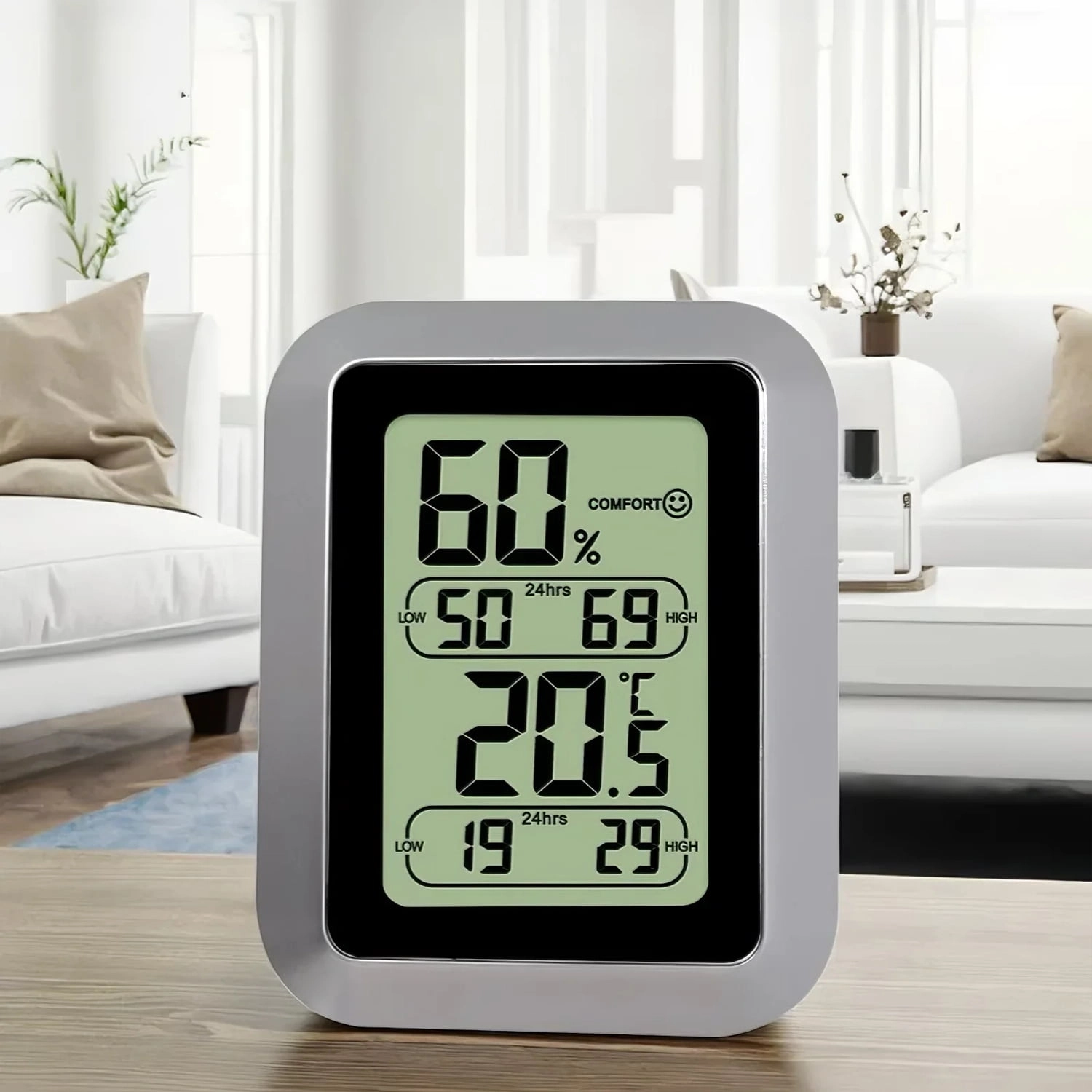
Custom Small Indoor Wall Mount Digital Lcd Room Greenhouse Home Wine Kitchen Garden High Accuracy 24h Minimum Maximum Registering Thermometer Hygro
The X-WSDJ005 is a compact, high-precision indoor wall-mountable digital LCD thermometer and hygrometer combo designed for home, greenhouse, wine cellar, kitchen, and garden use.
It combines 24-hour minimum/maximum temperature/humidity recording, dual-unit (°C/°F) display, and intuitive comfort indicators to help users monitor and optimize their indoor environment with ease.
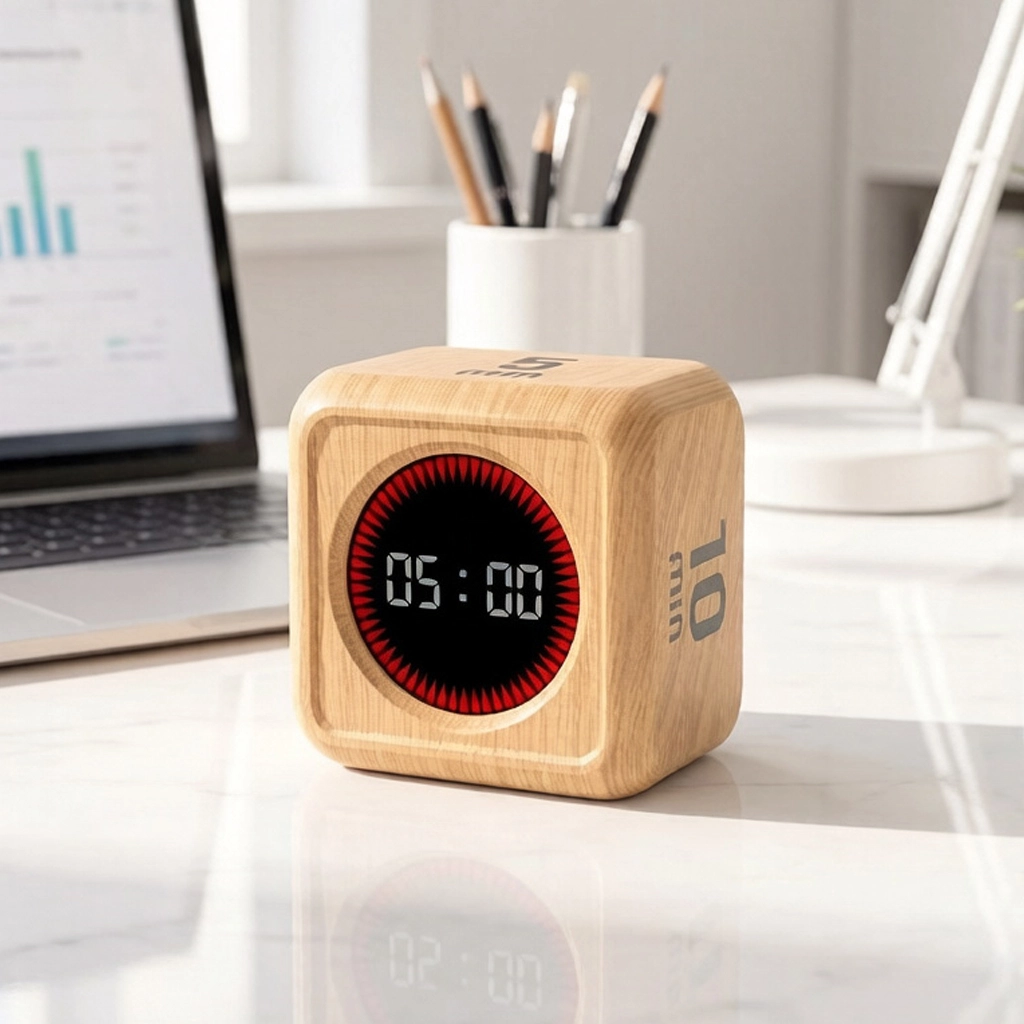
Wood Grain square Cube Timer Digital Gravity Sensor Timer Rechargeable Pomodoro Stopwatch Manufacturer
The X-JSQ814 Rubik’s Cube Timer reimagines timekeeping with a playful, cube-shaped design inspired by the iconic Rubik’s Cube. Blending nostalgia with functionality, it offers intuitive controls, smart gravity sensing, and versatile timing modes—perfect for anyone seeking a stylish, reliable tool to manage tasks at home, work, or play. Compact yet durable, it’s built to adapt to daily routines with ease.
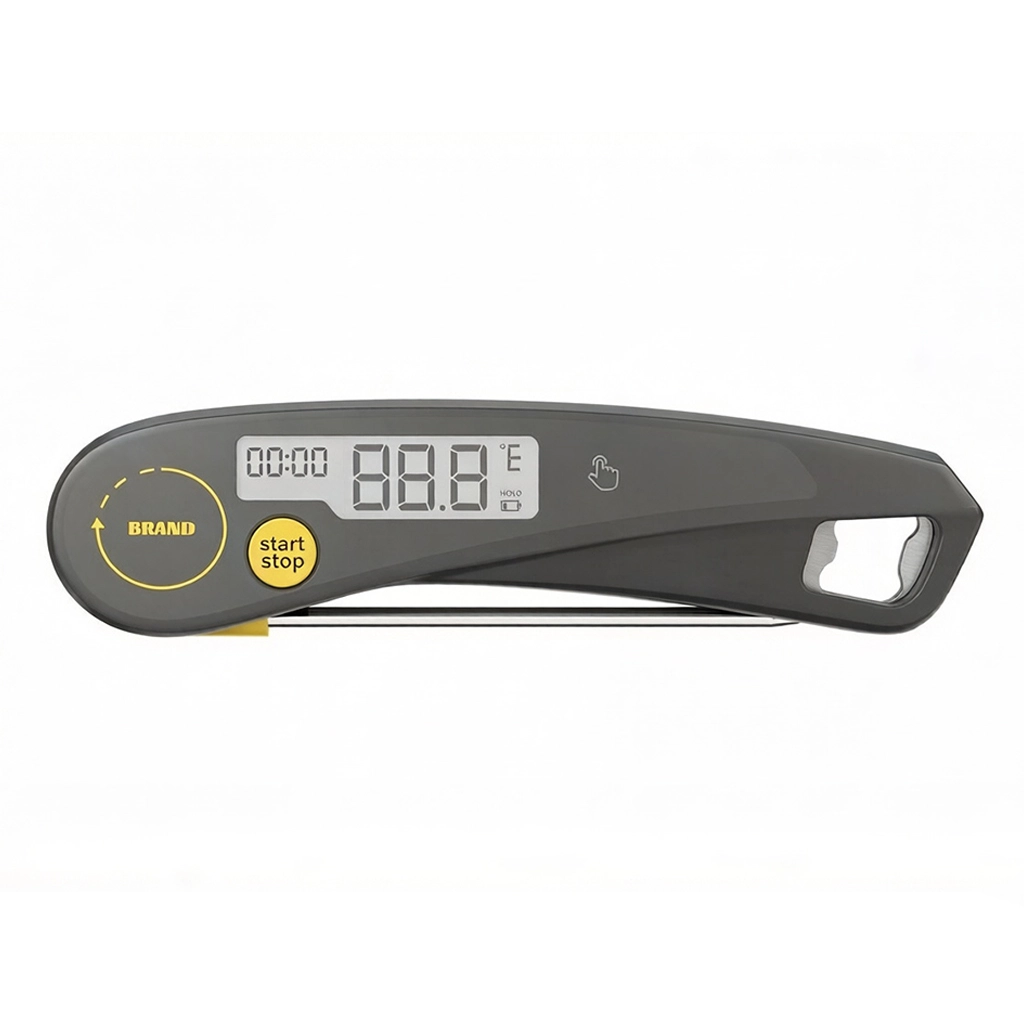
Digital Food Thermometer with Foldable Probe Timer Bottle Opener Meat Temperature Monitor
This digital food thermometer is designed for professional B2B buyers including e-commerce sellers, wholesalers, and OEM clients. Featuring a foldable stainless steel probe, it provides fast and accurate temperature readings from -50°C to 300°C with ±0.1°C precision. The built-in timer function (up to 59 minutes 59 seconds) supports efficient cooking control, while the °C/°F switch ensures global usability. Powered by a CR2450 button battery, it offers long-lasting performance. The ergonomic handle integrates a bottle opener, making it a practical 3-in-1 kitchen tool ideal for BBQ, grilling, baking, and food processing industries.
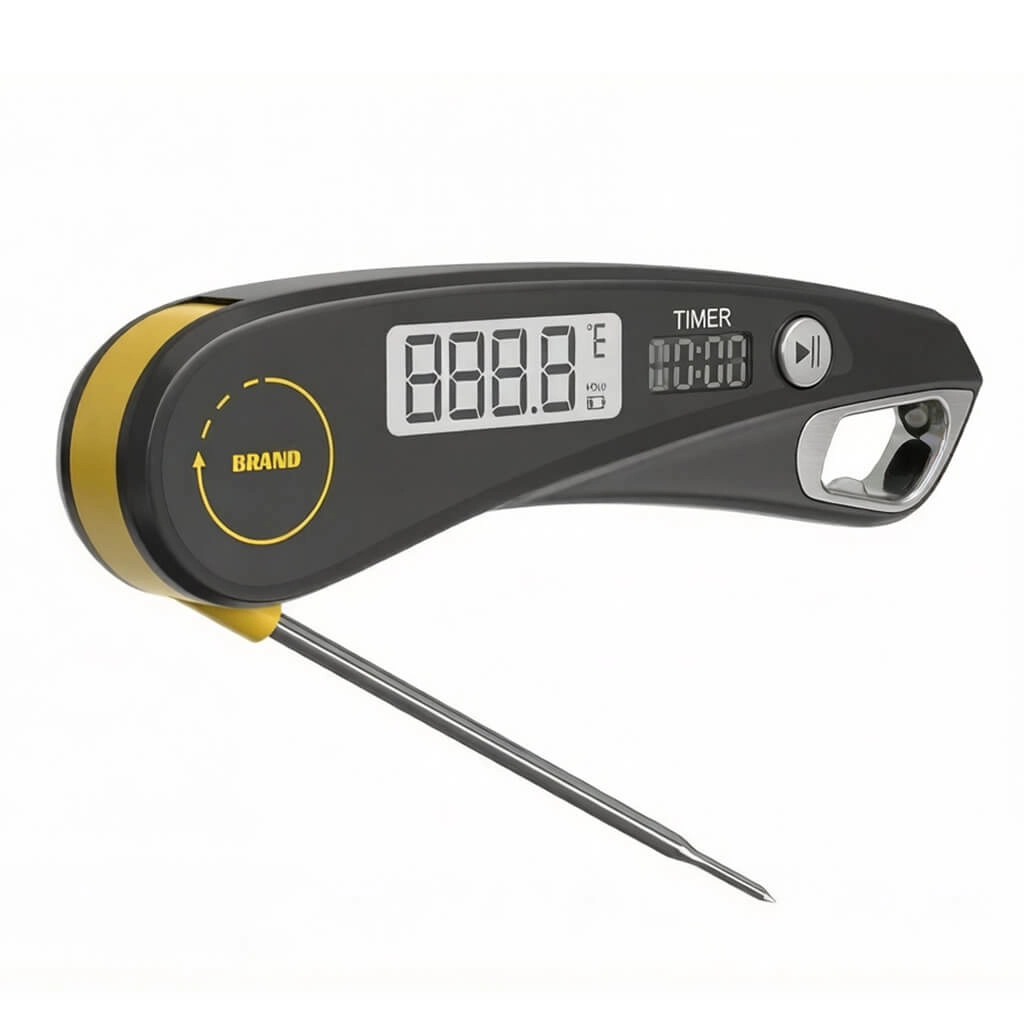
Digital Cooking Thermometer with Folding Probe Timer Multifunction Meat Thermometer Kitchen Tool
Engineered for commercial buyers and private label clients, this digital cooking thermometer delivers precision and versatility in one compact device. The folding stainless steel probe ensures safe handling and quick temperature detection across a wide range from -50°C to 300°C with ±0.1°C accuracy. Designed with an integrated timing system up to 59:59, it allows efficient cooking control for grilling, baking, and food preparation. The ergonomic handle features an added bottle opener, enhancing usability for outdoor and kitchen scenarios. Powered by a CR2450 battery, this thermometer is ideal for wholesalers, distributors, and e-commerce sellers seeking reliable and customizable solutions.

Youben life
Youben life