
Private Label Pomodoro Timer Packaging Strategies for Retail Brands and E-Commerce Sellers
- Building a Retail-Ready Packaging System for Time-Management Devices
- Start with channel, customer, and price architecture
- Balance shelf impact with parcel efficiency
- Design for fast comprehension and low return rates
- Packaging Specifications That Protect Brand Equity and Margin
- Select materials according to product risk and market expectations
- Integrate compliance and technical information early
- Use a structured cost model rather than unit price alone
- Operational Execution for Scalable Private-Label Launches
- Control artwork, samples, and approval gates
- Plan regional variants without creating unnecessary SKUs
- Validate the package in actual distribution conditions
- Why Youben life Supports Differentiated Timer Packaging Programs
- One integrated partner for product and package development
- Engineering depth improves packaging fit and differentiation
- Compliance, capacity, and commercial readiness
- Frequently Asked Questions
Packaging strategy determines more than how a digital Pomodoro timer looks on a retail shelf or in an e-commerce product image. It influences perceived value, shipping damage, fulfillment cost, product education, regulatory communication, return rates, and the speed at which a new time-management device can move from factory approval to market launch. For retail brands and online sellers, an effective packaging program combines structural protection, accurate technical information, brand differentiation, multilingual usability, sustainable material choices, and operational efficiency. The strongest private-label programs begin with the end customer, sales channel, target price, parcel network, compliance requirements, and replenishment model, then translate those commercial requirements into packaging specifications that a qualified OEM/ODM partner can reproduce consistently.
Building a Retail-Ready Packaging System for Time-Management Devices
Start with channel, customer, and price architecture
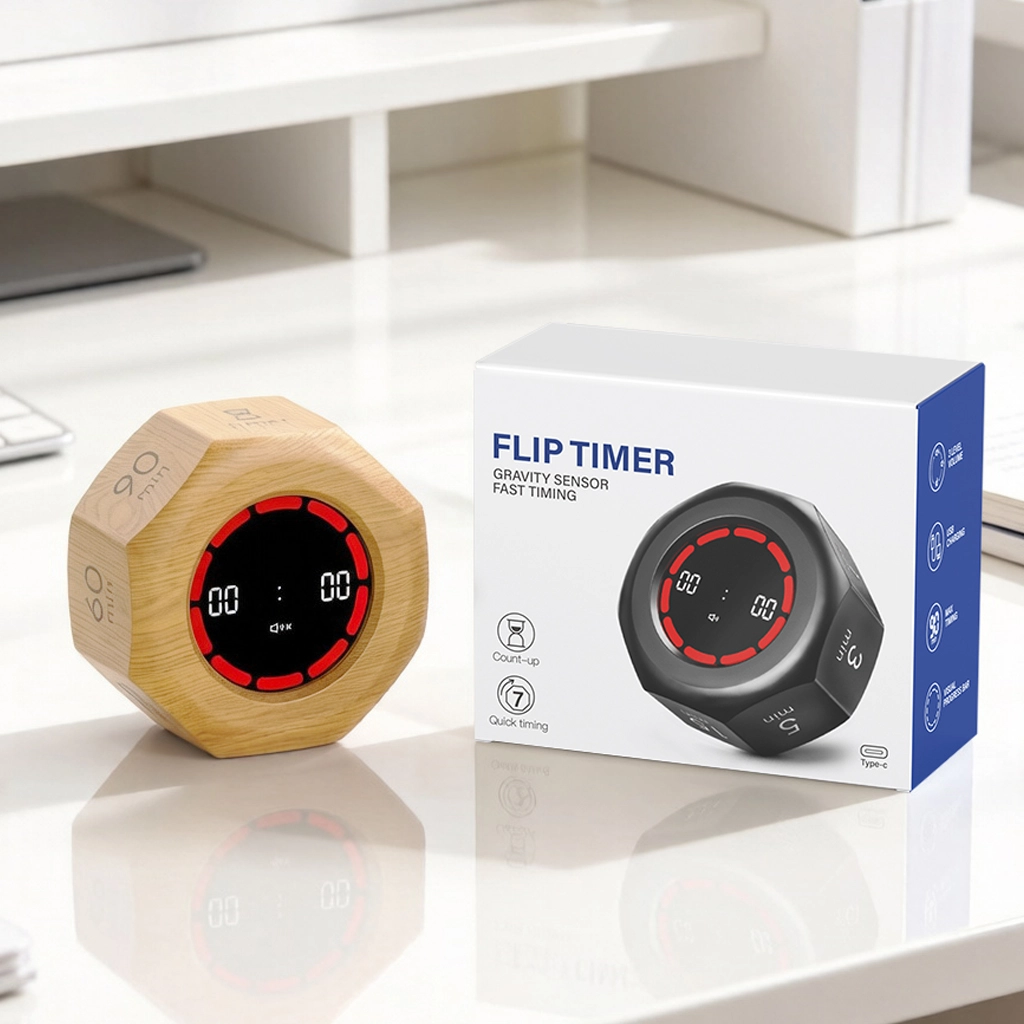
Packaging for a specialty stationery retailer should not follow the same logic as packaging for a marketplace fulfillment program. A shelf product needs strong front-panel communication, visible color coding, barcode placement, and a compact footprint that supports planogram efficiency. An e-commerce unit must withstand warehouse handling, parcel compression, vibration, and repeated transfers while presenting attractive imagery in digital listings. If the product is intended for corporate wellness programs, schools, or productivity subscription boxes, the package may need onboarding instructions, bulk identification, and simplified unpacking for large deployments.
Before artwork begins, project owners should define the target retail price, landed cost ceiling, expected order quantity, sales geography, package dimensions, and acceptable damage rate. These decisions establish whether a folding carton, rigid box, mailer, blister format, or carton-plus-paper-pulp insert is commercially appropriate. A low-cost entry product may benefit from a compact folding carton, while a High Quality visual countdown clock may justify a rigid presentation box with a molded insert. Packaging should support the product’s price position without consuming a disproportionate share of gross margin.
Balance shelf impact with parcel efficiency
High-contrast color blocks, clear product photography, and a concise benefit hierarchy help shoppers understand a timer within seconds. The front panel should normally communicate the product category, primary use case, display type, key operating benefit, and brand identity. Secondary panels can explain countdown, count-up, alarm, memory, silent mode, magnetic mounting, stand configuration, or battery information, provided each claim matches the approved product specification.
For e-commerce, dimensional efficiency is especially important because packaging volume affects carton utilization, storage, and parcel pricing. A package that is visually impressive but contains excessive empty space can increase freight cost and create a perception of waste. A structural engineer should use internal supports, corner protection, and controlled tolerances rather than simply increasing box size. Transit validation should consider drop, compression, vibration, and environmental exposure. The exact testing program depends on the distribution network and product fragility, but packaging decisions should be verified through documented samples instead of visual approval alone.
Design for fast comprehension and low return rates
Digital time-management products can appear simple while containing operating details that affect customer satisfaction. Buyers may need to understand how the work interval and break interval are adjusted, whether the alarm can be muted, how the display is oriented, how the device is powered, and whether the product supports a memory function. Packaging should direct customers to a concise quick-start guide, battery instructions, warranty information, and a QR code for digital support where appropriate.
Clear iconography is useful when it is supported by plain-language explanations. Avoid unverified claims such as clinically proven productivity improvement, guaranteed concentration, or universal compatibility. The Pomodoro Technique is commonly associated with alternating focused work sessions and breaks, but a hardware package should describe actual device functions rather than imply that the product delivers a particular behavioral outcome for every user.
Packaging Specifications That Protect Brand Equity and Margin
Select materials according to product risk and market expectations
Material selection should account for impact protection, print quality, moisture exposure, recyclability, assembly speed, and regional disposal requirements. Paperboard cartons can offer strong graphics and efficient storage, while molded pulp inserts can replace some plastic components when the product geometry allows it. Corrugated mailers may be appropriate for direct-to-consumer shipments, especially when an inner retail box is unnecessary. Plastic windows, laminates, coatings, magnets, foam, and mixed-material constructions should be reviewed carefully because they can complicate recycling and increase procurement complexity.
Environmental communication must remain precise. Terms such as recyclable, recycled content, plastic-free, or FSC-certified should only be used when the relevant material, chain-of-custody documentation, or local claim standard supports them. The ISO 14021 environmental label standard provides a useful reference for self-declared environmental claims. A buyer should also verify whether a packaging statement is valid in every destination market rather than transferring one country’s claim language globally.
Integrate compliance and technical information early
Packaging is part of the customer-facing compliance system. Depending on the destination and product configuration, artwork may need model identification, importer or responsible-person details, battery warnings, disposal symbols, electrical ratings, barcode data, and market-specific marks. For products containing electronic components, the supplier should identify applicable requirements before mass printing. The European Union RoHS Directive addresses the restriction of certain hazardous substances in electrical and electronic equipment, while the FCC Part 15 regulations cover relevant unintentional radiators in the United States.
Compliance marks should never be added as decorative elements without technical validation. Artwork control should include a master specification, approved dieline, color references, barcode verification, translation review, revision history, and a sign-off process linking the package version to the product hardware version. This prevents a common procurement problem in which packaging describes a previous firmware feature, battery type, display mode, or accessory configuration.
Use a structured cost model rather than unit price alone
Packaging cost should be evaluated as total landed packaging cost. The model should include material, printing plates, tooling, inserts, assembly labor, cartons, palletization, storage, freight, inspection, damage, and disposal. A slightly more expensive insert can produce a lower total cost if it reduces breakage and customer returns. Similarly, a smaller carton may reduce freight and warehouse charges enough to justify a more engineered internal structure.
Procurement teams should request a packaging bill of materials and identify one-time charges separately from recurring unit costs. Tooling ownership, minimum order quantities, spare packaging components, artwork revisions, and lead times should be stated in the quotation. The following comparison illustrates how common packaging options typically differ in commercial priorities; actual performance depends on design, supplier process, and distribution conditions.
| Packaging format | Primary advantage | Typical limitation | Best-fit channel |
|---|---|---|---|
| Folding carton with paper insert | Efficient graphics, storage, and shelf presentation | Requires accurate internal fit and moisture control | Retail and standard e-commerce |
| Rigid presentation box | High Quality perceived value and strong presentation | Higher material, storage, and freight cost | High Quality retail and gifting |
| Corrugated mailer | Good parcel protection and direct-shipping efficiency | Less suitable for high-impact shelf merchandising | Direct-to-consumer and subscription programs |
| Blister or plastic display pack | Strong product visibility and tamper evidence | More difficult material separation and recycling | Selected mass retail applications |
| Molded pulp insert | Paper-based cushioning and reduced plastic use | Geometry, dust, and surface-finish constraints | Sustainability-led retail and e-commerce |
Operational Execution for Scalable Private-Label Launches
Control artwork, samples, and approval gates
A scalable packaging project uses formal approval gates: concept direction, structural prototype, blank sample, printed color proof, production sample, pilot run, and mass-production release. Each gate should have a named decision owner and acceptance criteria. Buyers should approve the physical package with the final product inside it, because cable routing, battery access, buttons, display visibility, and accessory placement can change the fit.
Digital artwork files should be controlled through revision numbers and locked after final approval. Barcode readability should be checked on the production print rather than only in a design file. Translations should be reviewed by native-language specialists, particularly for warnings, battery instructions, and customer support information. A packaging inspection checklist should cover dimensions, print registration, color consistency, surface defects, adhesive strength, insert orientation, barcode quality, and carton marks.
Plan regional variants without creating unnecessary SKUs
Global sellers often need different languages, importer information, electrical labeling, recycling symbols, or regulatory statements by market. Creating a separate printed box for every region can increase minimum order quantities and create obsolete inventory. A better approach may combine a globally consistent base package with localized labels, over-sleeves, multilingual panels, or region-specific instruction leaflets. The correct solution depends on sales volume, regulatory obligations, customer experience expectations, and warehouse capability.
SKU governance is essential when a brand sells several display sizes, colors, battery configurations, or timer functions. Each package should have a unique internal code linked to the product model, firmware version, accessory list, and market destination. This reduces fulfillment errors and helps customer service identify the correct manual or replacement component. A reliable supplier should support version traceability from raw materials through finished goods.
Validate the package in actual distribution conditions
Laboratory testing is valuable, but field conditions can reveal issues that controlled tests miss. A project team should review warehouse stacking, pallet height, courier handling, seasonal humidity, temperature changes, and consumer opening behavior. Products with LCD or LED displays may require additional protection from pressure points, while units with magnets, stands, or detachable accessories need secure retention during transit.
Quality planning should define acceptable quality limits, inspection levels, sampling methods, and corrective-action procedures. The ISO 9001 quality management principles provide a recognized framework for controlled processes, documented information, continual improvement, and customer-focused operations. Certification alone does not replace product-specific inspection, but a mature quality system improves consistency across packaging suppliers, production batches, and replenishment orders.
Why Youben life Supports Differentiated Timer Packaging Programs
One integrated partner for product and package development
Our team at Youben life supports brands that need more than a generic stock unit placed in a printed carton. Established in 2010, we are an OEM/ODM manufacturer dedicated to Digital Timers, Pomodoro timers, Visual Countdown Clocks, temperature and humidity monitors, and thermo-hygrometers. This focused product specialization allows packaging decisions to be coordinated with industrial design, electronic architecture, display geometry, button layout, battery access, mounting options, and final assembly requirements.
Our 20,000m² vertically integrated facility in Guangzhou, China, supports turnkey development for global brands and Amazon bestsellers. We cover ID and MD industrial design, custom IC programming, precision mold tooling, product engineering, manufacturing, quality control, and retail-ready packaging. This integrated workflow reduces communication gaps between a packaging agency, electronics factory, mold supplier, and final assembler. It also helps project owners evaluate the total commercial effect of a packaging change before committing to production.
Engineering depth improves packaging fit and differentiation
A distinctive package is most effective when the hardware beneath it is equally differentiated. Our engineering team can support custom product concepts such as compact desktop timers, large-display visual countdown clocks, magnetic models, classroom devices, productivity tools, and environmental monitoring products. Packaging can then communicate genuine product benefits, including display readability, operating modes, mounting flexibility, low-power operation, or combined time and environmental data, instead of relying on generic claims.
For brands expanding from time-management hardware into adjacent categories, our portfolio includes Digital Timer products, pomodoro timer solutions, thermo hygrometer devices, and temperature humidity monitor products. This broader capability can simplify supplier management and create a consistent visual language across a productivity or home-environment product family. A unified packaging system may use shared typography, color architecture, icon rules, and instruction conventions while preserving clear model-level differentiation.
Compliance, capacity, and commercial readiness
Our products are developed to meet strict CE, FCC, and RoHS requirements, with compliance planning integrated into product and packaging workflows. Buyers should still confirm the exact certification and documentation package required for the target market and product configuration. Our decade-plus engineering experience and scalable manufacturing capacity help support pilot orders, retail launches, repeat replenishment, and larger programs without treating packaging as an afterthought.
For procurement teams, the practical value of this model is accountability. A single experienced partner can coordinate design revisions, tooling changes, electronic functions, packaging fit, inspection standards, and production schedules. This reduces the risk that a package will be approved before the final hardware is stable or that an attractive retail concept will fail during carton packing and shipment. It also gives brand owners a clearer path to cost control, quality consistency, and future model extensions.
Retail brands and e-commerce sellers planning a differentiated time-management product should evaluate supplier capability across design, engineering, compliance, packaging, and scale rather than comparing assembly prices alone. Youben life provides a structured route from concept development to retail-ready production, helping partners strengthen brand identity and build a coherent family of time and environmental monitoring products.
Contact Youben life at info@youbenlife.com or visit our product and OEM/ODM platform to discuss a retail-ready digital timer packaging program.
Frequently Asked Questions
What packaging format is best for a digital Pomodoro timer sold online?
A folding carton with a protective paper insert is often suitable for standard e-commerce, while a corrugated mailer can provide additional parcel protection for direct-to-consumer shipments. The correct choice depends on product fragility, parcel handling, presentation requirements, and total landed cost.
What information should appear on timer packaging?
Packaging should accurately communicate the product category, key operating functions, power or battery information, model identification, applicable warnings, barcode data, support details, and required market-specific compliance information. Every claim should match the approved hardware and documentation.
How can brands reduce packaging damage and returns?
Brands should validate the internal fit, protect displays and detachable accessories, conduct distribution-relevant drop and compression testing, and inspect production samples with the final product inside the package. Clear quick-start instructions can also reduce setup errors and avoid preventable returns.
Can one package design support multiple international markets?
A global base package combined with localized labels, sleeves, instruction leaflets, or market-specific stickers may reduce SKU complexity. The best approach depends on language, importer information, regulatory marks, sales volume, warehouse processes, and destination-market requirements.
What should buyers ask an OEM packaging supplier before placing an order?
Buyers should ask about structural design capability, tooling ownership, material specifications, minimum order quantities, artwork control, barcode verification, compliance documentation, packaging inspection standards, transit validation, lead times, regional variants, and the supplier’s ability to coordinate product engineering with final packaging.
Why is integrated product and packaging development useful?
Integrated development allows industrial design, electronics, mold tooling, assembly, compliance, and packaging fit to be reviewed together. This can reduce revision cycles, prevent mismatched artwork, improve protection, simplify supplier management, and support more consistent quality during scale-up.
Wholesale industrial programmable digital timer manufacturer and supplier
Smart Focus Timer Features That Improve Employee Productivity
Top Electronic Kitchen Timer Models Compared for 2026
Top 10 home electronics Manufacturers and Supplier Brands
Interested in this article?
Let’s talk.
Need specifications, pricing, or customization options? We’ll provide everything you need.

Youben life
Youben life