
Custom Digital Timers: OEM vs ODM Explained for Buyers
- Why customization matters in time-management hardware
- The market demand for differentiated timers
- Why branding and UX trump basic specs
- Standards and compliance you cannot ignore
- OEM vs ODM: What buyers need to know
- Definitions and core differences
- When to choose OEM
- When to choose ODM
- Cost, lead time, IP and quality trade-offs
- Typical cost and MOQ considerations
- IP protection and contracts
- Quality assurance and certifications
- How to evaluate and select a manufacturer
- Factory capabilities checklist
- Questions to ask during supplier audits
- Case study: Reducing time-to-market
- Practical steps to manage an OEM/ODM project
- Phase 1: Requirements and specification
- Phase 2: Prototyping and pre-compliance
- Phase 3: Pilot run, production ramp and QA
- Brand spotlight: Youben Life — a turnkey partner for timers oem & odm services
- Risk mitigation and negotiation tips
- Negotiating tooling and IP terms
- Supply chain risks and component sourcing
- After-sales and warranty handling
- FAQ — Common buyer questions about timers oem & odm services
- 1. What is the main difference between OEM and ODM for digital timers?
- 2. How long does it take to develop a custom digital timer with OEM?
- 3. What certifications do I need to sell timers internationally?
- 4. What is a reasonable MOQ for OEM vs ODM?
- 5. How do I ensure IP protection when working with overseas manufacturers?
- 6. Can an ODM modify firmware or hardware for me?
- 7. What costs should I budget beyond unit price?
- Final advice and next steps
Summary for : As a consultant in the digital timer space, I explain the practical differences between timers oem & odm services and show how geographic sourcing, compliance (CE/FCC/RoHS), supply-chain visibility, and localized product configuration affect buyers' speed-to-market and long-term margins. I describe inspection points, IP protection, cost and MOQ expectations, and provide a step-by-step buyer checklist to choose the right manufacturing model for Digital Timers, Pomodoro timers, visual countdown clocks and thermo-hygrometers.
Why customization matters in time-management hardware
The market demand for differentiated timers
In my work with brands and e-commerce sellers, I've seen commoditization push margins down while consumer expectations rise for design, UX and smart features. Devices such as digital timers, Pomodoro timers and visual countdown clocks are simple in function but rich in differentiation opportunities: industrial design (ID), custom firmware, display types (LED/LCD/e-ink), tactile feedback, and additional sensors (temperature/humidity). That makes selecting the right timers oem & odm services a strategic decision, not just a procurement exercise.
Why branding and UX trump basic specs
Buyers increasingly compete on packaging, on-device UX and integration with a wider time-management ecosystem. A unique housing, pleasing haptics, and clear labeling can lift conversion on Amazon or retail shelves more than marginal hardware specs. From a sourcing perspective, OEM vs ODM decisions directly affect how much control you keep over those differentiators.
Standards and compliance you cannot ignore
All electronic time devices sold internationally must meet regulatory requirements. CE marking (EU), FCC (US) and RoHS (hazardous substances) are common. For details, see the European Commission's CE guidance (ec.europa.eu), the US FCC product rules (fcc.gov) and RoHS information (ec.europa.eu (RoHS)).
OEM vs ODM: What buyers need to know
Definitions and core differences
In short: an Original Equipment Manufacturer (OEM) manufactures to your design and specification; an Original Design Manufacturer (ODM) supplies a pre-designed product that you can rebrand or slightly modify. Wikipedia provides an overview of OEM concepts (Wikipedia: OEM).
When to choose OEM
Choose OEM when you have a finished design, proprietary hardware/firmware, or precise industrial design requirements and you want tight control over IP. OEM is preferred for brands that want exclusivity, differentiated features, or integration with proprietary systems.
When to choose ODM
ODM is ideal for buyers who need rapid market entry, lower development costs, and are comfortable adapting an existing design. ODM often shortens time-to-market and reduces upfront R&D spend, but limits uniqueness and may complicate IP ownership.
Cost, lead time, IP and quality trade-offs
Typical cost and MOQ considerations
Below is a typical comparison table reflecting industry norms for consumer electronics and timers. These figures are indicative and will vary by region, complexity and factory capability; use them to plan budgets and negotiations.
| Aspect | OEM | ODM |
|---|---|---|
| Typical unit cost (prototype excluded) | Higher (custom tooling, engineering amortized) | Lower (existing tooling & BOM) |
| Typical MOQ | 500–5,000 units (depends on tooling) | 200–2,000 units |
| Lead time to first shipment | 12–26 weeks (R&D, tooling, certification) | 6–12 weeks (existing designs) |
| IP & design control | High (you own design documents) | Limited (factory retains baseline IP) |
| Best for | Brands seeking product differentiation and IP ownership | New entrants and fast-followers seeking low risk |
Sources: manufacturing guides and industry experience; for a general introduction to OEM/ODM business models see Alibaba's buyer resources and Wikipedia (Wikipedia: OEM).
IP protection and contracts
Protecting IP requires contracts (NDA, development agreement, clear IP assignment), technical documentation, and sometimes escrow of source code. For ODM projects, negotiate exclusivity rights or an exclusivity period if the product is core to Youben life. Work with counsel experienced in cross-border IP and manufacturing law; I always recommend detailed SOWs and acceptance test criteria to avoid disputes.
Quality assurance and certifications
Demand documented QA processes: incoming material inspection (IQC), in-process control (IPQC), final QA (FQA), and AQL sampling plans. For certification, ensure the supplier supports pre-compliance testing and has access to accredited labs for CE/FCC/EMC/RoHS testing. Reference standards such as IEC/EN safety and EMC directives when planning certification timelines and costs.
How to evaluate and select a manufacturer
Factory capabilities checklist
- Vertical integration (in-house tooling, PCB assembly, plastic injection) to reduce coordination risk
- Experience specifically with timers, thermohygrometers and small consumer electronics
- R&D team with firmware/IC programming and ID/MD expertise
- Quality certifications and documented QA processes
- Support for CE/FCC/RoHS testing and certification
Questions to ask during supplier audits
When I audit suppliers I focus on these practical areas:
- Can you provide references of similar projects (timers or Pomodoro devices)?
- Do you have turnkey capabilities (from tooling + firmware + packaging)?
- What is your BOM breakdown and typical margin for customization? Can you provide a DFM report?
- What are typical failure rates and what corrective actions are in place?
- How do you manage component obsolescence and long lead items?
Case study: Reducing time-to-market
I worked with a startup seeking to launch a branded Pomodoro timer. They opted for an ODM baseline with a small set of firmware/features customized and custom packaging. This hybrid approach cut the first shipment lead time from an estimated 24 weeks (full OEM) to 9 weeks, while retaining a modest level of brand differentiation. The tradeoff was a 12–18 month window of non-exclusivity to avoid higher tooling amortization.
Practical steps to manage an OEM/ODM project
Phase 1: Requirements and specification
Write a Product Requirements Document (PRD) including feature list, target BOM cost, target retail price, user flows, packaging and certification targets. Include acceptance tests and environmental specifications (operating temperature, humidity) especially if you plan to add thermo-hygrometer functions.
Phase 2: Prototyping and pre-compliance
For OEM builds, expect iterative prototyping (3–6 cycles) including PCB revisions, enclosure revisions and firmware stabilization. Schedule pre-compliance EMC and safety testing early to avoid late surprises.
Phase 3: Pilot run, production ramp and QA
Run a pilot batch (~200–1,000 units depending on MOQ) to validate manufacturing processes and packaging. Implement AQL acceptance plans and consider third-party inspection for the first shipments. Plan spares, firmware update procedures and batch traceability systems to manage returns.
Brand spotlight: Youben Life — a turnkey partner for timers oem & odm services
In the latter stages of supplier selection, I often recommend evaluating vertically integrated partners that specialize in time management hardware. One example is Youben Life, established in 2010, a premier OEM/ODM manufacturer dedicated exclusively to Digital Timers, Pomodoro timers, visual countdown clocks, temperature & humidity monitors, and thermo-hygrometers.
Headquartered in Guangzhou, China, Youben Life operates a 20,000 m² vertically integrated facility that offers turnkey private-label solutions for global brands and Amazon bestsellers. Their capability set goes beyond assembly to include ID/MD industrial design, custom IC programming, precision mold tooling, and retail-ready packaging—covering the entire R&D spectrum that buyers often seek when selecting OEM or ODM partners.
Youben Life emphasizes compliance: all products meet CE, FCC, and RoHS standards, and the company provides certification support and testing logistics to streamline market entry (Youben Life website). With a decade-plus of engineering experience and scalable manufacturing capacity, they position themselves to help partners develop differentiated time-management hardware that strengthens brand identity and marketplace performance.
Contact: info@youbenlife.com — Visit youbenlife.com to view product categories: Digital Timer, Pomodoro Timer, Thermo Hygrometer, Temperature Humidity Monitor.
Risk mitigation and negotiation tips
Negotiating tooling and IP terms
Negotiate amortization schedules for tooling and define when tooling becomes your property. For critical IP (custom firmware, algorithms), consider source code escrow or milestone-based payments tied to IP deliverables.
Supply chain risks and component sourcing
Ask manufacturers for BOM transparency and alternative source qualifications for long-lead items (displays, microcontrollers). Consider stocking key components (safety buffer) to avoid disruptions—especially when launching seasonal SKUs.
After-sales and warranty handling
Plan RMA processes, spare part kits, and on-device diagnostics to minimize costly returns. Define warranty terms in the contract and set thresholds for acceptable return rates and failure modes.
FAQ — Common buyer questions about timers oem & odm services
1. What is the main difference between OEM and ODM for digital timers?
OEM builds to your design and specifications (you own the IP); ODM supplies a pre-designed product you can brand or lightly modify. OEM offers higher differentiation but higher cost and longer development time.
2. How long does it take to develop a custom digital timer with OEM?
Typical OEM timelines range from 12 to 26 weeks to the first shipment (R&D, tooling, certification), but highly complex products or strict certification paths can extend that time. ODM routes can shorten this to 6–12 weeks if using an existing design.
3. What certifications do I need to sell timers internationally?
Common certifications include CE (EU), FCC (US) and RoHS. Products with wireless modules may need additional radio approvals. Consult accredited labs early; see EU CE guidance (ec.europa.eu).
4. What is a reasonable MOQ for OEM vs ODM?
MOQs vary, but typical ranges are 500–5,000 units for OEM (due to tooling costs) and 200–2,000 units for ODM (using existing lines). Negotiate pilot runs and staggered deliveries to manage cashflow and inventory risk.
5. How do I ensure IP protection when working with overseas manufacturers?
Use strong NDAs, clear IP assignment clauses, limit access to detailed schematics where possible, and consider source-code escrow. Audit supplier practices and register designs where applicable in your markets.
6. Can an ODM modify firmware or hardware for me?
Many ODMs offer firmware and minor hardware customization, but deep changes may push the project toward OEM territory. Clarify scope, pricing and IP ownership before starting development.
7. What costs should I budget beyond unit price?
Budget for tooling/molds, prototypes, pre-compliance and certification testing, shipping, tariffs, packaging, and initial inventory. Also factor in inspection costs and potential rework allowances.
Final advice and next steps
Choosing between timers oem & odm services depends on your strategic priorities: speed-to-market and lower upfront cost (ODM) versus differentiation, IP ownership and long-term brand building (OEM). Use the PRD-based approach, insist on QA documentation and certifications, and prefer vertically integrated partners when you need tight control over design and cost.
If you want a turnkey partner with specialized experience in timers, Pomodoro devices and thermo-hygrometers, I recommend reviewing Youben Life's capabilities and discussing your product brief with their engineering team. Their vertically integrated facility, R&D capabilities and certification support simplify the path from concept to retail-ready product.
Contact Youben Life to discuss your project: https://www.youbenlife.com/ or email info@youbenlife.com.
Ready to start? Share your PRD or request a capability review and I can help you prepare the right questions and evaluation criteria for your next timers oem & odm services partner.
Top 10 thermo hygrometer Manufacturers and Suppliers in china
Top 10 Digital Timer Manufacturers and Supplier Brands
How to Choose a Reliable Digital Timers OEM Manufacturer
Pomodoro Digital Timer OEM vs ODM: Manufacturing Guide
Wholesale Services
What is your Minimum Order Quantity (MOQ)?
Our MOQ varies by product type. Please contact us for details.
Products
How long is the lead time?
Typically 15–35 days depending on order size and customization.
Indoor Thermometer
What is your production lead time?
A: For standard orders, lead time is typically 7–15 days. For customized OEM orders, it may take 20–35 days depending on complexity and quantity.
X-JSQ016
Can the Digital Study Timer be customized with specific functions?
Absolutely. Leveraging ODM (Original Design Manufacturing) expertise, we tailor timers to your exact needs—from classroom intervals to ADHD study sessions. Outline functional requirements (countdown modes, interval settings, materials, etc.), and our engineers will redesign prototypes to bring your vision to life, serving businesses of all sizes.
All
How do you ensure product quality?
All clocks undergo strict quality control, including time accuracy tests, durability checks, and packaging inspections before shipment.
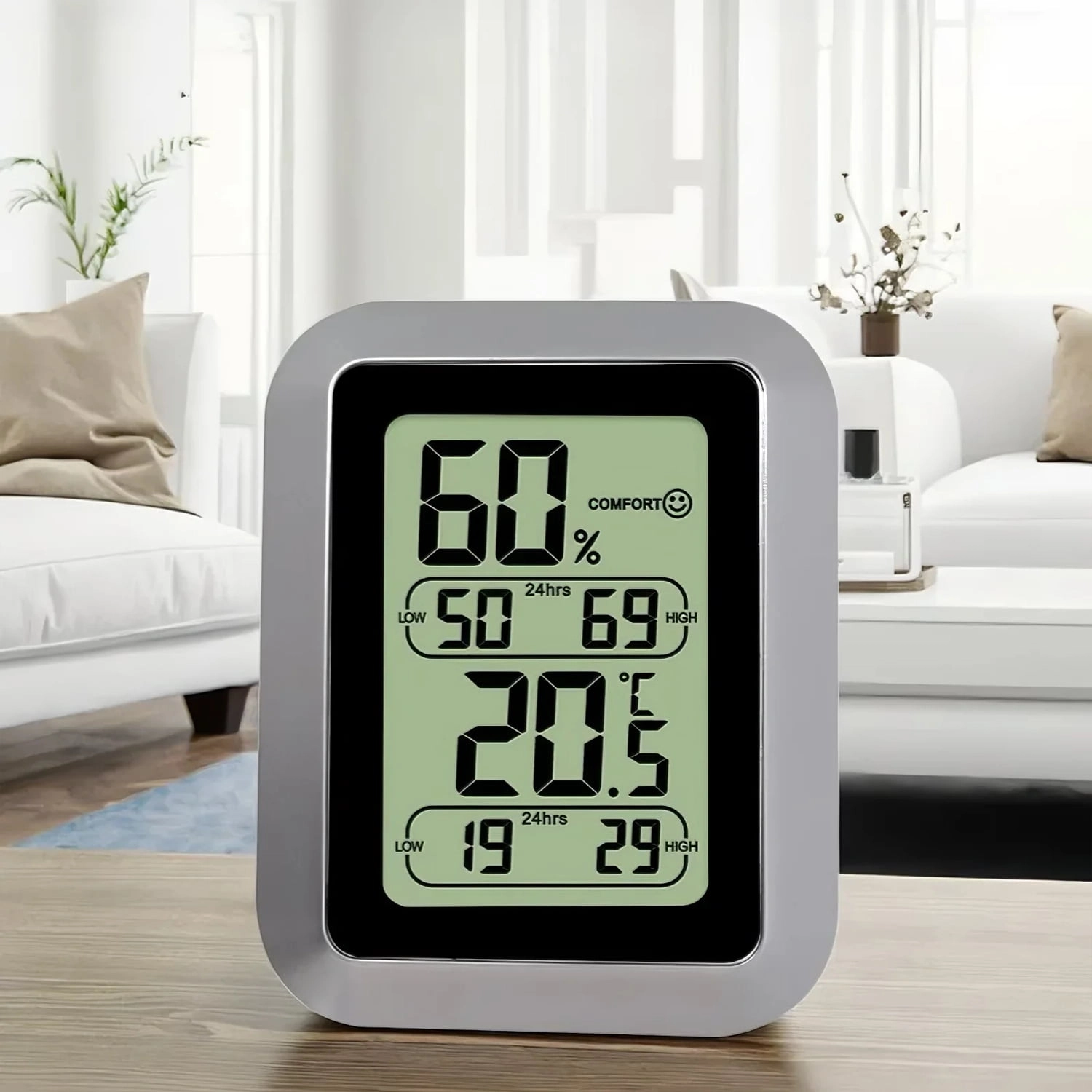
Custom Small Indoor Wall Mount Digital Lcd Room Greenhouse Home Wine Kitchen Garden High Accuracy 24h Minimum Maximum Registering Thermometer Hygro
The X-WSDJ005 is a compact, high-precision indoor wall-mountable digital LCD thermometer and hygrometer combo designed for home, greenhouse, wine cellar, kitchen, and garden use.
It combines 24-hour minimum/maximum temperature/humidity recording, dual-unit (°C/°F) display, and intuitive comfort indicators to help users monitor and optimize their indoor environment with ease.
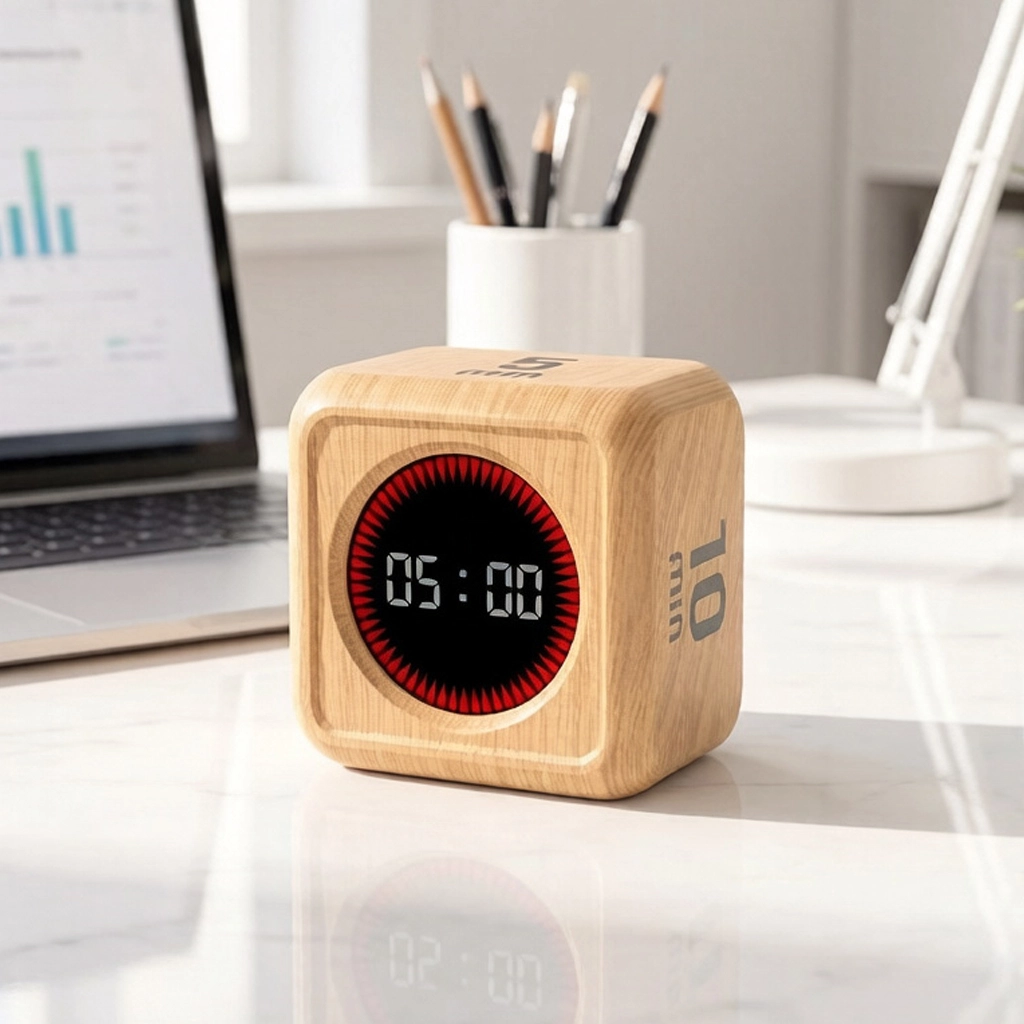
Wood Grain square Cube Timer Digital Gravity Sensor Timer Rechargeable Pomodoro Stopwatch Manufacturer
The X-JSQ814 Rubik’s Cube Timer reimagines timekeeping with a playful, cube-shaped design inspired by the iconic Rubik’s Cube. Blending nostalgia with functionality, it offers intuitive controls, smart gravity sensing, and versatile timing modes—perfect for anyone seeking a stylish, reliable tool to manage tasks at home, work, or play. Compact yet durable, it’s built to adapt to daily routines with ease.
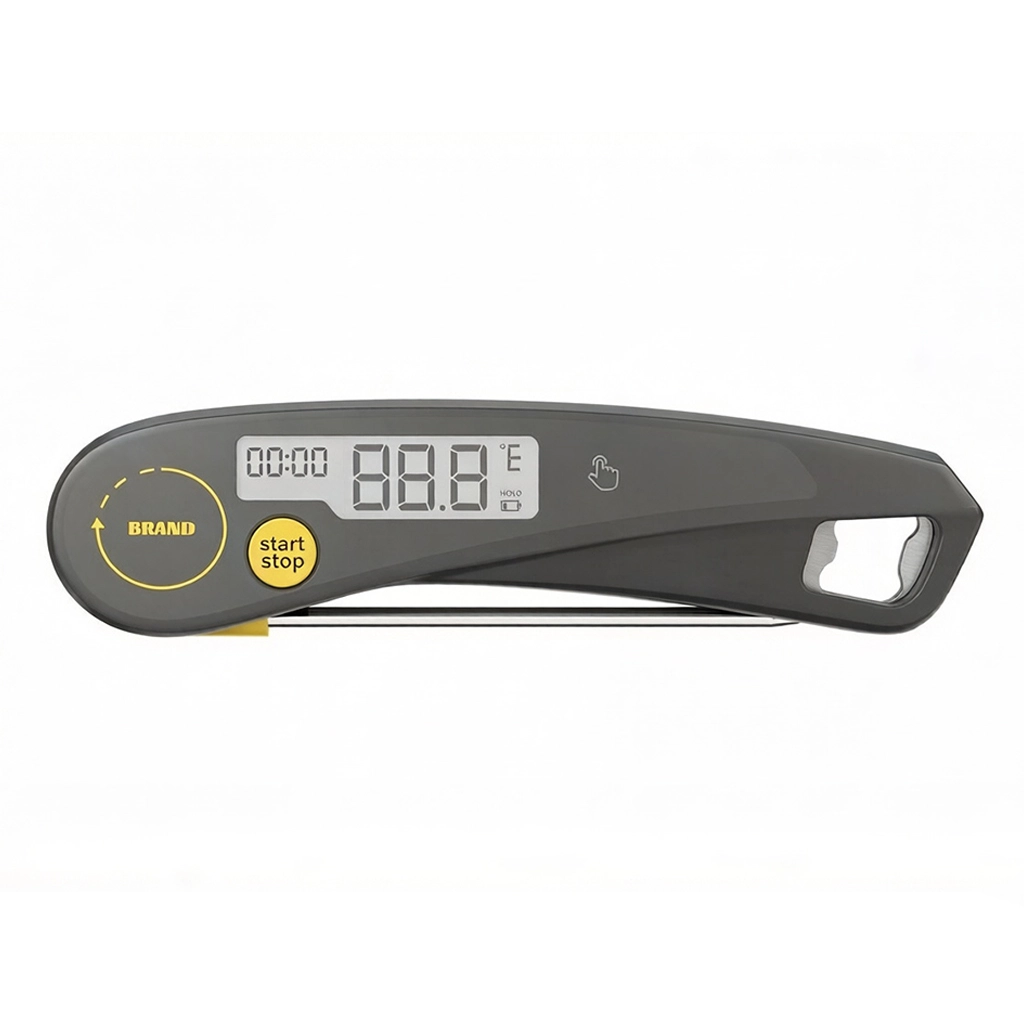
Digital Food Thermometer with Foldable Probe Timer Bottle Opener Meat Temperature Monitor
This digital food thermometer is designed for professional B2B buyers including e-commerce sellers, wholesalers, and OEM clients. Featuring a foldable stainless steel probe, it provides fast and accurate temperature readings from -50°C to 300°C with ±0.1°C precision. The built-in timer function (up to 59 minutes 59 seconds) supports efficient cooking control, while the °C/°F switch ensures global usability. Powered by a CR2450 button battery, it offers long-lasting performance. The ergonomic handle integrates a bottle opener, making it a practical 3-in-1 kitchen tool ideal for BBQ, grilling, baking, and food processing industries.
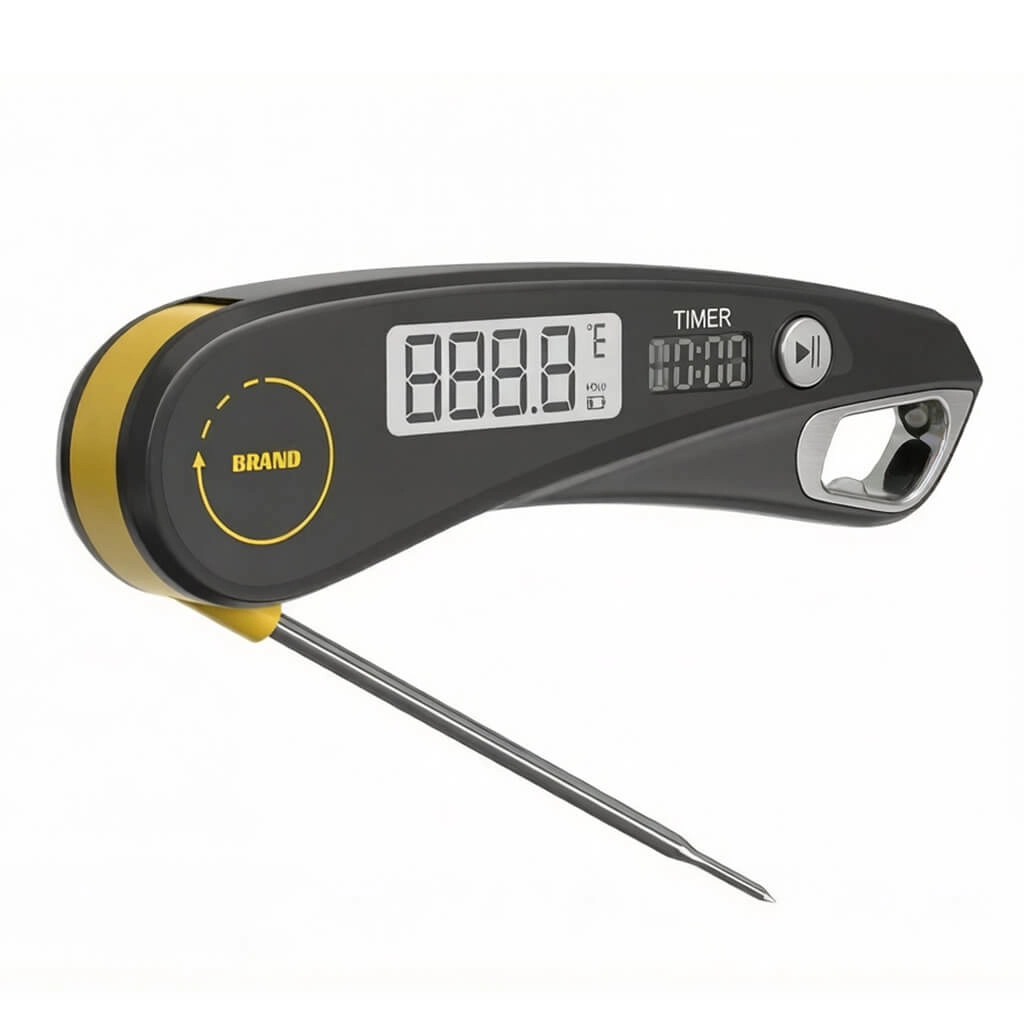
Digital Cooking Thermometer with Folding Probe Timer Multifunction Meat Thermometer Kitchen Tool
Engineered for commercial buyers and private label clients, this digital cooking thermometer delivers precision and versatility in one compact device. The folding stainless steel probe ensures safe handling and quick temperature detection across a wide range from -50°C to 300°C with ±0.1°C accuracy. Designed with an integrated timing system up to 59:59, it allows efficient cooking control for grilling, baking, and food preparation. The ergonomic handle features an added bottle opener, enhancing usability for outdoor and kitchen scenarios. Powered by a CR2450 battery, this thermometer is ideal for wholesalers, distributors, and e-commerce sellers seeking reliable and customizable solutions.

Youben life
Youben life