
How to Choose a Reliable Digital Timers OEM Manufacturer
- Understanding Buyer Intent: What Brands Seek from Timer Suppliers
- Primary business objectives driving OEM/ODM selection
- Common user pain points and how suppliers should address them
- mapping for timers oem & odm services
- Technical and Capabilities Checklist for Digital Timer Manufacturers
- Engineering and R&D depth
- Prototyping, tooling, and NPI services
- Testing, QA and regulatory compliance
- Commercial Considerations: MOQ, Lead Times, and Cost Structure
- Minimum order quantities and pricing transparency
- Lead times, capacity planning and scalability
- Warranty, returns and repair policies
- Risk Management, IP Protection, and Compliance
- IP ownership and NDA best practices
- Supply chain transparency and ethical sourcing
- Quality systems and certifications
- Practical Supplier Evaluation — Questions, On-site Checks, and Red Flags
- Key questions to ask during supplier evaluation
- On-site inspection checklist
- Common red flags
- Comparison: OEM vs. ODM — Which Model Fits Your Strategy?
- Youben Life — A Case Study in Full-Spectrum Timers OEM/ODM
- What differentiates Youben Life
- Capabilities and production profile
- How they align with the buyer checklist
- Supplier Selection Roadmap — Step-by-Step
- Stage 1 — Discovery and shortlisting
- Stage 2 — Technical due diligence and samples
- Stage 3 — Pilot and contractual safeguards
- Quantitative Comparison Table — Typical Metrics to Request
- Conclusion and Actionable Next Steps
- Frequently Asked Questions (FAQ)
- 1. What is the difference between OEM and ODM for digital timers?
- 2. Which certifications should I require from a digital timer manufacturer?
- 3. How do I protect my firmware and IP with an OEM/ODM partner?
- 4. What are reasonable lead times for prototypes and mass production?
- 5. How many units should I run in a pilot batch?
- 6. Can an OEM/ODM handle Amazon FBA packaging and labeling?
- Contact & Next Steps
I often get asked by product managers and brand owners: how do you pick a reliable partner for timers oem & odm services? In this guide I distill my decade-plus experience designing and launching commercial digital timers — from Pomodoro timers to visual countdown clocks and thermo-hygrometers — into a practical, evidence-based checklist. I explain the technical capabilities, certifications, supply-chain checks, and contract provisions that separate reliable manufacturing partners from risky ones, and I provide concrete questions and metrics you can use during supplier selection and negotiation.
Understanding Buyer Intent: What Brands Seek from Timer Suppliers
Primary business objectives driving OEM/ODM selection
When brands search for timers oem & odm services they usually want one or more of the following: fast time-to-market, control over industrial design, firmware customization, regulatory compliance for multiple markets, and scalable manufacturing without quality drift. My role has been to map those business objectives to measurable supplier capabilities.
Common user pain points and how suppliers should address them
Typical pain points include inconsistent production quality, firmware bugs, insufficient testing for EMC or environmental conditions, long lead times, and unclear intellectual property (IP) ownership. A good supplier mitigates these by providing documented quality systems, in-house R&D and testing, clear contractual IP terms, and transparent capacity planning.
mapping for timers oem & odm services
Searchers looking for timers oem & odm services are usually in one of three buckets: (1) brands building a private-label product, (2) startups needing engineering and production support, and (3) retailers sourcing an Amazon SKU. Understanding which bucket you fall into helps prioritize criteria such as MOQ, NPI support, and certification requirements.
Technical and Capabilities Checklist for Digital Timer Manufacturers
Engineering and R&D depth
Ask whether the supplier offers full-spectrum R&D: ID/MD industrial design, electronics engineering, custom IC programming, firmware development, and test fixture construction. Suppliers who only assemble PCBs cannot help you optimize BOM cost or solve firmware stability issues. I recommend visiting a facility or arranging a virtual tour to confirm the presence of engineering workbenches, oscilloscope racks, calibration equipment, and software repositories.
Prototyping, tooling, and NPI services
New Product Introduction (NPI) capability is essential. Confirm they can produce precision molds, create small-run injection molded parts, and iterate on ABS/PC materials. A capable OEM should handle SLS/3D print prototypes, short-run molds, and progressively scale to high-volume tooling without changing critical tolerances.
Testing, QA and regulatory compliance
Digital timers sold globally must meet electromagnetic compatibility and safety standards. Check for compliance capabilities: CE marking, RoHS conformance, and FCC testing for any wireless components. I base this recommendation on cross-market requirements such as CE documentation guidance on the EU Commission site (CE marking guidance) and RoHS information (RoHS).
Commercial Considerations: MOQ, Lead Times, and Cost Structure
Minimum order quantities and pricing transparency
MOQ affects unit cost and inventory risk. Ask for tiered pricing based on volume bands and an explicit BOM cost breakdown (components, assembly, test, packaging). Good suppliers will show parts provenance and offer cost-down programs as volumes scale.
Lead times, capacity planning and scalability
Request documented lead times for prototypes, pilot runs, and mass production. Confirm the supplier's monthly capacity and ask about contingency plans for spikes (e.g., multiple SMT lines, alternative sourcing for critical components). For example, a vertically integrated 20,000m² facility typically supports faster scaling than a white-box assembler — an important point I will return to when I describe Youben Life.
Warranty, returns and repair policies
Define warranty terms, returns RMA process, and repair/refurbishment workflow in the supplier agreement. An OEM that offers a clear lifetime-of-spare-parts policy reduces long-term servicing costs and improves consumer trust.
Risk Management, IP Protection, and Compliance
IP ownership and NDA best practices
Make IP ownership explicit: design rights, firmware source code escrow, and non-compete clauses. I insist on tight NDAs before sharing schematics and use source-code escrow or Git repository access clauses so you can maintain firmware continuity if the relationship ends.
Supply chain transparency and ethical sourcing
Ask for bills of materials and vendor lists for critical components. Verify compliance with environmental and labor standards. Public documentation and factory audits are increasingly expected by western retailers and marketplaces.
Quality systems and certifications
Look for ISO 9001 quality management system certification as a baseline for process control (ISO 9001). Additionally, request test reports for EMC, safety, and any wireless modules from accredited labs.
Practical Supplier Evaluation — Questions, On-site Checks, and Red Flags
Key questions to ask during supplier evaluation
- Can you share recent CE/FCC/RoHS test reports and certificates?
- Do you provide firmware source code and documentation under the contract?
- What is your typical NPI timeline from prototype to mass production?
- What are your MOQ, tooling costs, and payment terms?
On-site inspection checklist
During visits, inspect assembly lines for ESD control, SMT equipment models, AOI and X-ray inspection, and environmental test chambers. Confirm traceability markings (lot codes/UID) and packing/test logs for sample units. I always review the factory's calibration records and FAI (First Article Inspection) reports.
Common red flags
Be wary of suppliers that refuse to show test facilities, provide vague answers on IP ownership, or cannot produce recent certification reports. Another red flag is excessive reliance on multiple brokers for critical components without clear traceability.
Comparison: OEM vs. ODM — Which Model Fits Your Strategy?
Choosing between OEM and ODM depends on how much differentiation you need and your internal capabilities. Below is a concise comparison table to clarify trade-offs.
| Criteria | OEM (Original Equipment Manufacturer) | ODM (Original Design Manufacturer) |
|---|---|---|
| Design Ownership | Client-owned (you provide designs) | Supplier provides/owns design (can be customized) |
| Time-to-market | Depends on client readiness | Generally faster for standard SKUs |
| Customization | High — full control | Moderate — faster but limited by platform |
| Cost at low volumes | Higher (design & tooling amortized) | Lower (reuse of existing designs) |
| Best for | Brands with IP, unique features | Retailers or brands needing quick SKUs |
Youben Life — A Case Study in Full-Spectrum Timers OEM/ODM
To illustrate how these criteria apply in practice, I’ll summarize a manufacturer I’ve vetted extensively. Youben Life, established in 2010, is a premier OEM/ODM manufacturer dedicated exclusively to Digital Timers, Pomodoro timers, Visual Countdown Clocks, temperature and humidity monitors, and thermo-hygrometers. Headquartered in Guangzhou, China, their 20,000m² vertically integrated facility provides turnkey private label solutions for global brands and Amazon bestsellers.
What differentiates Youben Life
Unlike many contract assemblers, Youben Life offers end-to-end R&D, including ID/MD industrial design, custom IC programming, precision mold tooling, and retail-ready packaging. They manage firmware development and maintain strict CE, FCC, and RoHS compliance across product lines — key competencies I require in a partner. They publish certifications and test reports on request and support full source-code handover or escrow as contractually agreed.
Capabilities and production profile
Their vertically integrated model reduces lead-time friction and simplifies BOM traceability. For brands needing differentiated time management hardware — whether a bespoke Pomodoro timer with tactile controls or a temperature/humidity monitor with data-logging firmware — a partner that can design, test, and scale production internally reduces integration risk.
How they align with the buyer checklist
Youben Life meets key selection criteria: clear NPI processes, in-house testing, ISO-level quality control practices, and the ability to produce Amazon-ready packaging. They support both private-label OEM runs and bespoke ODM platforms, making them suitable for companies that value both speed and differentiation. Website: https://www.youbenlife.com/ Email: info@youbenlife.com.
Supplier Selection Roadmap — Step-by-Step
Stage 1 — Discovery and shortlisting
Start with a list of 5–8 suppliers. Request capability decks, recent test reports, and references. Shortlist 2–3 based on R&D capability, certifications, and strategic fit (OEM vs ODM).
Stage 2 — Technical due diligence and samples
Request engineering samples, run your own acceptance tests, and audit BOM and supplier traceability. Use standard test suites: functional validation, EMC pre-scan, and environmental stress screening (temperature/humidity cycling).
Stage 3 — Pilot and contractual safeguards
Run a pilot batch (typically 500–2,000 units depending on complexity). Include clear contract terms for IP, warranty, lead times, penalties for late delivery, and quality escape remedies. Insist on production monitoring metrics and monthly quality dashboards.
Quantitative Comparison Table — Typical Metrics to Request
| Metric | Acceptable Target | Why it matters |
|---|---|---|
| Prototype lead time | 2–6 weeks | Speed of iteration affects time-to-market |
| Pilot run lead time | 4–8 weeks | Validates manufacturing and packaging |
| Mass production lead time | 6–12 weeks | Typical for complex electronics |
| FPY (First Pass Yield) | >95% | Higher FPY reduces rework costs |
| On-time delivery | >98% | Critical for retail commitments |
These targets are consistent with best practices in electronics manufacturing. For regulatory context, refer to official guidance on certifications such as CE (EU Commission CE guidance) and ISO 9001 (ISO 9001).
Conclusion and Actionable Next Steps
Choosing a reliable timers oem & odm services partner requires a balance of technical capability, documented quality systems, transparent commercial terms, and clear IP protections. Use the checklists and metrics above to shortlist suppliers, perform due diligence, and run a controlled pilot before scaling. If you need a partner that combines engineering, compliance, and production under one roof, consider a vertically integrated manufacturer with proven experience in digital timers.
Frequently Asked Questions (FAQ)
1. What is the difference between OEM and ODM for digital timers?
OEM means you provide the design and the manufacturer produces it under Youben life. ODM means the manufacturer offers an existing design that they can rebrand or customize. ODM can accelerate time-to-market, while OEM gives you more IP control.
2. Which certifications should I require from a digital timer manufacturer?
Request CE and RoHS for the EU, FCC for the US (if any RF/wireless components exist), and ISO 9001 for quality systems. Ask for accredited lab reports for EMC and safety tests.
3. How do I protect my firmware and IP with an OEM/ODM partner?
Include IP assignment clauses, NDA, and source-code escrow or Git access terms in the contract. Define who owns firmware updates and whether the supplier can reuse code for other customers.
4. What are reasonable lead times for prototypes and mass production?
Prototypes: 2–6 weeks. Pilot runs: 4–8 weeks. Mass production: 6–12 weeks, depending on complexity and component lead times. Always verify actual current lead times due to global component fluctuations.
5. How many units should I run in a pilot batch?
Pilot batch size commonly ranges from 500–2,000 units, depending on product complexity and retail requirements. The pilot verifies manufacturing, packaging, and logistics before committing to larger volumes.
6. Can an OEM/ODM handle Amazon FBA packaging and labeling?
Yes — many experienced digital timer manufacturers provide retail-ready packaging, labeling, and FNSKU/sticker application suitable for Amazon FBA. Confirm compliance with your retailer's packaging guidelines during negotiation.
Contact & Next Steps
If you’re evaluating timers oem & odm services and want a manufacturer that can design, certify, and scale digital timers, Pomodoro timers, visual countdown clocks, and thermo-hygrometers, consider contacting Youben Life. They combine R&D, tooling, and vertically integrated production, with proven CE, FCC, and RoHS compliance. Visit https://www.youbenlife.com/ or email info@youbenlife.com to request capability decks, test reports, and a quote.
Ready to shortlist suppliers? Start with the checklist above: request certifications, review BOM traceability, and plan a pilot run. If you want, I can review your RFP or evaluate supplier quotes and test reports to help you make a confident selection.
References: Pomodoro Technique context (Wikipedia), timer/ timing device descriptions (Wikipedia), ISO 9001 (ISO), CE guidance (EU Commission), RoHS (EU RoHS).
Boost Your Brand's Presence: The Strategic Advantage of Promotional Kitchen Timers
Top room temperature meter Manufacturers and Suppliers
Top 10 temperature humidity monitor Manufacturers and Suppliers
Customizing Digital Timer Clock: PCB, Enclosure and Firmware Choices
Service
Can you assist with shipping to international locations?
Yes, we have extensive experience with international shipping and can handle all logistics.
Food Thermometer
Do you support OEM and custom branding?
Yes, we provide full OEM/ODM services including logo printing, packaging customization, and product design.
Do you support small trial orders?
Yes, trial orders are welcome for new customers to test market response.
About shipping logistics
What shipping terms can you offer?
We usually offer DAP terms.
About after-sale service
Do you offer warranty service?
Generally speaking, no, but we have a quality inspection team that checks all goods before shipment.
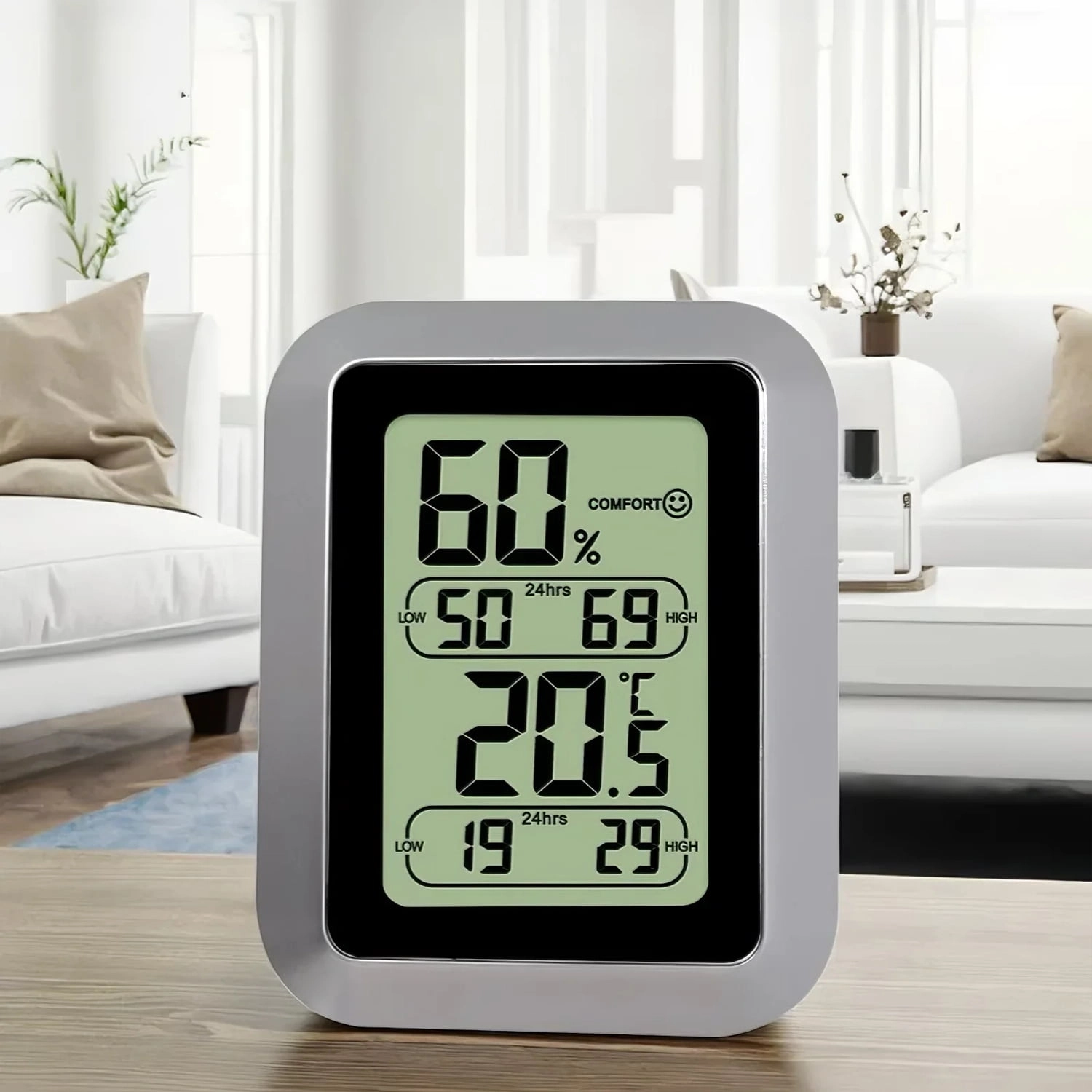
Custom Small Indoor Wall Mount Digital Lcd Room Greenhouse Home Wine Kitchen Garden High Accuracy 24h Minimum Maximum Registering Thermometer Hygro
The X-WSDJ005 is a compact, high-precision indoor wall-mountable digital LCD thermometer and hygrometer combo designed for home, greenhouse, wine cellar, kitchen, and garden use.
It combines 24-hour minimum/maximum temperature/humidity recording, dual-unit (°C/°F) display, and intuitive comfort indicators to help users monitor and optimize their indoor environment with ease.
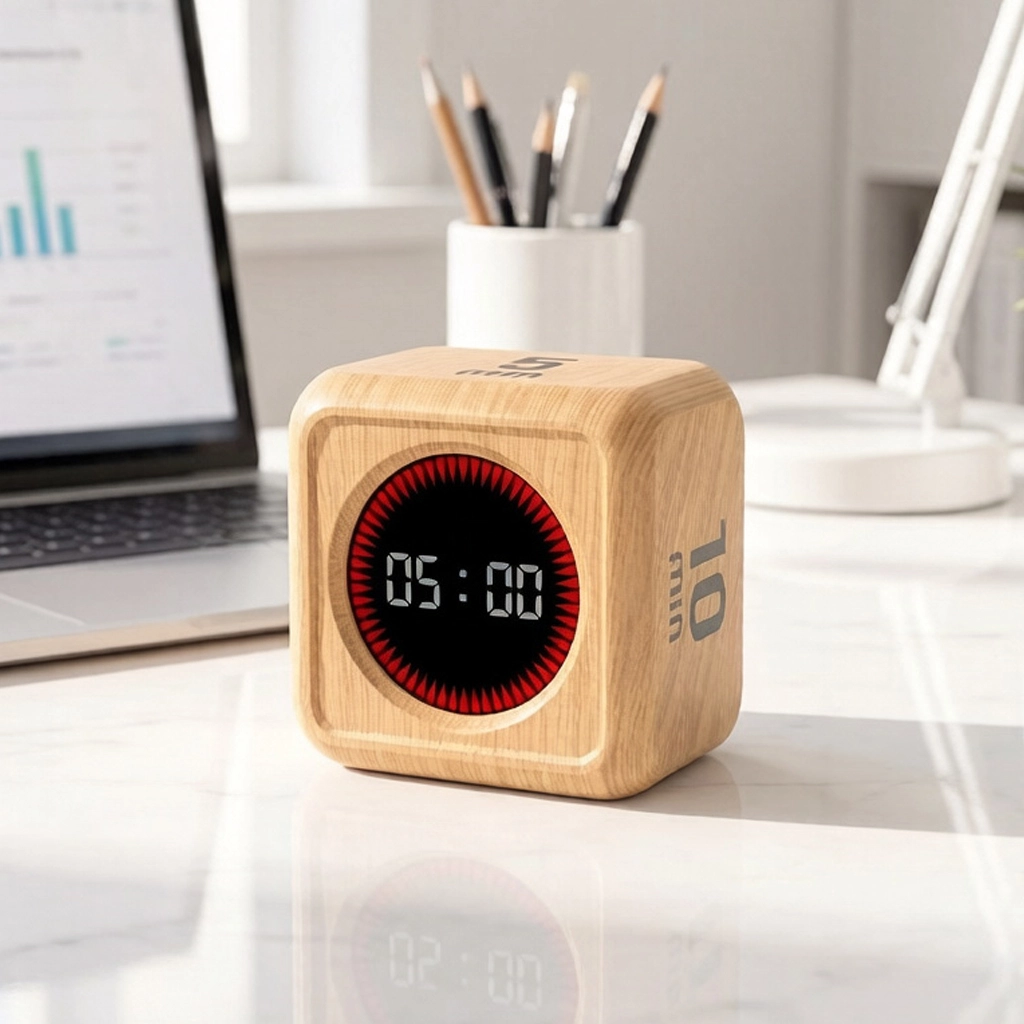
Wood Grain square Cube Timer Digital Gravity Sensor Timer Rechargeable Pomodoro Stopwatch Manufacturer
The X-JSQ814 Rubik’s Cube Timer reimagines timekeeping with a playful, cube-shaped design inspired by the iconic Rubik’s Cube. Blending nostalgia with functionality, it offers intuitive controls, smart gravity sensing, and versatile timing modes—perfect for anyone seeking a stylish, reliable tool to manage tasks at home, work, or play. Compact yet durable, it’s built to adapt to daily routines with ease.
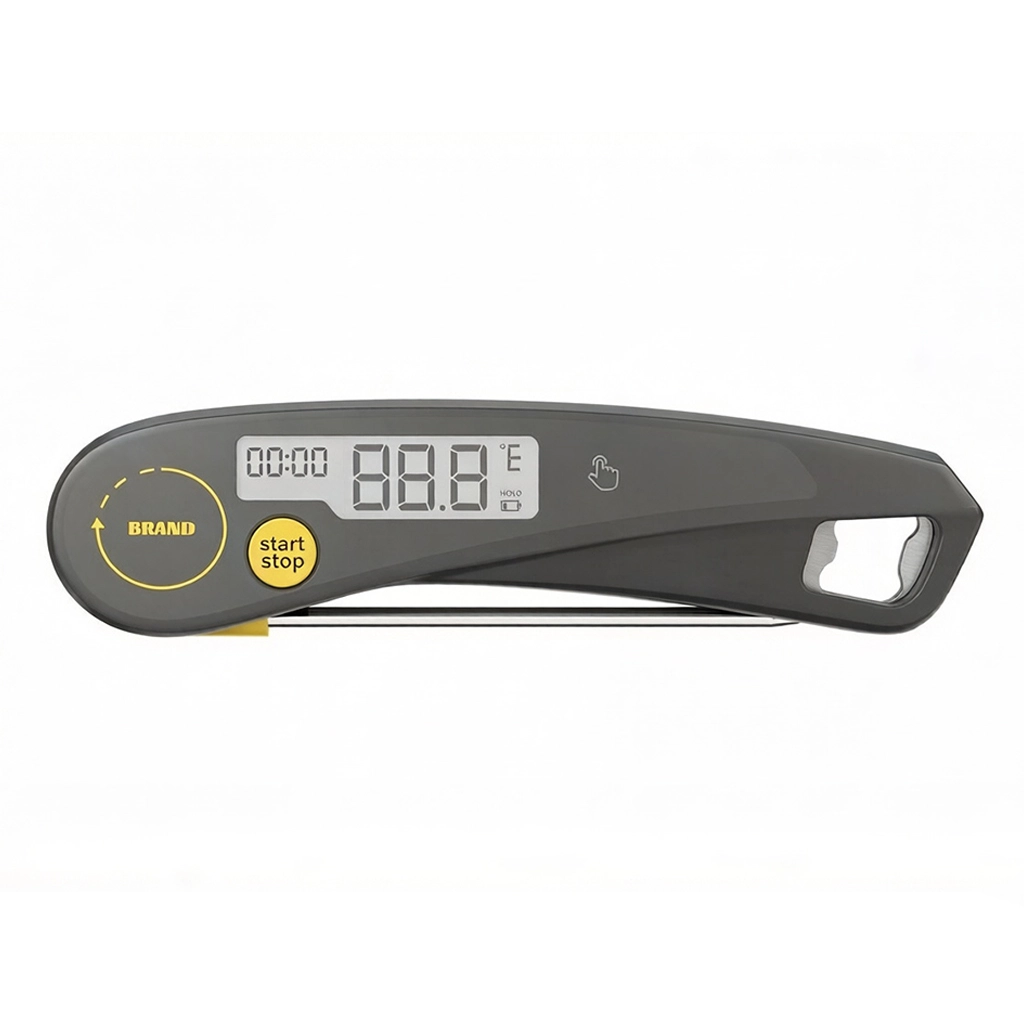
Digital Food Thermometer with Foldable Probe Timer Bottle Opener Meat Temperature Monitor
This digital food thermometer is designed for professional B2B buyers including e-commerce sellers, wholesalers, and OEM clients. Featuring a foldable stainless steel probe, it provides fast and accurate temperature readings from -50°C to 300°C with ±0.1°C precision. The built-in timer function (up to 59 minutes 59 seconds) supports efficient cooking control, while the °C/°F switch ensures global usability. Powered by a CR2450 button battery, it offers long-lasting performance. The ergonomic handle integrates a bottle opener, making it a practical 3-in-1 kitchen tool ideal for BBQ, grilling, baking, and food processing industries.
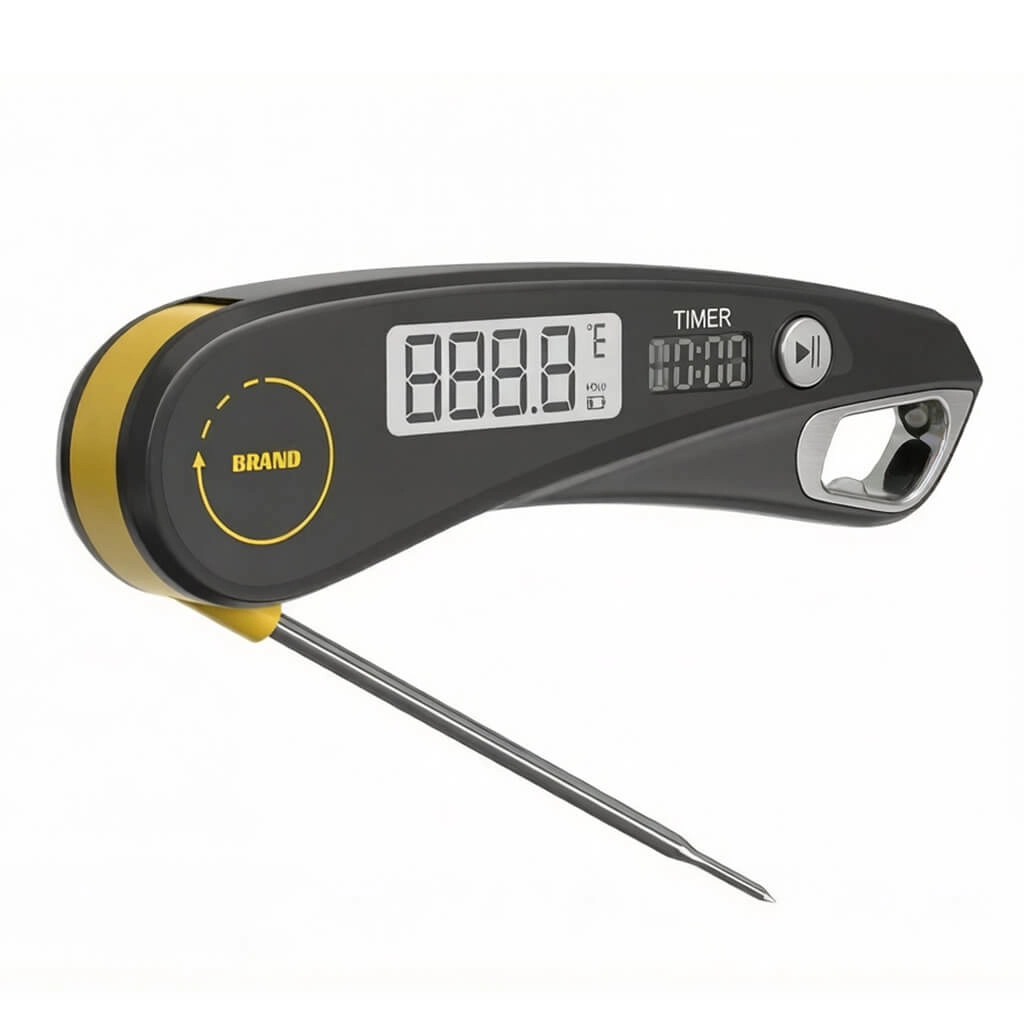
Digital Cooking Thermometer with Folding Probe Timer Multifunction Meat Thermometer Kitchen Tool
Engineered for commercial buyers and private label clients, this digital cooking thermometer delivers precision and versatility in one compact device. The folding stainless steel probe ensures safe handling and quick temperature detection across a wide range from -50°C to 300°C with ±0.1°C accuracy. Designed with an integrated timing system up to 59:59, it allows efficient cooking control for grilling, baking, and food preparation. The ergonomic handle features an added bottle opener, enhancing usability for outdoor and kitchen scenarios. Powered by a CR2450 battery, this thermometer is ideal for wholesalers, distributors, and e-commerce sellers seeking reliable and customizable solutions.

Youben life
Youben life